Full Text (PDF)
Indian Journal of Obstetrics and Gynecology 13(4):p 137-144, October-December 2025. | DOI: 10.21088/ijog.2321.1636.13425.1
Original Article
Subsequent Pregnancy After Stillbirth: Risks, Outcomes and Clinical Insights
Shruti Bhalodiya, Vaishali Taralekar, Manju Talathi
Author Information
Licence:
Attribution-Non-commercial 4.0 International (CC BY-NC 4.0)This license enables reusers to distribute, remix, adapt, and build upon the material in any medium or format for noncommercial purposes only, and only so long as attribution is given to the creator.
Indian Journal of Obstetrics and Gynecology 13(4):p 137-144, October-December 2025. | DOI: 10.21088/ijog.2321.1636.13425.1
How Cite This Article:
Bhalodiya S, Taralekar V, Talathi M. Subsequent Pregnancy After Stillbirth: Risks, Outcomes and Clinical Insights. Indian J Obstet Gynecol. 2025;13(4):137-44.Timeline
Received : September 01, 2025
Accepted : October 22, 2025
Published : December 24, 2025
Abstract
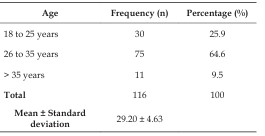
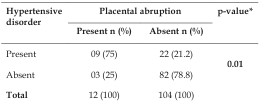
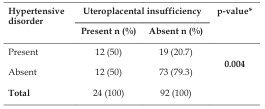
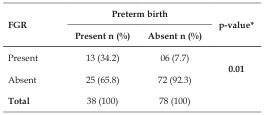
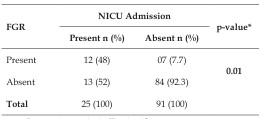
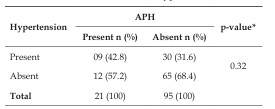
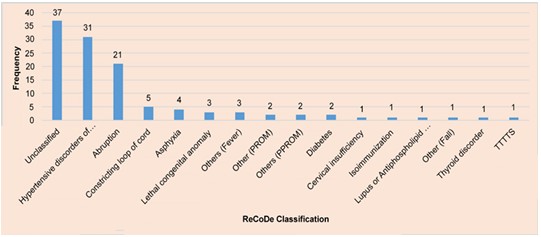
Background: Women with a prior stillbirth are at elevated risk for adverse outcomes in subsequent pregnancies. Identifying these outcomes and contributing factors is essential for improved antenatal surveillance and care. Objective: To assess pregnancy outcomes in women with a prior history of stillbirth and to classify the etiology of previous stillbirths using the ReCoDe system (Relevant Condition at Death). Materials and methods: This was a prospective observational study conducted at a tertiary care center in Pune, India, from June 2023 to June 2025. A total of 116 pregnant women with a prior history of stillbirth were enrolled after informing consent the subjects were enrolled in a study. Detailed demographic, obstetric, and clinical data were collected. Pregnancy outcomes were analyzed and the causes of previous stillbirth were categorized using the ReCoDe classification system. Results: In this study, the mean maternal age was 29.2 years. Most participants (67.2%) had a BMI in the overweight or obese range. Hypertensive disorders were significantly associated with placental abruption (p=0.01) and uteroplacental insufficiency (p=0.004). Gestational diabetes mellitus was present in 13.8% of cases. Fetal growth restriction (FGR) was significantly associated with preterm birth (p=0.01) and NICU admission (p=0.01). The recurrent stillbirth rate was 10.3%. The ReCoDe classification identified hypertensive disorders (26.7%) and placental abruption (18.1%) as the most common causes of prior stillbirths, while 31.9% remained unclassified. Conclusion: Women with prior stillbirths exhibit significantly higher rates of adverse maternal and fetal outcomes in subsequent pregnancies. Hypertensive disorders and FGR are major contributors. Structured antenatal monitoring and use of classification systems like ReCoDe can guide risk stratification and clinical management.
References
- 1. ICMR-SPIC Consortium, Mukherjee R. Cohort profile of the ICMR-Stillbirth Pooled India Cohort (ICMR-SPIC): Estimating Prevalence, Analyzing Risk Factors, and Developing Prediction Models for Stillbirths in India. medRxiv. 2025 Jan 17: 2025-01.
- 2. Ofir K., Kalter A., Moran O., Sivan E., Schiff E., Simchen M.J. Subsequent pregnancy after stillbirth: Obstetrical and medical risks. Journal of perinatal medicine. 2013 Sep 1; 41(5): 543-8.
- 3. Lamont K., Scott N.W., Jones G.T., Bhattacharya S. Risk of recurrent stillbirth: Systematic review and meta-analysis. bmj. 2015 Jun 24; 350.
- 4. Reddy UM. Management of pregnancy after stillbirth. Clinical obstetrics and gynecology. 2010 Sep 1; 53(3): 700-9.
- 5. Gardosi J., Kady S.M., McGeown P., Francis A., Tonks A. Classification of stillbirth by relevant condition at death (ReCoDe): Population based cohort study. Bmj. 2005 Nov 10; 331(7525): 1113-7.
- 6. Getahun D., Lawrence J.M., Fassett M.J., Strickland D., Koebnick C., Chen W., Jacobsen S.J. The association between stillbirth in the first pregnancy and subsequent adverse perinatal outcomes. American journal of obstetrics and gynecology. 2009 Oct 1; 201(4): 378-e1.
- 7. Gardosi J., Kady S.M., McGeown P., Francis A., Tonks A. Classification of stillbirth by relevant condition at death (ReCoDe): Population based cohort study. Bmj. 2005 Nov 10; 331(7525): 1113-7.
- 8. Clemenza S., Serena C., Vannuccini S., Farsi E., Huri M., Toscano F., Petraglia F., Mecacci F. Pregnancy Outcomes Subsequent to Stillbirth—A Single Tertiary-Care Center Experience. Clinical and Experimental Obstetrics & Gynecology. 2022; 49:0-.
- 9. Lean S.C., Derricott H., Jones R.L., Heazell A.E. Advanced maternal age and adverse pregnancy outcomes: A systematic review and meta-analysis. PloS one. 2017 Oct 17; 12(10): e0186287.
- 10. Cortés Y.I., Catov J.M., Brooks M., Harlow S.D., Isasi C.R., Jackson E.A., Matthews K.A., Thurston R.C., Barinas-Mitchell E. History of adverse pregnancy outcomes, blood pressure, and subclinical vascular measures in late midlife: SWAN (Study of Women’s Health Across the Nation). Journal of the American Heart Association. 2017 Dec 29; 7(1): e007138.
- 11. Cortés Y.I., Catov J.M., Brooks M., Harlow S.D., Isasi C.R., Jackson E.A., Matthews K.A., Thurston R.C., Barinas-Mitchell E. History of adverse pregnancy outcomes, blood pressure, and subclinical vascular measures in late midlife: SWAN (Study of Women’s Health Across the Nation). Journal of the American Heart Association. 2017 Dec 29; 7(1): e007138.
- 12. Zhang J., Liu X., Rao L., Ma R., Wu W., Chen C., Lin Y. Adverse obstetric and perinatal outcomes of patients with history of recurrent miscarriage: A retrospective cohort study. Fertility and Sterility. 2023 Sep 1; 120(3): 626-34.
- 13. Priyadarshinee L., Meetei L.T., Singh L.R., Longjam N., Singh M.R., Devi P.R., Sen S. A cross sectional study of pregnancy outcome in women with recurrent pregnancy loss. International Journal of Reproduction, Contraception, Obstetrics and Gynecology. 2023; 12(8): 2501.
- 14. Dandona R., Kumar G.A., Akbar M., Dora S.S., Dandona L. Substantial increase in stillbirth rate during the COVID-19 pandemic: results from a population-based study in the Indian state of Bihar. BMJ Global Health. 2023 Jul 25; 8(7).
- 15. Jamal S. To Study the Perinatal Outcomes in Pregnancy with Previous Stillbirth. Journal of South Asian Federation of Obstetrics and Gynaecology. 2024 Jan 10; 16(1): 1-5.
- 16. Wojcieszek A.M., Shepherd E., Middleton P., Lassi Z.S., Wilson T., Murphy M.M., Heazell A.E., Ellwood D.A., Silver R.M., Flenady V. Care prior to and during subsequent pregnancies following stillbirth for improving outcomes. Cochrane Database of Systematic Reviews. 2018(12).
Data Sharing Statement
There are no additional data available.
Funding
This research received no funding.
Author Contributions
All authors contributed significantly to the work and approve its publication.
Ethics Declaration
Information Not provided
About this article

Cite this article
Bhalodiya S, Taralekar V, Talathi M. Subsequent Pregnancy After Stillbirth: Risks, Outcomes and Clinical Insights. Indian J Obstet Gynecol. 2025;13(4):137-44.
Licence:
Attribution-Non-commercial 4.0 International (CC BY-NC 4.0)This license enables reusers to distribute, remix, adapt, and build upon the material in any medium or format for noncommercial purposes only, and only so long as attribution is given to the creator.
| Received | Accepted | Published |
|---|---|---|
| September 01, 2025 | October 22, 2025 | December 24, 2025 |
DOI: 10.21088/ijog.2321.1636.13425.1
Keywords
StillbirthPregnancy OutcomesReCoDe ClassificationHypertensive DisordersFGRNICU AdmissionSearch for Similar Articles
Similar Articles
- When Eclampsia Strikes the Brain Twice
- Emergency Management of Cesarean Scar Pregnancy: A Rare Case of Life-Threatenin...
- The Efficacy of Structured Teaching Programs in Enhancing Pregnancy Management...
- Audit of Caesarean Sections by the Robson Ten Group Classification: A Six-Month...
- A Cross-Sectional Study on the Epidemiology and Risk Factors of Uterine Fibroids
Article Level Metrics
Last UpdatedWednesday 17 June 2026, 01:43:04 (IST)
1406
Accesses
12
152
00
Citations
NA
NA
NA
Download citation
Article Keywords
Keyword Highlighting
Highlight selected keywords in the article text.
Timeline
| Received | September 01, 2025 |
| Accepted | October 22, 2025 |
| Published | December 24, 2025 |
licence
Attribution-Non-commercial 4.0 International (CC BY-NC 4.0)
This license enables reusers to distribute, remix, adapt, and build upon the material in any medium or format for noncommercial purposes only, and only so long as attribution is given to the creator.