Full Text (PDF)
Indian Journal of Obstetrics and Gynecology 13(4):p 145-151, October-December 2025. | DOI: 10.21088/ijog.2321.1636.13425.2
Original Article
Association Between Abnormal Uterine Bleeding and Thyroid Dysfunction: A Cross-Sectional Analytical Study
Tanvi Parasnis, Vaishali Taralekar, Manju Talathi
Author Information
Licence:
Attribution-Non-commercial 4.0 International (CC BY-NC 4.0)This license enables reusers to distribute, remix, adapt, and build upon the material in any medium or format for noncommercial purposes only, and only so long as attribution is given to the creator.
Indian Journal of Obstetrics and Gynecology 13(4):p 145-151, October-December 2025. | DOI: 10.21088/ijog.2321.1636.13425.2
How Cite This Article:
Parasnis T, Taralekar V, Talathi M. Association Between Abnormal Uterine Bleeding and Thyroid Dysfunction: A Cross-Sectional Analytical Study. Indian J Obstet Gynecol. 2025;13(4):145-51.Timeline
Received : September 02, 2025
Accepted : November 14, 2025
Published : December 24, 2025
Abstract
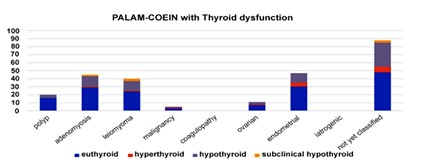
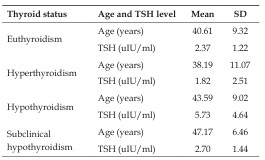
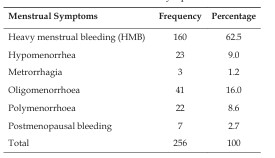
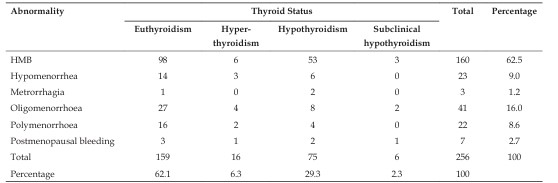
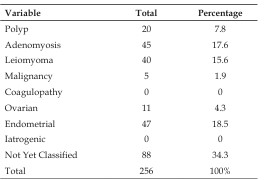
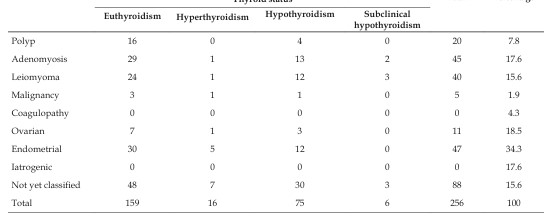
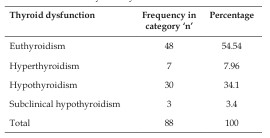
Background: Abnormal menstrual patterns are many times associated with thyroid dysfunction which is yet an under evaluated cause. Objective: This study aims to determine the association between abnormal uterine bleeding (AUB) and thyroid dysfunction. Materials and methods: This prospective, single-center, cross sectional analytical study was conducted with all women who were attended with AUB at investigation site. In total, 256 women were enrolled in study. Those with diagnosed thyroid dysfunction were excluded from the study. After assessment of the menstrual pattern, all women were subjected for Abdomino-pelvic ultrasonography and blood tests hemogram and thyroid profile. The women were divided into these categories based on thyroid values: Euthyroid, hyperthyroid, subclinical hypothyroidism and hypothyroid. Results: In this study, the average age of women was 41.48 years. Out of a total of 256 individuals, the majority (62.1%) were found to be euthyroid, indicating normal thyroid function. Hypothyroidism was observed in 29.3% of the women, while hyperthyroidism accounted for 6.3%. A smaller proportion (2.3%) exhibited subclinical hypothyroidism. The most frequent complaint was heavy menstrual bleeding (HMB), reported by 160 individuals, predominantly among those with euthyroidism (61.3%) and hypothyroidism (33.1%). Metrorrhagia occurred in only three cases, two of which were in individuals with hypothyroidism (66.7%). Isolated thyroid dysfunction was present in 15.6% of the study population, which is significant. Conclusions: Hypothyroidism was significantly associated to HMB. Most women were euthyroid, but altered thyroid function, especially hypothyroidism, influenced menstrual irregularities in a substantial subset. There is need to shed light on isolated thyroid dysfunction.
References
- 1. Lakshmi Seshadri. Essentials of gynaecology. 3rd ed. Vol. 1. Gurugram: Wolters Kluwer India; 2022. pp. 103–113.
- 2. Mukherji J., Ganguly R.P., Seal S.L. Basics of Gynaecology. 1st ed. Academic Publishers; 2019. pp. 40–48.
- 3. Surks M.I., Chopra I.J., Mariash C.N., Nicoloff J.T., Solomon D.H. American Thyroid Association guidelines for use of laboratory tests in thyroid disorders. JAMA. 1990; 263(11): 1529–32.
- 4. Deshmukh P., Boricha B., Pandey A. The association of thyroid disorders with abnormal uterine bleeding. Int J Reprod Contracept Obstet Gynecol. 2015; 701–8.
- 5. Menon A. Rising prevalence of Thyroid disorders in India - The time to act is now. Thyroid Research and Practice. 2020; 17(3): 99.
- 6. Nekkanti D., S. V.K. The study of thyroid dysfunction in patients with abnormal uterine bleeding. Int J Reprod Contracept Obstet Gynecol. 2023; 12(12): 3498–502.
- 7. Kotur P., Kumar S. Effects of hypothyroidism in Indian women of reproductive age group – A review article. Indian Journal of Obstetrics and Gynecology Research. 2020; 7(1): 1–6.
- 8. Mazzaferri E.L. Evaluation and management of common thyroid disorders in women. Am J Obstet Gynecol. 1997; 176(3): 507–14.
- 9. Dittrich R., Beckmann M.W., Oppelt P.G., Hoffmann I., Lotz L., Kuwert T., et al. Thyroid hormone receptors and reproduction. J Reprod Immunol. 2011; 90(1): 58–66.
- 10. Michiels J.J., Schroyens W., Bememan Z., van der Planken M. Acquired von Willebrand Syndrome Type 1 in Hypothyroidism: Reversal After Treatment With Thyroxine. Clinical and Applied Thrombosis/Hemostasis. 2001; 7(2): 113–5.
- 11. Brown EDL, Obeng-Gyasi B., Hall J.E., Shekhar S. The Thyroid Hormone Axis and Female Reproduction. Int J Mol Sci. 2023; 24(12): 9815.
- 12. Shawl A.S., Naz M. Association between thyroid disorders and abnormal uterine bleeding in reproductive ages. Int J Reprod Contracept Obstet Gynecol. 2020; 9(9): 3580.
- 13. Verma K., Verma S., Rajoria L. A cross sectional study to evaluate the relation between thyroid disorders and abnormal uterine bleeding in reproductive age group. Indian Journal of Obstetrics and Gynecology Research. 2021; 6(2): 177–80.
- 14. Sebtain A., Qasim M., Bahadur A., Ali A., Samin K.A., Ahmed M. Subclinical Hypothyroidism in Perimenopausal Abnormal Uterine Bleeding Patients. Cureus. 2022; 14(2): e21839.
- 15. Patil A., Shiragur S.S., Gobbur V., Mudanur S., Bidri S., Yaliwal R., et al. Association of Bleeding Patterns with Thyroid Dysfunction in Patients with Abnormal Uterine Bleeding: A Prospective Cross-sectional Study. Journal of Clinical and Diagnostic Research. 2022;
- 16. Singh S., Sahoo S., Das P.C. A study of thyroid dysfunction in dysfunctional uterine bleeding. Int J Reprod Contracept Obstet Gynecol. 2018; 7(3): 1002.
- 17. Koutras D.A. Disturbances of Menstruation in Thyroid Disease. Ann N Y Acad Sci. 1997; 816(1): 280–4.
- 18. Joshi B.R., Rizal S., Subedi S. Thyroid Dysfunction in Patient with Abnormal Uterine Bleeding in a Tertiary Hospital of Eastern Nepal: A Descriptive Cross-sectional Study. Journal of Nepal Medical Association. 2021; 59(239).
- 19. Güngör Semiz G., Hekimsoy Z. Menstrual Cycle Characteristics in Women with and Without Thyroid Disease. Cureus. 2024; 16(6): e62724.
Data Sharing Statement
There are no additional data available.
Funding
This research received no funding.
Author Contributions
All authors contributed significantly to the work and approve its publication.
Ethics Declaration
This article does not involve any human or animal subjects, and therefore does not require ethics approval.
Acknowledgements
Information Not Provided
Conflicts of Interest
No conflicts of interest in this work.
About this article

Cite this article
Parasnis T, Taralekar V, Talathi M. Association Between Abnormal Uterine Bleeding and Thyroid Dysfunction: A Cross-Sectional Analytical Study. Indian J Obstet Gynecol. 2025;13(4):145-51.
Licence:
Attribution-Non-commercial 4.0 International (CC BY-NC 4.0)This license enables reusers to distribute, remix, adapt, and build upon the material in any medium or format for noncommercial purposes only, and only so long as attribution is given to the creator.
| Received | Accepted | Published |
|---|---|---|
| September 02, 2025 | November 14, 2025 | December 24, 2025 |
DOI: 10.21088/ijog.2321.1636.13425.2
Keywords
Abnormal uterine bleedingThyroid dysfunctionHypothyroidismSearch for Similar Articles
Similar Articles
- When Eclampsia Strikes the Brain Twice
- Emergency Management of Cesarean Scar Pregnancy: A Rare Case of Life-Threatenin...
- The Efficacy of Structured Teaching Programs in Enhancing Pregnancy Management...
- Audit of Caesarean Sections by the Robson Ten Group Classification: A Six-Month...
- A Cross-Sectional Study on the Epidemiology and Risk Factors of Uterine Fibroids
Article Level Metrics
Last UpdatedWednesday 17 June 2026, 01:39:56 (IST)
1406
Accesses
43
152
00
Citations
NA
NA
NA
Download citation
Article Keywords
Keyword Highlighting
Highlight selected keywords in the article text.
Timeline
| Received | September 02, 2025 |
| Accepted | November 14, 2025 |
| Published | December 24, 2025 |
licence
Attribution-Non-commercial 4.0 International (CC BY-NC 4.0)
This license enables reusers to distribute, remix, adapt, and build upon the material in any medium or format for noncommercial purposes only, and only so long as attribution is given to the creator.