Full Text (PDF)
Indian Journal of Anatomy 14(2):p 57-62, May-Aug 2025. | DOI: https://doi.org/10.21088/ija.2320.0022.14225.3
Review Article
Structural and Functional Effects of Lithium Carbonate on the Thyroid Gland: A Review
Ghulam Mohammad Bhat, Shah Sumaya Jan
Author Information
Licence:
Attribution-Non-commercial 4.0 International (CC BY-NC 4.0)This license enables reusers to distribute, remix, adapt, and build upon the material in any medium or format for noncommercial purposes only, and only so long as attribution is given to the creator.
Indian Journal of Anatomy 14(2):p 57-62, May-Aug 2025. | DOI: https://doi.org/10.21088/ija.2320.0022.14225.3
How Cite This Article:
Ghulam Mohammad Bhat, Shah Sumaya Jan. Structural and Functional Effects of Lithium Carbonate on the Thyroid Gland: A Review. Ind Jr Anat. 2025; 14(2): 57-62.Timeline
Received : July 22, 2025
Accepted : August 06, 2025
Published : August 25, 2025
Abstract
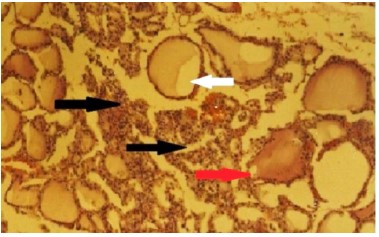
Lithium carbonate is considered the gold standard to treat and prevent bipolar disorders, especially in developing countries. The treatment is prolonged, which may be associated with thyroid toxicities of a variable nature. The present minireview is written to explore the current status of knowledge regarding the impact of Lithium treatment on the structure and function of the thyroid gland which will help the clinicians in better management of patients on lithium therapy. PubMed databases and Google Scholar were searched for structural and functional effects of Lithium carbonate therapy on the thyroid gland. The pathophysiology of Lithium carbonate is intricate yet may incorporate increasing intrathyroidal iodine content, repressing the formation and release of thyroid hormones, modifying the hypothalamus-pituitary axis, and Wnt/β-catenin flagging. Goiter is commonly observed in 50% of patients and 25% of patients have hypothyroidism. Patients receiving lithium therapy have less incidence of hyperthyroidism than the general population. Lithium, given over a prolonged period, causes large and mini follicular goiter with hyperplastic epithelium and hyperchromatic nuclei, hyperplasia of stroma with expanded vascularity, sometimes hemorrhages, and finally may lead to thyroiditis, like the picture. Sometimes it may lead to eosinophilic infiltrates into the stroma of the thyroid gland, known as Hurthle cell infiltrate, which is the precursor of thyroid carcinoma. Thus, it is exhorted that those on lithium treatment ought to be periodically assessed for thyroid dysfunction.
References
- 1. Halder A., Ravindran N.P., Nagda P., Harshe D., Harshe G. Review of Psychotropic Agents Associated with Sialorrhoea, Except Clozapine. Indian J Psychol Med. 2021: 1–5.
- 2. Sharma S.D., Iqbal M. Lithium induced toxicity in rats: a haematological, biochemical and histopathological study. Biol Pharm Bull 2005; 28: 834-7.
- 3. Ng B.Z. and Yacob S. Neuroleptic Malignant Syndrome in a Patient with Lithium-induced Nephrogenic Diabetes Insipidus: A Case Report. Indian J Psychol Med. 2021: 1–2.
- 4. Kraszewska A., Abramowicz M., ChłopockaWoźniak M., Sowiński J., Rybakowski. The effect of lithium on thyroid function in patients with bipolar disorder. J. Psychiatr Pol. 2014 May-Jun; 48(3): 417-28.).
- 5. Zamani N., Hosseini E., Modaresi M., Abdallah, Pirbalouti A.G. Perinatal effects of lithium carbonate nanoparticles on pituitarygonadal and pituitary-thyroid axes of rats’ female progenies”, Pharmacophore 2017; 8(6S), e-1173338.
- 6. Steven Lippmann. Is Lithium Bad for Kidney? J Clin Psychiatry 1982; 43: 220-3.
- 7. Clarke W.B., Clarke R.M., Olson E.K., Barr R.D., Downing R.G. Binding of lithium and boron to human plasma proteins. Biol. Trace Element Res 1998; 65: 237-49.
- 8. Csutora P., Karsal A., Nagy T., Vas B., Kovacs G., Rideg O., Bogner P., Miseta A. Lithium induces phosphoglucomutase activity in various tissues of rats and in bipolar patients. Int J Neuropsych pharmacol 2005; 1: 1-7.
- 9. Daniel W., Netter K.J. Alteration of cytochrome P. 450 by prolonged administration of imipramine and/or lithium to rats. Naunyn Schmiedebergs. Arch Pharmacol 1990; 342: 234-40.
- 10. Sani G., Perugi G., Tondo L. Treatment of bipolar disorder in a lifetime perspective: is lithium still the best choice? Clin Drug Investig. 2017; 37(8): 13–27. doi: 10.1007/s40261-017- 0531 2.
- 11. Nederlof M., Heerrdink E.R., Egberts A.C.G., Wilting I., Stoker L.J., Hoekstra R., Kupka R.W. Monitoring of patients treated with lithium for bipolar disorder: an international survey. Int J Bipolar Disord. 2018; 6: 12. doi: 10.1186/ s40345-018-0120-1.
- 12. Mohandas E., Rajmohan V. Lithium use in special populations. Indian J Psychiat 2007; 49: 211-8.
- 13. Alastair J.J.W. Drug therapy. N. Engl J.M. 1995; 333(25): 1688-94.
- 14. Bagchi N., Brown T.R., Mack R.E. Studies on the mechanism of inhibition of thyroid function by lithium. Biochim Biophys Acta 1978; 542: 163-9.
- 15. Williams J.A., Berens S.C., Wolff J. Thyroid secretion in vitro: inhibition of TSH and dibutyryl cyclic-AMP stimulated 131-I release by Li+1. Endocrinology 1971; 88: 1385-8.
- 16. Singer I., Rotenberg D. Mechanisms of lithium action. N Engl J Med 1973; 289: 254-60.
- 17. Terao T., Oga T., Nozaki S., Ohta A., Otsubo Y., Yamamoto S., Zamami M., Okada M. Possible inhibitory effect of lithium on peripheral conversion of thyroxine to triiodothyronine: a prospective study. Int Clin Psychopharmacol. 1995 Jun; 10(2): 103-5. doi: 10.1097/00004850- 199506000-00006. PMID: 7673651.
- 18. Berens S.C., Bernstein R.S., Robbins J., Wolff J. Antithyroid effects of lithium. J Clin Invest 1970; 49: 1357-67.
- 19. Emerson C.H., Anderson A.J., Howard W.J., Utiger R.D. Serum thyroxine and triiodothyronine concentrations during iodide treatment of hyperthyroidism. J Clin Endocrinol Metab 1975; 40: 33-6.
- 20. Pfeifer W.D., Davis L.C., Van der Velde C.D. Lithium accumulation in some endocrine tissues. Acta Biol Med Ger 1976; 35: 1519-23.
- 21. Shah N.A., Bhat G.M., Shahdad S., Itoo M.S., Shah B.A., Khan J.A. Effects of Lithium carbonate on the Microanatomy of thyroid gland of albino rats. Int J Res Med Sci 2014; 2(1): 279-284. DOI: 10.5455/2320-6012
- 22. Tseng H. Len. Interstitial myocarditis probably related to lithium carbonate intoxication. Arch Path. 1971; 92: 444-8.
- 23. Helte C.E. Morphometeric and electron microscopic studies of goitre induced by lithium in rats. Amer J Anatomy 1973; 136: 297-304.
- 24. Fauernoldt, L. Vendosborg. Thyroid gland morphology after lithium treatment. Acta Pathol Microbiol. Scand Sect A 1981; 89: 339-41.
- 25. Shimizu M., Hirokawa M., Manabe T., Shimosuma K., Sonoo H. and Harada T. Lithium associated autoimmune thyroiditis. J Clin Pathol 1997; 50(2): 172-4.
- 26. Qian L., Pucci R., Castro C.Y., Eltorky M.A. Renal cell carcinoma metastatic to Hurthle cell adenoma of thyroid gland. Ann Diag Pathol 2004; 8(5): 305-8.
- 27. Vincent A., Baruch P., Vincent P. Early onset of lithium associated hypothyroidism. J Psychiatry Neurosci 1999; 18: 74-7.
- 28. Czarnywojtek A., Zgorzalewicz-Stachowiak M., Czarnocka B., Sawicka-Gutaj N., Gut P., Krela-Kazmierczak I., Ruchala M. Effect of lithium carbonate on the function of the thyroid gland: mechanism of action and clinical implications. J Physiol Pharmacol. 2020 Apr; 71(2). doi: 10.26402/jpp.2020.2.03.
- 29. Arathil P., Mathew K., Narayanan D. Lithiuminduced Thyroiditis in a Patient Having Bipolar Affective Disorder - A Rare Case Report. Indian J Psychol Med. 2018 Nov-Dec; 40(6): 577-579. doi: 10.4103/IJPSYM.IJPSYM_403_17.
- 30. Bocchetta A., Loviselli A. Lithium treatment and thyroid abnormalities. Clin Pract Epidemiol Ment Health. 2006; 2, 23. https:// doi.org/10.1186/1745-0179-2-23
Data Sharing Statement
There are no additional data available. All raw data and code are available upon request.
Funding
This research received no funding.
Author Contributions
All authors contributed significantly to the work and approve its publication.
Ethics Declaration
This article does not involve any human or animal subjects, and therefore does not require ethics approval.
Acknowledgements
We would like to express our gratitude to the patients, their families, and all those who have contributed to this study.
Conflicts of Interest
No conflicts of interest in this work.
About this article

Cite this article
Ghulam Mohammad Bhat, Shah Sumaya Jan. Structural and Functional Effects of Lithium Carbonate on the Thyroid Gland: A Review. Ind Jr Anat. 2025; 14(2): 57-62.
Licence:
Attribution-Non-commercial 4.0 International (CC BY-NC 4.0)This license enables reusers to distribute, remix, adapt, and build upon the material in any medium or format for noncommercial purposes only, and only so long as attribution is given to the creator.
| Received | Accepted | Published |
|---|---|---|
| July 22, 2025 | August 06, 2025 | August 25, 2025 |
DOI: https://doi.org/10.21088/ija.2320.0022.14225.3
Keywords
Lithium carbonateThyroiditisHypothyroidismGoiterHurthle cellSearch for Similar Articles
Similar Articles
- An Accessory Inferior Pulmonary Vein: A Variation in the Pulmonary Venous Format...
- The Purpose and Utility of the Nipple-Areolar Complex of the Mammary Gland with...
- Morphometric Study of Anterior Border of Human Hip Bone in the Maharashtra Regio...
- Surgeons’ Perspectives on Cadaveric Dissection in Medical Education: A Cross-Sec...
- Transforming Anatomy Education: Emerging Technologies, Challenges, and Future Di...
Article Level Metrics
Last UpdatedTuesday 20 October 2026, 07:57:16 (IST)
6207
Accesses
3
706
00
Citations
NA
NA
NA
Download citation
Article Keywords
Keyword Highlighting
Highlight selected keywords in the article text.
Timeline
| Received | July 22, 2025 |
| Accepted | August 06, 2025 |
| Published | August 25, 2025 |
licence
Attribution-Non-commercial 4.0 International (CC BY-NC 4.0)
This license enables reusers to distribute, remix, adapt, and build upon the material in any medium or format for noncommercial purposes only, and only so long as attribution is given to the creator.