Full Text (PDF)
International Journal of Food, Nutrition & Dietetics 11(1):p 17-20, January-April 2023. | DOI: 10.21088/ijfnd.2322.0775.11123.2
Original Article
Role of Two Question Canadian Nutritional Screening Tool in Plastic Surgery
Ravi Kumar Chittoria, K Sri Harsha Reddy
Author Information
Licence:
Attribution-Non-commercial 4.0 International (CC BY-NC 4.0)This license enables reusers to distribute, remix, adapt, and build upon the material in any medium or format for noncommercial purposes only, and only so long as attribution is given to the creator.
International Journal of Food, Nutrition & Dietetics 11(1):p 17-20, January-April 2023. | DOI: 10.21088/ijfnd.2322.0775.11123.2
How Cite This Article:
Reddy KSH, Chittoria RK. Role of two question Canadian nutritional screening tool in plastic surgery. Int J Food Nutr Diet. 2023;11(1):17–20.Timeline
Received : December 10, 2022
Accepted : January 20, 2023
Published : February 28, 2023
Abstract
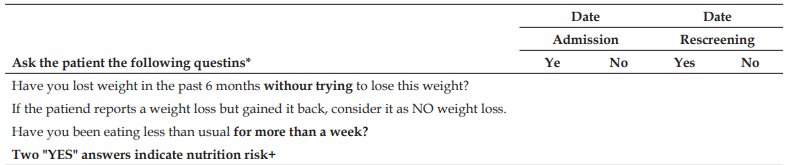
The purpose of this article is to convey the importance of nutrition in plastic surgery, to suggest outpatient nutritional interventions within the surgical care setting, and to assist the plastic surgeon in incorporating nutrition as a key practise enhancement strategy for the care of wound patients in the future. Nutritional state has a well-known impact on surgical results. Malnutrition is widespread among the hospitalized patient population, and up to 1 in 4 plastic surgery outpatients are at risk for malnutrition. Micro- and macronutrients are essential for optimal wound healing. Certain patient populations in the field of plastic surgery are more vulnerable to malnutrition, hence, universal screening and interventions should be implemented. Exposure and incentive interventions have been used in outpatient settings to increase optimal nutritional consumption and overcome obstacles. Universal screening utilising established and quick measures like the Canadian Nutritional Screening Tool (CNST) is suggested in the clinical context. Such screening should be accompanied by proper blood tests, BMI measures, and, if necessary, immediate referral to a dietitian. The term "rehabilitation" was coined with the help of surgery, and it refers to the dietary optimization of patients as well as the promotion of functional capacity development prior to surgery.
References
- 1. Hill GL, Blackett RL, Pickford I, et al. Malnutrition in surgical patients: An unrecognised problem. Lancet. 1977;1:689–692.
- 2. Ho JW, Wu AH, Lee MW, et al. Malnutrition risk predicts surgical outcomes in patients undergoing gastrointestinal operations: results of a prospective study. Clin Nutr. 2015;34:679–684.
- 3. Allard JP, Keller H, Jeejeebhoy KN, et al. Malnutrition at hospital admission contributors and effect on length of stay: a prospective cohort study from the Canadian Malnutrition Task Force. JPEN J Parenter Enteral Nutr. 2016;40:487–497.
- 4. Yu J, Hunter PJ, Perry JA, Karen, et al. Plastic surgery patients are malnourished: utilising the Canadian Malnutrition Screening Tool. Plast Reconstr Surg Glob Open. 2016;4:e1058.
- 5. Keller HH, McCullough J, Davidson B, et al. The Integrated Nutrition Pathway for Acute Care (INPAC): building consensus with a modified Delphi. Nutr J. 2015;14:63.
- 6. Detsky AS, McLaughlin JR, Baker JP, et al. What is subjective global assessment of nutritional status? JPEN J Parenter Enteral Nutr. 1987;11:8–13.
- 7. Roy M, Hunter P, Perry JA, et al. Development of a universal nutritional screening platform for plastic surgery patients. Plast Reconstr Surg Glob Open. 2017;5:e1342.
- 8. Posthauer ME. The role of nutrition in wound care. Adv Skin Wound Care. 2012;25:62–63.
- 9. Ruberg RL. The role of nutrition in plastic surgical practice: a review. Plast Reconstr Surg. 1980;65:363–370.
- 10. Dudrick SJ, Wilmore DW, Vars HM, et al. Long-term total parenteral nutrition with growth, development, and positive nitrogen balance. Surgery. 1968;64:134–142.
- 11. Butterworth CE Jr. The skeleton in the hospital closet. Nutrition. 1994;10:442.
- 12. Bistrian BR, Blackburn GL, Hallowell E, et al. Protein status of general surgical patients. JAMA. 1974;230:858–860.
- 13. Copeland EM 3rd, Daly JM, Dudrick SJ. Nutrition as an adjunct to cancer treatment in the adult. Cancer Res. 1977;37:2451–2456.
- 14. Blackburn GL, Thornton PA. Nutritional assessment of the hospitalized patient. Med Clin North Am. 1979;63:1103–11115.
- 15. Roy M, Perry JA, Cross KM. Nutrition and the plastic surgeon: possible interventions and practice considerations. Plast Reconstr Surg Glob Open. 2018;6(8):e1704.
Data Sharing Statement
There are no additional data available. All raw data and code are available upon request.
Funding
This research received no funding.
Author Contributions
Whether all authors contributed significantly to the work and approve its publication.
Ethics Declaration
This article does not involve any human or animal subjects, and therefore does not require ethics approval.
Acknowledgements
We would like to express our gratitude to the patients, their families, and all those who have contributed to this study.
Conflicts of Interest
The authors report no conflicts of interest in this work.
About this article

Cite this article
Reddy KSH, Chittoria RK. Role of two question Canadian nutritional screening tool in plastic surgery. Int J Food Nutr Diet. 2023;11(1):17–20.
Licence:
Attribution-Non-commercial 4.0 International (CC BY-NC 4.0)This license enables reusers to distribute, remix, adapt, and build upon the material in any medium or format for noncommercial purposes only, and only so long as attribution is given to the creator.
| Received | Accepted | Published |
|---|---|---|
| December 10, 2022 | January 20, 2023 | February 28, 2023 |
DOI: 10.21088/ijfnd.2322.0775.11123.2
Keywords
Canadian Nutritional Screening Tool (CNST)MalnutritionNutritional screening toolSearch for Similar Articles
Similar Articles
- Assessment of Awareness and Sources of Information Regarding Polycystic Ovary Sy...
- Food Exchange List: A Powerful Tool for Weight Management
- Effect of Banana (Musa acuminata) Peel Flour Inclusion on the Quality Characteri...
- Rising Malnutrition in India: Epidemiology, Inequalities, and Policy Challenges...
- Development and Nutritional Evaluation of a Protein-Rich Red Lentil Spread as a...
Article Level Metrics
Last UpdatedSaturday 18 July 2026, 08:09:33 (IST)
952
Accesses
5
107
00
Citations
NA
NA
NA
Download citation
Article Keywords
Keyword Highlighting
Highlight selected keywords in the article text.
Timeline
| Received | December 10, 2022 |
| Accepted | January 20, 2023 |
| Published | February 28, 2023 |
licence
Attribution-Non-commercial 4.0 International (CC BY-NC 4.0)
This license enables reusers to distribute, remix, adapt, and build upon the material in any medium or format for noncommercial purposes only, and only so long as attribution is given to the creator.