Full Text (PDF)
Indian Journal of Anatomy 12(1):p 31-34, January-March 2023. | DOI: https://doi.org/10.21088/ija.2320.0022.12123.3
Original Article
Role of Indigenous Modified Splint for Management of Stiffness of Finger during the COVID-19 Crisis
Ravi Kumar Chittoria, Neljo Thomas, Nishad K, Barath Kumar Singh, Jacob Antony Chakiath
Author Information
Licence:
Attribution-Non-commercial 4.0 International (CC BY-NC 4.0)This license enables reusers to distribute, remix, adapt, and build upon the material in any medium or format for noncommercial purposes only, and only so long as attribution is given to the creator.
Indian Journal of Anatomy 12(1):p 31-34, January-March 2023. | DOI: https://doi.org/10.21088/ija.2320.0022.12123.3
How Cite This Article:
Neljo Thomas, Ravi Kumar Chittoria, Nishad K, et al./Role of Indigenous Modified Splint for Management of Stiffness of Finger during the Covid-19 Crisis/Indian J Anat. 2023;12(1):31-34.Timeline
Received : January 13, 2023
Accepted : March 02, 2023
Published : March 30, 2023
Abstract
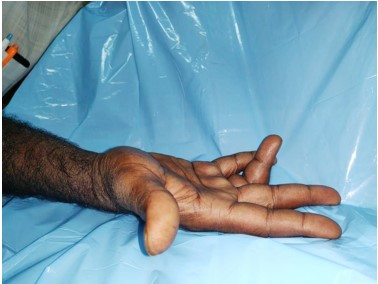
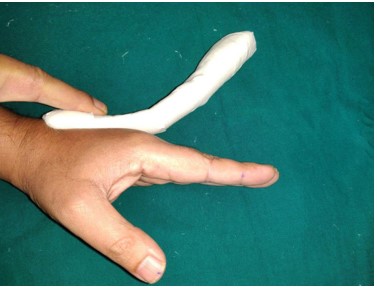
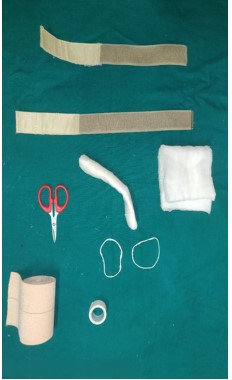
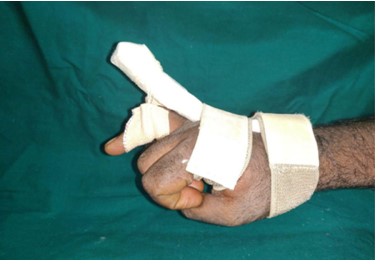
Stiff finger is a common condition found among the elder population due to various types of arthritis. In the younger age group it occur ususally as a sequel of trauma. It siaadifficult condition to treat and follow up. Patient cooperation and strict adherence to exercise routines in paramount for success of treatment of stifffinger. The ideal treatment includes release of the adhesions, active physiotherapy. However because of the covid 19 crisis, the usual treatments of the various disease have been compromised due to lack of travel, transport, need to maintain social distancing etc. We devised our own splint managent for stiff finger and found it to useful.
References
- 1. Young VL, Wray RC, Weeks PM. The surgical management of stiff joints in the hand. Plast Reconstr Surg 1978;62:835–41. Houshian S, Jing SS, Chikkamuniyappa C, et al.
- 2. Management of posttraumatic proximal interphalangeal joint contracture. J Hand Surg Am 2015;40:2081–2084.
- 3. Michlovitz SL, Harris BA, Watkins MP. Therapy interventions for improving joint range of motion: a systematic review. J Hand Ther 2004;17(2):118–131.
- 4. Weeks PM, Wray RC, Kuxhaus M. The results of nonoperative management of stiff joints in the hand.PRS 1978;71:58–63.
- 5. Glasgow C, Wilton J, Tooth L. Optimal daily total endrange time for contracture: resolution in hand splinting. J Hand Ther 2003;16(3):207–218.
- 6. Flowers KR, La Stayo P. Effect of total end range timeon improving passive range of motion. J Hand Ther1994;7(3):150–157.
- 7. Flowers KR. A proposed decision hierarchy for splinting the stiff joint, with an emphasis on force application parameters. J Hand Ther 2002;15(2):158– 162.
- 8. Agee JM, Goss BC. Use of skeletal extension torquein reversing Dupuytren contractures of the proximalinterphalangeal joint. J Hand Surg 2012;37:1467–1474.
- 9. Houshian S, Chikkamuniyappa C, Schroeder H.Gradual joint distraction of post-traumatic flexioncontracture of the proximal interphalangeal joint by a mini-external fixator. J Bone Joint Surg Br 2007;89(2):206–209.
- 10. Houshian S, Jing SS, Kazemian GH, et al. Distraction for proximal interphalangeal joint contractures:long-term results. J Hand Surg Am 2013;38:1951–1956.
- 11. Houshian S, Chikkamuniyappa C. Distraction correction of chronic flexion contractures of PIP joint: comparison between two distraction rates. J Hand Surg2007;32(5):651–656.
Data Sharing Statement
There are no additional data available. All raw data and code are available upon request.
Funding
This research received no funding.
Author Contributions
All authors contributed significantly to the work and approve its publication.
Ethics Declaration
This article does not involve any human or animal subjects, and therefore does not require ethics approval.
Acknowledgements
We would like to express our gratitude to the patients, their families, and all those who have contributed to this study.
Conflicts of Interest
No conflicts of interest in this work.
About this article

Cite this article
Neljo Thomas, Ravi Kumar Chittoria, Nishad K, et al./Role of Indigenous Modified Splint for Management of Stiffness of Finger during the Covid-19 Crisis/Indian J Anat. 2023;12(1):31-34.
Licence:
Attribution-Non-commercial 4.0 International (CC BY-NC 4.0)This license enables reusers to distribute, remix, adapt, and build upon the material in any medium or format for noncommercial purposes only, and only so long as attribution is given to the creator.
| Received | Accepted | Published |
|---|---|---|
| January 13, 2023 | March 02, 2023 | March 30, 2023 |
DOI: https://doi.org/10.21088/ija.2320.0022.12123.3
Keywords
Stiff fingerCOVID-19Corona pandemicSearch for Similar Articles
Article Level Metrics
Last UpdatedFriday 27 November 2026, 22:08:50 (IST)
7523
Accesses
2
868
00
Citations
NA
NA
NA
Download citation
Article Keywords
Keyword Highlighting
Highlight selected keywords in the article text.
Timeline
| Received | January 13, 2023 |
| Accepted | March 02, 2023 |
| Published | March 30, 2023 |
licence
Attribution-Non-commercial 4.0 International (CC BY-NC 4.0)
This license enables reusers to distribute, remix, adapt, and build upon the material in any medium or format for noncommercial purposes only, and only so long as attribution is given to the creator.