Full Text (PDF)
New Indian Journal of Surgery 13(4):p 157-159, October - December 2022. | DOI: https://doi.org/10.21088/nijs.0976.4747.13422.2
Original Article
Role of External Tissue Expansion Wound Closure in the Electrical Burn Wound to the Scalp
Ravi Kumar Chittoria, Jackson Nuli, Barath Kumar Singh
Author Information
Licence:
Attribution-Non-commercial 4.0 International (CC BY-NC 4.0)This license enables reusers to distribute, remix, adapt, and build upon the material in any medium or format for noncommercial purposes only, and only so long as attribution is given to the creator.
New Indian Journal of Surgery 13(4):p 157-159, October - December 2022. | DOI: https://doi.org/10.21088/nijs.0976.4747.13422.2
How Cite This Article:
Jackson Nuli, Ravi Kumar Chittoria, Barath Kumar Singh/Role of External Tissue Expansion Wound Closure in the Electrical Burn Wound to the Scalp/New Indian J Surg. 2022;13(4): 157–159.Timeline
Received : September 28, 2022
Accepted : November 01, 2022
Published : December 25, 2022
Abstract
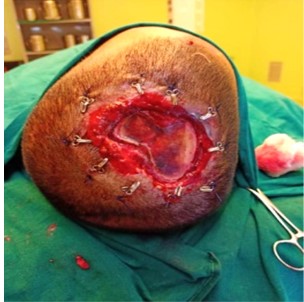
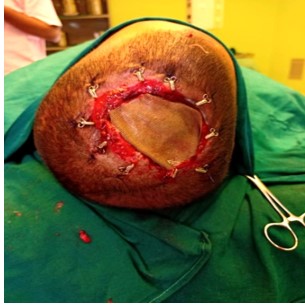
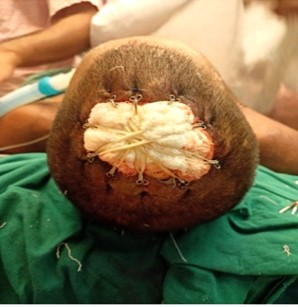
Electrical burns constitute 3–5% of all burn cases; in developing countries, this ratio increases up to 21–27% and the mortality rate is reported to be between 3.75% and 58.8%. Most of the acute burns are life threatening, and require various types of surgical interventions such as eschar excision or split thickness skin grafting, depending on the size, location and depth of the lesion. The deep electrical burns to the scalp were difficult to manage as it was more prone to exposure of the calvarial bone. In our case, calvarial boneat the vertex exposed post eschar excision. Tissue expansion is based on the principle that all living tissues respond in a dynamic fashion to mechanical stress placed on them. Below we present a case of electrical burns wound to the calvarium utilizing the use simple costeffective external tissue expansion technique for preventing wound retraction and for holding the dressing of the scalp wound.
References
- 1. Aggarwal S, Maitz P, Kennedy P. Electrical flash burns due to switchboard explosions in New South Wales, a 9-year experience. Burns 2011; 37:1038–1043.
- 2. Patil SB, Khare NA, Jaiswal S, Jain A, Chitranshi A, Math M. Changing patterns in electrical burn injuries in a developing country: should prevention programs focus on the rural population? J Burn Care Res 2010; 31:931–934.
- 3. Neumann CG. The expansion of an area of skin by progressive distension of a subcutaneous balloon; use of the method for securing skin for subtotal reconstruction of the ear. PlastReconstr Surg. 1957; 19:124–130.
- 4. Radovan C. Breast reconstruction after mastectomy using temporary expander. PlastReconstr Surg. 1982; 70:195–208.
- 5. Austad ED, Rose GL. A self-inflating tissue expander. PlastReconstr Surg. 1982; 70:588– 594.
- 6. Koul AR, Patil RK, Philip VK. Early use of microvascular free tissue transfer in the management of electrical injuries. Burns 2008; 34:681–687.
- 7. Lasheen AE, Salim A, Hefny MR, Al-Bakly E. External tissue expansion successfully achieved using negative pressure. Surg Today. 2004; 34:193–196.
- 8. Barnea Y, Gur E, Amir A, Leshem D, Zaretski A, Miller E, et al. Delayed primary closure of fasciotomy wounds with Wisebands, a skinand soft tissue-stretch device. Injury. 2006; 37:561–566.
- 9. Nielson DL, Wu SC, Armstrong DG. Delayed primary closure of diabetic foot wounds using the DermaClose RC Tissue Expander. Foot Ankle J. 2008; 1:3.
Data Sharing Statement
There are no additional data available. All raw data and code are available upon request.
Funding
This research received no funding.
Author Contributions
All authors contributed significantly to the work and approve its publication.
Ethics Declaration
This article does not involve any human or animal subjects, and therefore does not require ethics approval.
Acknowledgements
We would like to express our gratitude to the patients, their families, and all those who have contributed to this study.
Conflicts of Interest
No conflicts of interest in this work.
About this article

Cite this article
Jackson Nuli, Ravi Kumar Chittoria, Barath Kumar Singh/Role of External Tissue Expansion Wound Closure in the Electrical Burn Wound to the Scalp/New Indian J Surg. 2022;13(4): 157–159.
Licence:
Attribution-Non-commercial 4.0 International (CC BY-NC 4.0)This license enables reusers to distribute, remix, adapt, and build upon the material in any medium or format for noncommercial purposes only, and only so long as attribution is given to the creator.
| Received | Accepted | Published |
|---|---|---|
| September 28, 2022 | November 01, 2022 | December 25, 2022 |
DOI: https://doi.org/10.21088/nijs.0976.4747.13422.2
Keywords
External tissue expansion wound closureScalpElectrical burnsSearch for Similar Articles
Similar Articles
- End Stage Renal Disease: AVF for Hemodialysys: Clinical Assessment with/without...
- Neutrophil Lymphocyte Ratio: A Prognostic Indicator of Limb Survival in CLI Pati...
- Role of Pan-Tilt Camera in Tele-interaction During Surgery at the Time of COVID-...
- Rare Case of Gall Bladder Perforation following acute Calculus Cholecystitis in...
- Early Detection of Common Bile Duct Injury Post Cholecystectomy, What are the Op...
Article Level Metrics
Last UpdatedFriday 09 October 2026, 05:08:59 (IST)
5948
Accesses
2
636
00
Citations
NA
NA
NA
Download citation
Article Keywords
Keyword Highlighting
Highlight selected keywords in the article text.
Timeline
| Received | September 28, 2022 |
| Accepted | November 01, 2022 |
| Published | December 25, 2022 |
licence
Attribution-Non-commercial 4.0 International (CC BY-NC 4.0)
This license enables reusers to distribute, remix, adapt, and build upon the material in any medium or format for noncommercial purposes only, and only so long as attribution is given to the creator.