Full Text (PDF)
Journal of Biochemistry and Biophysics 7(2):p 45-48, July-December 2022. | DOI: https://doi.org/10.21088/rfpjbb.2582-3558.7222.1
Original Article
Role of Cyclical Negative Pressure Wound Therapy in Wound Bed Preparation in Necrotizing Fascitis
Ravi Kumar Chittoria, Shivanand Hosamani, Barath Kumar Singh P.
Author Information
Licence:
Attribution-Non-commercial 4.0 International (CC BY-NC 4.0)This license
enables reusers to distribute, remix, adapt, and build upon the material in any
medium or format for noncommercial purposes only, and only so long as
attribution is given to the creator.
Journal of Biochemistry and Biophysics 7(2):p 45-48, July-December 2022. | DOI: https://doi.org/10.21088/rfpjbb.2582-3558.7222.1
How Cite This Article:
Shivanand Hosamani, Ravi Kumar Chittoria, Barath Kumar Singh. P/Role of Cyclical Negative Pressure Wound Therapy in Wound Bed Preparation in Necrotizing Fascitis/JBB Journal of Biochemistry and Biophysics. 2022;7(2):45–48.Timeline
Received : November 21, 2022
Accepted : December 03, 2022
Published : December 26, 2022
Abstract
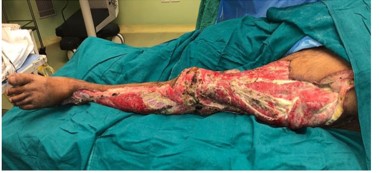
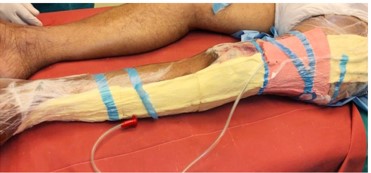
Necrotizing fasciitis is an infection of subcutaneous tissue and fascia which may spread rapidly to deeper tissue and surrounding tissue which may cause damage to the tissue and present as a localized infection and fulminant septic shock with high mortality rate. Negative pressure wound therapy (NPWT) has been used to treat wounds in numerous different anatomical locations, with different levels of complexity and varying pathologies. NPWT has been found to be effective in wound bed preparation but cyclical negative pressure wound therapy (cNPWT) has not been reported in literature. This study highlights our experience in wound bed preparation using cNPWTin a case on necrotizing fasciitis.
References
- 1. Stevens DL, Bryant AE. Necrotizing Soft-Tissue Infections. N Engl J Med 2017; 377:2253.
- 2. Stevens DL, Bisno AL, Chambers HF, et al. Practice guidelines for the diagnosis and management of skin and soft tissue infections: 2014 update by the infectious diseases’ society of America. Clin Infect Dis 2014; 59:147.
- 3. Bonne SL, Kadri SS. Evaluation and Management of Necrotizing Soft Tissue Infections. Infect Dis Clin North Am 2017; 31:497.
- 4. Camille Hua, Tomas Urbina, RomainBosc, et al. Necrotising soft-tissue infections. Lancet Infect Dis 2022.
- 5. Jahnson L, Berggren L, Björsell-Ostling E, et al. Streptococcal myositis. Scand J Infect Dis 1992; 24:661.
- 6. Argenta LC, Morykwas MJ. Vacuum-assisted closure: a new method for wound control and treatment: clinical experience. Ann PlastSurg 1997;38:563–76.
- 7. Morykwas MJ, Argenta LC, Shelton-Brown EI, McGuirt W. Vacuum-assisted closure: a new method for wound control and treatment: animal studies and basic foundation. Ann PlastSurg 1997;38:553–62.
- 8. Glass GE, Nanchahal J. The methodology of negative pressure wound therapy: separating fact from fiction. J PlastReconstrAesthet Surg. (2012) 65:989– 1001.
- 9. Kairinos N, Voogd AM, Botha PH, Kotze T, Kahn D, Hudson DA, et al. Negative-pressure wound therapy II: negative-pressure wound therapy and increased perfusion. Just an illusion? PlastReconstr Surg. (2009) 123:601– 12.
- 10. Borgquist O, Ingemansson R, Malmsjo M. Wound edge microvascular blood flow during negativepressure wound therapy: examining the effects of pressures from−10 to−175 mmHg. PlastReconstr Surg. (2010) 125:502– 9.
- 11. Kairinos N, McKune A, Solomons M, Hudson DA, Kahn D. The flaws of laser Doppler in negativepressure wound therapy research. Wound Repair Regen. (2014) 22:424–9.
- 12. Muenchow S, Horch RE, Dragu A. Effects of topical negative pressure therapy on perfusion and microcirculation of human skin. ClinHemorheolMicrocirc. (2019) 72:365–74.
- 13. Sogorski A, Lehnhardt M, Goertz O, Harati K, Kapalschinski N, Hirsch T, et al. Improvement of local microcirculation through intermittent Negative Pressure Wound Therapy (NPWT). J Tissue Viability. (2018) 27:267– 73.
Data Sharing Statement
There are no additional data available. All raw data and code are available upon request.
Funding
This research received no funding.
Author Contributions
All authors contributed significantly to the work and approve its publication.
Ethics Declaration
This article does not involve any human or animal subjects, and therefore does not require ethics approval.
Acknowledgements
We would like to express our gratitude to the patients, their families, and all those who have contributed to this study.
Conflicts of Interest
No conflicts of interest in this work.
About this article

Cite this article
Shivanand Hosamani, Ravi Kumar Chittoria, Barath Kumar Singh. P/Role of Cyclical Negative Pressure Wound Therapy in Wound Bed Preparation in Necrotizing Fascitis/JBB Journal of Biochemistry and Biophysics. 2022;7(2):45–48.
Licence:
Attribution-Non-commercial 4.0 International (CC BY-NC 4.0)This license
enables reusers to distribute, remix, adapt, and build upon the material in any
medium or format for noncommercial purposes only, and only so long as
attribution is given to the creator.
| Received | Accepted | Published |
|---|---|---|
| November 21, 2022 | December 03, 2022 | December 26, 2022 |
DOI: https://doi.org/10.21088/rfpjbb.2582-3558.7222.1
Keywords
Cyclical Negative pressure wound therapy (cNPWT); Wound bed preparation; Necrotizing fasciitis.Cyclical Negative pressure wound therapy (cNPWT)Wound bed preparationNecrotizing fasciitisArticle Level Metrics
Last UpdatedThursday 26 November 2026, 17:42:41 (IST)
1883
Accesses
7
346
00
Citations
NA
NA
NA
Download citation
Article Keywords
Keyword Highlighting
Highlight selected keywords in the article text.
Timeline
| Received | November 21, 2022 |
| Accepted | December 03, 2022 |
| Published | December 26, 2022 |
licence
Attribution-Non-commercial 4.0 International (CC BY-NC 4.0)
This license
enables reusers to distribute, remix, adapt, and build upon the material in any
medium or format for noncommercial purposes only, and only so long as
attribution is given to the creator.