Full Text (PDF)
New Indian Journal of Surgery 13(2):p 81-87, April–June 2022. | DOI: https://doi.org/10.21088/nijs.0976.4747.13222.5
Original Article
Review and Follow up of Open Pre-rectus Mesh Repair in the Management of Midline Incisional Hernias
Author Information
Licence:
Attribution-Non-commercial 4.0 International (CC BY-NC 4.0)This license enables reusers to distribute, remix, adapt, and build upon the material in any medium or format for noncommercial purposes only, and only so long as attribution is given to the creator.
New Indian Journal of Surgery 13(2):p 81-87, April–June 2022. | DOI: https://doi.org/10.21088/nijs.0976.4747.13222.5
How Cite This Article:
Suryanarayana Bandlamudi/Review and Follow up of Open Pre-rectus Mesh Repair in the Management of Midline Incisional Hernias/New Indian J Surg. 2022;13(2):81–87.Timeline
Received : January 02, 2022
Accepted : February 03, 2022
Published : June 30, 2022
Abstract
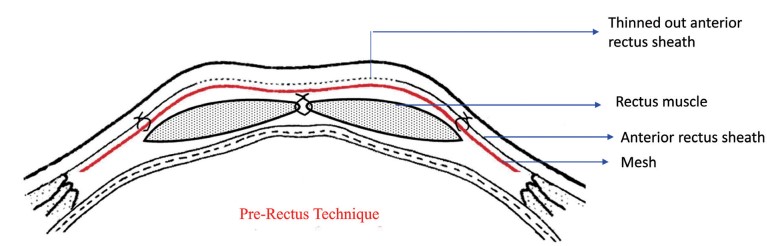
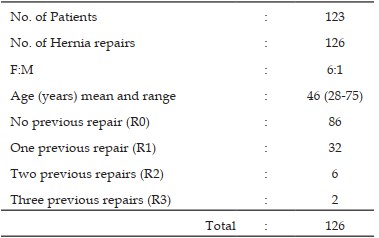
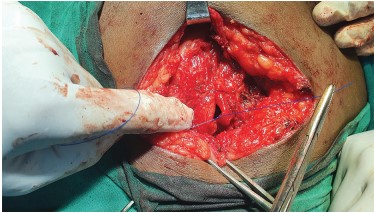
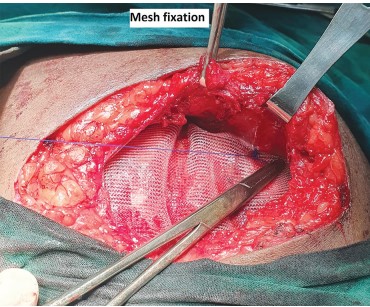
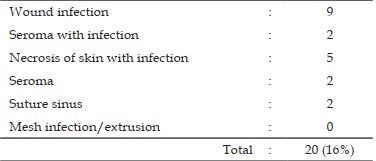
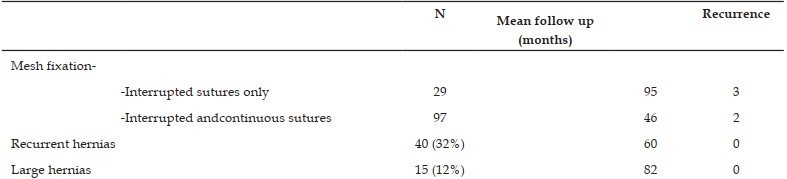
Background: Repair of incisional hernia with prosthetic mesh provides tension free closure of the abdominal wall with improved results. Different methods of fixation of mesh have been described with varying results. Mesh fixation to the fascia is the most important part of a hernia repair. Anterior rectus sheaths are tough aponeurotic structures and so are ideal for mesh fixation. This study reports the long-term results of placement of prosthetic mesh in pre-rectus position and fixation to anterior rectus sheaths along with linea alba by open technique, for incisional hernias occurring in the midline. The primary end point was hernia recurrence. Patients and Methods: A total of 126 consecutive patients with incisional hernias occurring in the midline were operated from July 2009 to October2020. After dissection of the plane between rectus muscles and anterior rectus sheath, a polypropylene mesh of suitable size was placed in front of the rectus muscles and fixed to the posterior surfaces of anterior rectus sheaths and the linea alba. In 2013, cases were reviewed and the study continued. The patients were followed on phone or by personal visits up to March 2021. Results: The average period of follow up was 60 months. There were five recurrences. Wound infection was noted in 16 patients with complete healing in all cases with antibiotics and dressings. There were 4 cases of seroma, 5 cases of skin edge necrosis and two cases of suture sinus. There was no mortality, mesh infection or extrusion. Conclusion: Open ‘pre-rectus’ technique for repair of midline incisional hernias is effective with a low recurrence rate.
References
- 1. Bucknall TE, Cox PJ, Harold E (1982) Burst abdomen and incisional hernia: a prospective study of 1129 major laparotomies. Br Med J 284: 519-20.
- 2. Mudge M, Hughes LE (1985) Incisional hernia: a10 year prospective study of incidence and attitudes. Br J Surg 72:70-71.
- 3. Muysoms FE, Miserez M, Berrevoet G et al (2009) Classification of primary and incisional abdominal wall hernias. Hernia 13:407-414. doi: 10.1007/ s10029-009-0518-x
- 4. Burger JW, Liujendijk RW, Hop WC, et al (2004) Long term follow up of a randomized trial of suture versus mesh repair of incisional hernia. Ann Surg 240(4):578-585. doi: 10.1097/01. sla.0000141193.08524.e7.
- 5. Shell DH IV, de la Torre J, Patricio A (2008) Open Repair of Ventral Incisional Hernias. Surg Clin N Am 88(1): 61-83. doi: 10.1016/j.suc.2007.10.008.
- 6. Flum DR, Horvath K, Thomas K (2003) Have Outcomes of Incisional Hernia Repair Improved with Time? A Population-Based Analysis. Annals of Surgery 237(1):129-135. doi: 10.1097/00000658- 200301000-00018.
- 7. Voeller GR, Ramshaw B, Park AE, et al. (1999) Incisional hernia. J Am Coll Surg 189(6):635-7. doi: 10.1016/s1072-7515(99)00224-0
- 8. Kokotovic D, Gogenur I, Helgstrand F (2017) Substantial variation among hernia experts in the decision for treatment of patients with incisional hernia: a descriptive study on agreement. Hernia 21(2):271-278. doi.org/10.1007/s10029-016-1562-y
- 9. Langer C, Schaper A, Liersch T (2005) Prognostic factors in incisional hernia surgery: 25 years of experience. Hernia 9:16-21. doi: 10.1007/s00104- 002-0594-2
- 10. Korenkov M, Paul A, Saurland S et al. (2001) Classification and surgical treatment: results of an experts’ meeting. Langenbecks Arch Surg 386(1):65-73. doi: 10.1007/s004230000182
- 11. Awad ZT, Puri V, LeBlanc K. (2005) Mechanisms of Ventral Hernia Recurrence after Mesh Repair and a New Proposed Classification. JACS 201(1): 132-140. doi: 10.1016/j.jamcollsurg.2005.02.035
- 12. Israelsson LA, Smedberg S, Montgomery A et al. (2006) Incisional hernia repair in Sweden 2002. Hernia 10:258-261. doi: 10.1007/s10029-006- 0084-4
- 13. Weber G, Baracs J, Horvath OP. (2010) “Onlay” mesh provides significantly better results than “sublay” reconstruction. Prospective randomized multicenter study of abdominal wall reconstruction with sutures only, or with surgical mesh--results of a five-years follow-up. National library of medicine. 63(5):302-11. doi: 10.1556/ MaSeb.63.2010.5.3
- 14. TS de Vries Reilingh, D van Geldere, Langenhorst B. (2004) Repair of large midline incisional hernias with polypropylene mesh: comparison of three operative techniques. Hernia 8(1):56-9. doi: 10.1007/s10029-003-0170-9
- 15. Andrew Kingsnorth (2006) The Management of Incisional Hernia. Ann R Coll Surg Engl 88(3): 252- 260. doi: 10.1308/003588406X106324
- 16. Martin K, Allan K, Simon S. (2008) Open Mesh Repair of Incisional Hernia Using a Sublay Technique: Long-Term follow up. World J Surg 32:31-36. doi: 10.1007/s00268-007-9118-z
- 17. Hasan HE, Bibi ME, Mark B et al. (2013) Laparoscopic vs Open Incisional Hernia Repair A Randomized Clinical Trial. JAMA Surg. 148(3):259- 263. doi: 10.1001/jamasurg.2013.1466
- 18. Moreau E, Helmy N, Vons C. (2012) Laparoscopic treatment of incisional hernia. State of the art in 2012. J. Visc. Surg.149, e40-e48. doi: 10.1016/j. jviscsurg.2012.09.001
- 19. Koehler RH, Voeller G (1999) Recurrences in Laparoscopic Incisional Hernia Repairs: A Personal Series and Review of the Literature. JSLS 3(4):293-304
- 20. Lavanchy JL, Stefan EB, Andreas K. (2019) Long-term results of laparoscopic versus open intraperitoneal on-lay mesh incisional hernia repair: a propensity score-matched analysis. Surg Endosc 33(1): 225–233. doi: 10.1007/s00464-018- 6298-6
- 21. Carbajo MA, Martin del Olmo JC, Blanco JI et al (2003) Laparoscopic approach to incisional hernia. Surg Endosc. 17(1):118-22. doi: 10.1007/s00464- 002-9079-0
- 22. Ahonen-siirtola M, Nevala T, Vironen J et al. (2018) Laparoscopic versus hybrid approach for treatment of incisional ventral hernia: a prospective randomized multicenter study of 1-month follow-up results. Hernia 22:1015-1022. doi: 10.1007/s10029-018-1784-2
- 23. Ben-Haim M, Kuriansky J, Tal R et al (2002) Pitfalls and complications with laparoscopic intraperitoneal expanded polytetrafluoroethylene patch repair of postoperative ventral hernia. Surg Endosc 16(5):785-8. doi: 10.1007/s00464-001-9126- 2
- 24. LeBlanc KA, Melvin JE, James MC. (2007) Enterotomy and Mortality Rates of Laparoscopic Incisional and Ventral Hernia Repair: a Review of the Literature. JSLS 11(4):408-414.
- 25. Haytham MA, Kaafarani MD, Kwan Hur, Seroma in ventral incisional herniorrhaphy: incidence, predictors and outcome. J Am Surg 198:639-644. doi.org/10.1016/j.amjsurg.2009.07.019
- 26. Muysoms F, Campanelli G, Champault G et al. (2012) EuraHS: the development of an international online platform for registration and outcome measurement of ventral abdominal wall hernia repair. 16(3):239-250. doi: 10.1007/s10029- 012-0912-7
- 27. Parker SG, Halligan S, Liang MK et al. (2019) International classification of abdominal wall planes (ICAP) to describe mesh insertion for ventral hernia repair. BJS Society Ltd. Wiley Online Library. doi.org/10.1002/bjs.11400.
- 28. William SR, David E, Scott R et al. (2016) Guidelines for Laparoscopic Ventral Hernia Repair. Society of American Gastrointestinal and Endoscopic Surgeons (SAGES).
- 29. Kockerling F, Koch A, Lorenz R et al. (2015) How long do we need to follow-up our hernia patients to find the real recurrence rate? Front Surg 2:24. doi: 10.3389/fsurg.2015.00024
- 30. Kockerling F. (2019) Recurrent Incisional Hernia Repair—An Overview. Front Surg 6:26. doi: 10.3389/fsurg.2019.00026
- 31. Ferrari G, Bertoglio C, Magistro C et al. (2013) Laparoscopic repair for recurrent incisional hernias: a single institute experience of 10 years. Hernia 17:573-580. doi:10.1007/s10029-013-1098-3
- 32. Berry M F, Sonya P, David W L et al. Repair of large complex recurrent incisional hernias with retro muscular mesh and panniculectomy. J Am Surg 194:199-204. doi: 10.1016/j.amjsurg.2006.10.031.
Data Sharing Statement
There are no additional data available. All raw data and code are available upon request.
Funding
This research received no funding.
Author Contributions
All authors contributed significantly to the work and approve its publication.
Ethics Declaration
This article does not involve any human or animal subjects, and therefore does not require ethics approval.
Acknowledgements
We would like to express our gratitude to the patients, their families, and all those who have contributed to this study.
Conflicts of Interest
No conflicts of interest in this work.
About this article

Cite this article
Suryanarayana Bandlamudi/Review and Follow up of Open Pre-rectus Mesh Repair in the Management of Midline Incisional Hernias/New Indian J Surg. 2022;13(2):81–87.
Licence:
Attribution-Non-commercial 4.0 International (CC BY-NC 4.0)This license enables reusers to distribute, remix, adapt, and build upon the material in any medium or format for noncommercial purposes only, and only so long as attribution is given to the creator.
| Received | Accepted | Published |
|---|---|---|
| January 02, 2022 | February 03, 2022 | June 30, 2022 |
DOI: https://doi.org/10.21088/nijs.0976.4747.13222.5
Keywords
Midline IncisionalMesh FixationPolypropylene MeshSearch for Similar Articles
Similar Articles
- Role of Bates-Jenson Wound Assessment Tool (BJWAT) in Wound Management
- Role of New Antimicrobial Solution in the Management of a Chronic Left Foot Woun...
- Laparoscopic Excision of a Giant Retroperitoneal Benign Mesenteric Cyst Encasing...
- Endoscopic-Assisted Sural Nerve and Biceps Femoris Muscle Biopsy in a Young Woma...
- Amniotic Membrane in Wound Healing: Biological Basis, Clinical Evidence and Futu...
Article Level Metrics
Last UpdatedSunday 22 November 2026, 23:51:45 (IST)
9577
Accesses
10
879
00
Citations
NA
NA
NA
Download citation
Article Keywords
Keyword Highlighting
Highlight selected keywords in the article text.
Timeline
| Received | January 02, 2022 |
| Accepted | February 03, 2022 |
| Published | June 30, 2022 |
licence
Attribution-Non-commercial 4.0 International (CC BY-NC 4.0)
This license enables reusers to distribute, remix, adapt, and build upon the material in any medium or format for noncommercial purposes only, and only so long as attribution is given to the creator.