Full Text (PDF)
New Indian Journal of Surgery 14(4):p 181-187, October-December 2023. | DOI: https://doi.org/10.21088/nijs.0976.4747.14423.2
Original Article
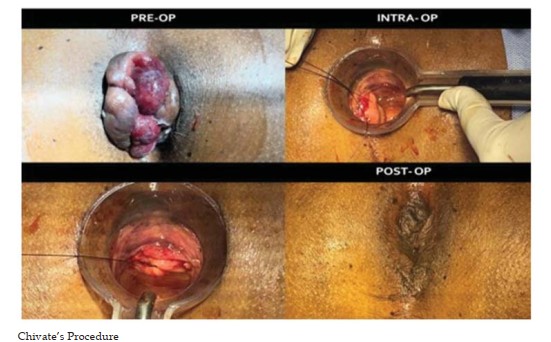
Retrospective Comparative Study between Stapled (Longo’s) Haemorrhoidopexy v/s Suture Rectopexy (Chivate’s) in Management of Haemorrhoids
Sarangam Venkata Satyanarayana Rao, Matabudul null, Vandana Gourvee Bachoo, Shirishsing Rampudaruth, Mohammad Suleman
Author Information
Licence:
Attribution-Non-commercial 4.0 International (CC BY-NC 4.0)This license enables reusers to distribute, remix, adapt, and build upon the material in any medium or format for noncommercial purposes only, and only so long as attribution is given to the creator.
New Indian Journal of Surgery 14(4):p 181-187, October-December 2023. | DOI: https://doi.org/10.21088/nijs.0976.4747.14423.2
How Cite This Article:
Sarangam Venkata Satyanarayana Rao, Matabudul, Vandana Gourvee Bachoo, et al./Retrospective Comparative Study between Stapled (Longo’s) Haemorrhoidopexy v/s Suture Rectopexy (Chivate’s) in Management of Haemorrhoids/New Indian J Surg. 2023; 14(3):181–187Timeline
Received : August 16, 2023
Accepted : October 03, 2023
Published : December 25, 2023
Abstract
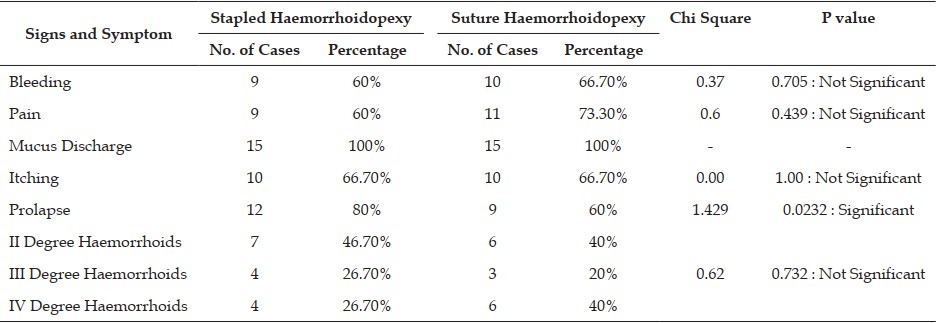
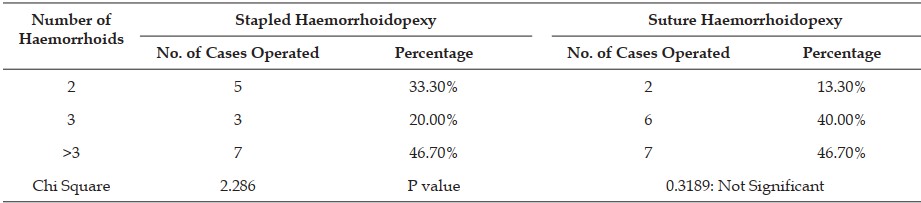
Background: Haemmoroids refer to anal cushions and when it becomes pathological, it will produce symptoms of bleeding, mucus discharge, itching, pain and prolapse. The objective of the present study was to compare between the results of Longo’s and Chivate’s procedure in terms of operative time, post-operative pain and complications, return to normal work and recurrence. Materials and Methods: In the present study 30 number of patients clinically diagnosed as second degree, third degree and fourth degree haemmrhoids are enrolled and operated. 15 number of cases were selected under Group A category and Stapled Haemorrhoidopexy was perfomed. Another 15 number of patients were put under Group B category and Suture Rectopexy was performed. The results of both these procedures were compared. Post-operative check-ups at 12 hours, 24 hours and upto 48 hours were done. Follow-up of all the cases were done at 2 weeks, 4 weeks, 8 weeks and upto a period of 6 months. Statistical Analysis: Standard statistical analysis method like SPSS (software version 200) was adopted for the analysis. The data were evaluated by comparing two groups using Chi Square Test with a P value <0.05 as significant. Results: In Stapled Haemorrhoidopexy, there was less post-operative pain as per visual analogue score, less of operating time, fewer days of hospital stay and early return to normal work. In Suture Rectopexy, there were also similar results. Hence, no significant differences in post-operative complications were found in both the procedures. There were four recurrences with stapled haemorrhoidopexy and two recurrences with sutured rectopexy in the present study. Conclusion: At present many surgical procedures are practiced for haemorrhoids. However, we found that stapled haemorrhoidopexy of Longos’s offers better results in terms of fewer post-operative complications, good patient compliance and better long term results.
References
- 1. Martel G Boushy RP. The treatment of Haemorrhoids in Unusual Situations and Difficult Circumstances. Semin Colon Rectal Surg 18 (2007): 187-196.
- 2. Gibbons CP, Trowbridge EA, Bannister JJ, Read NW (1986) Role of anal cushions in continence. Lancet 1:886-888.
- 3. Gibbons CP, Bannister JJ, Read NW (1988) Role of constipation and anal hypertonia in the pathogenesis of haemorrhoids. Br J Surg 75:656- 660.
- 4. Sneider EB, Maykel JA. Diagnosis and management of symptomatic hemorrhoids. SurgClin North Am 90 (2010):17-32.
- 5. Cintron JR, Abcarian H. Benign Anorectal: Hemorrhoids. In: Wolff BG, Fleshman JW, Beck DE, Pemberton JH, Wexner SD, Church JM, et al., editors. The ASCRS Textbook of Colon and Rectal Surgery. New York, NY: Springer New York (2007):156-177.
- 6. Cataldo P, Ellis CN, Gregorcyk S, et al. Practice parameters for the management of hemorrhoids (revised). Dis Colon Rectum 48 (2005):189-194.
- 7. Turell R. Hemorrhoids: advances and retreats. Am J Surg 99 (1960):154-167.
- 8. Ahmed Q, Noorani S. Stapled haemorrhoidectomy/ anoplasty: a study at KVSS Site Hospital, Karachi. Pak J Surg 19 (2003):9-12.
- 9. Longo A (1998) Treatment of hemorrhoids disease by reduction of mucosa and haemorrhoidal prolapse with a circular suturing device: a new procedure; in Proceed. 6th World Congr Endoscop Surg, Rome, June 3-6.
- 10. Shantikumar D Chivate et al, Transanal Suture Rectopexy for Haemorrhoids: Chivate’s Painless Cure for Piles, Indian J Surg. 2012 Oct; 74(5):412- 417.
- 11. Daniel R, Jose MR, SF Paneerselvam P, et al. Open Haemorrhoidectomy Versus Stapled Haemorrhoidopexy-A Prospective Study In A Tertiary Hospital In South India (2017): 3939-3942.
- 12. Dr Mohan SVS DDKBR, Dr Sushil Kumar BV, Swathi. J open versus closed hemorrhoidectomy: surgical outcome. IOSR Journal of Dental and Medical Sciences 13 (2014):59-62.
- 13. Gravié JF, Lehur PA, Huten N, et al. Stapled hemorrhoidopexy versus milligan-morgan hemorrhoidectomy: A prospective, randomized, multicenter trial with 2 year postoperative follow up. Ann Surg 242 (2005): 29-35.
- 14. Bhandari RS, LakheyPj, Singh YP, et al. Stapled haemorrhoidectomy versus openhae morrhoidectomy: a prospective comparative study 2015 (2015): 5.
- 15. Giordano P, Gravante G, Sorge R, et al. Longterm outcomes of stapled hemorrhoidopexy vs conventional hemorrhoidectomy: a meta-analysis of randomized controlled trials. Arch Surg 144.
- 16. Nisar PJ, Acheson AG, Neal KR, et al. Stapled haemorroidopexy compared with conventional haemorroidectomy: systematic review of randomized, controlled trials. Dis Colon Rectum 47 (2004): 1837-1845.
- 17. Tjandra JJ, Chan MK. Systematic review on the procedure for prolapse and hemorrhoids (stapled haemorroidopexcy). Dis Colon Rectum 50 (2007): 878-92.21.
Data Sharing Statement
There are no additional data available. All raw data and code are available upon request.
Funding
This research received no funding.
Author Contributions
All authors contributed significantly to the work and approve its publication.
Ethics Declaration
This article does not involve any human or animal subjects, and therefore does not require ethics approval.
Acknowledgements
We would like to express our gratitude to the patients, their families, and all those who have contributed to this study.
Conflicts of Interest
No conflicts of interest in this work.
About this article

Cite this article
Sarangam Venkata Satyanarayana Rao, Matabudul, Vandana Gourvee Bachoo, et al./Retrospective Comparative Study between Stapled (Longo’s) Haemorrhoidopexy v/s Suture Rectopexy (Chivate’s) in Management of Haemorrhoids/New Indian J Surg. 2023; 14(3):181–187
Licence:
Attribution-Non-commercial 4.0 International (CC BY-NC 4.0)This license enables reusers to distribute, remix, adapt, and build upon the material in any medium or format for noncommercial purposes only, and only so long as attribution is given to the creator.
| Received | Accepted | Published |
|---|---|---|
| August 16, 2023 | October 03, 2023 | December 25, 2023 |
DOI: https://doi.org/10.21088/nijs.0976.4747.14423.2
Keywords
HaemorrhoidsRecurrencePilesComplicationsStapled (Longo’s) HaemorrhoidopexySuture (Chivate’s) RectopexySearch for Similar Articles
Similar Articles
- Role of Bates-Jenson Wound Assessment Tool (BJWAT) in Wound Management
- Role of New Antimicrobial Solution in the Management of a Chronic Left Foot Woun...
- Laparoscopic Excision of a Giant Retroperitoneal Benign Mesenteric Cyst Encasing...
- Endoscopic-Assisted Sural Nerve and Biceps Femoris Muscle Biopsy in a Young Woma...
- Amniotic Membrane in Wound Healing: Biological Basis, Clinical Evidence and Futu...
Article Level Metrics
Last UpdatedSunday 22 November 2026, 21:35:36 (IST)
9574
Accesses
8
879
00
Citations
NA
NA
NA
Download citation
Article Keywords
Keyword Highlighting
Highlight selected keywords in the article text.
Timeline
| Received | August 16, 2023 |
| Accepted | October 03, 2023 |
| Published | December 25, 2023 |
licence
Attribution-Non-commercial 4.0 International (CC BY-NC 4.0)
This license enables reusers to distribute, remix, adapt, and build upon the material in any medium or format for noncommercial purposes only, and only so long as attribution is given to the creator.