Full Text (PDF)
Indian Journal of Library and Information Sciences 18(3):p 208-217, September - December 2024. | DOI: https://doi.org/10.21088/ijlis.0973.9548.18224.3
Original Article
Research Productivity of Jawaharlal Nehru University and Jamia Millia Islamia (2019-2023): A Bibliometric Analysis
Author Information
Licence:
Attribution-Non-commercial 4.0 International (CC BY-NC 4.0)This license enables reusers to distribute, remix, adapt, and build upon the material in any medium or format for noncommercial purposes only, and only so long as attribution is given to the creator.
Indian Journal of Library and Information Sciences 18(3):p 208-217, September - December 2024. | DOI: https://doi.org/10.21088/ijlis.0973.9548.18224.3
How Cite This Article:
Lohrii Kaini Mahemei, Research Productivity of Jawaharlal Nehru University and Jamia Millia Islamia (2019-2023): A Bibliometric Analysis Ind J Lib Inf Sci 2024; 18 (3):208-217.Timeline
Received : September 10, 2024
Accepted : November 23, 2024
Published : December 30, 2024
Abstract
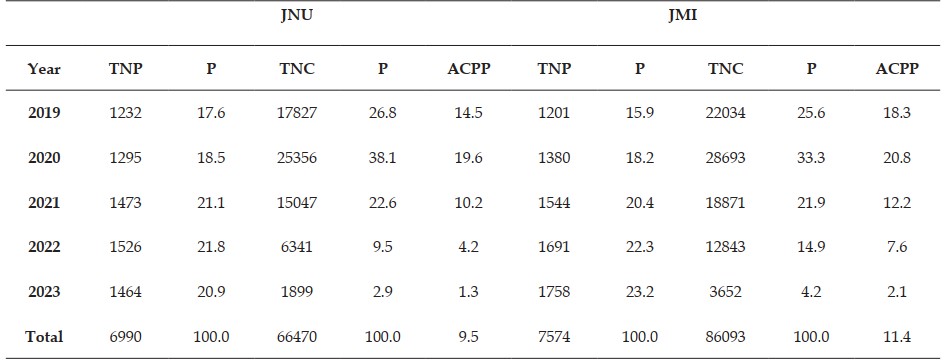
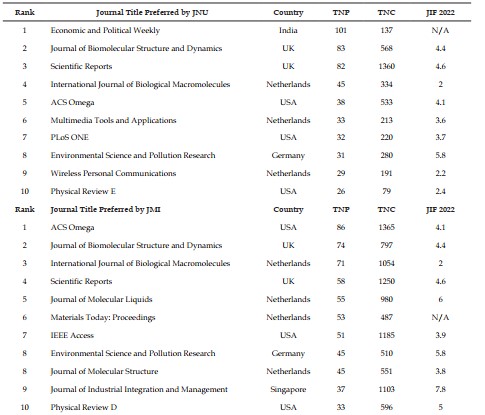
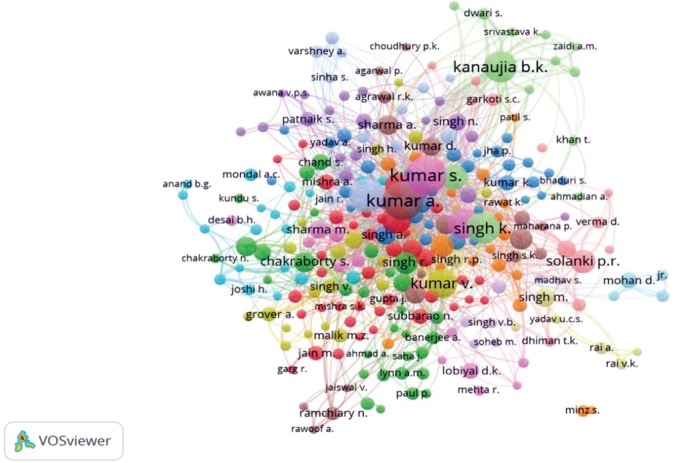
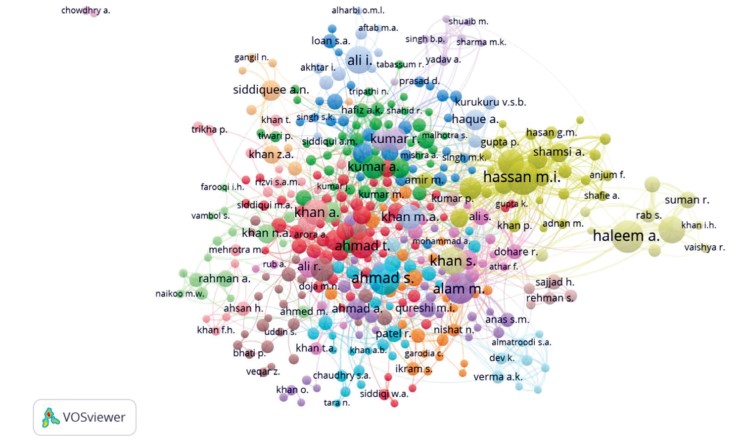
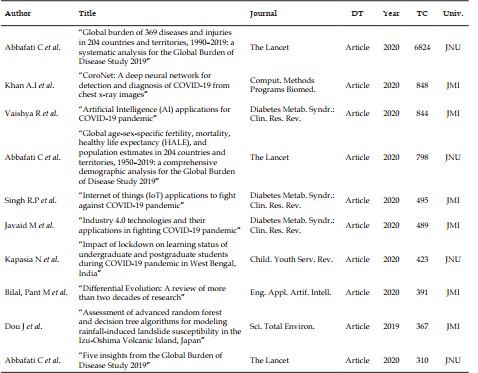
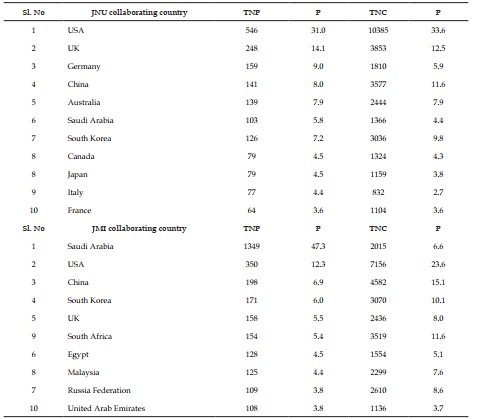
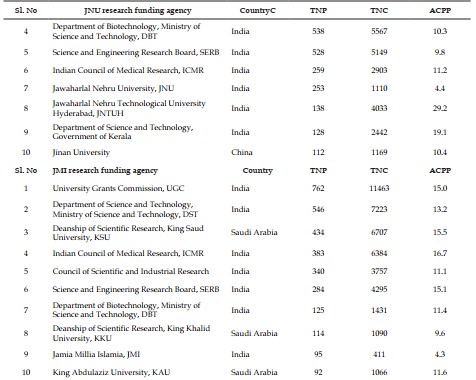
The main purpose of the present study is to make a quantitative analysis and to compare the research publications between two prestigious central universities in India. The data are collected from the Scopus database during the period 2019 to 2023 and mainly focus on the growth of publications, highly cited articles, authorship networks, international collaboration patterns, funding agencies and channels for communicating their research findings. A total of 6990 and 7574 publication records of JNU and JMI respectively were analysed using MS Excel and scientometric techniques. For JNU, 2022 (21.8% publications) is the most productive year, whereas for JMI, the year 2023 with 23.2% publications. The year 2020 received the highest number of citations i.e. 38.1% and 33.3% for both universities. Researchers of JNU and JMI channel their research findings in 1819 and 1806 unique journals in which 66.7% and 64.9% of articles are published respectively. The ACPP for JNU’s prolific authors ranges from 6.4 to 18.8 whereas for JMI’s most productive authors range from 10 to 51.7. Both JNU and JMI published scientific publications collaborated with 166 and 135 different international countries respectively.
References
- 1. Chaturbhuj, S., & Motewar, N. R. (2021). Scientometric Analysis of the Research Productivity of Savitribai Phule Pune University. DESIDOC Journal of Library & Information Technology, 41(6), 438-447. https://doi.org/10.14429/djlit.41.6.16993
- 2. Gopikuttan, A., & Aswathy, S. (2014). Publication Productivity of University of Kerala: A Scientometric View. DESIDOC Journal of Library & Information Technology, 34(2), 131-139.
- 3. Government of India. National Institutional Ranking Framework. Ministry of Education. Retrieved March 22, 2024, from https://www. nirfindia.org/Home
- 4. Jamia Millia Islamia (A Central University). Annual Report 2022-2023. https://jmi.ac.in/ upload/menuupload/university_annual_report_ english_2022_2023.pdf
- 5. Janen, T. (2022). Research Output of University of Jaffna, Sri Lanka during 2000-2019. DESIDOC Journal of Library & Information Technology, 42(1), 3-10. https://doi.org/10.14429/djlit.42.1.17000
- 6. Jawaharlal Nehru University. 53rd Annual Report (1 April 2022 to 31 March 2023). https:// www.jnu.ac.in/sites/default/files/annual_ reports/53AnnualReport_Eng.pdf
- 7. Pradhan, B., Kuri, R., Singh, K., Gireesh Kumar, T. K., & Pati, P. K. (2020). Research Performance of National Institute of Technology Rourkela: A Scientometric Analysis. Library Philosophy and Practice (e-journal), 4397. https://digitalcommons. unl.edu/libphilprac/4397
- 8. QS World University Rankings: Top global universities. (n.d). Retrieved March 22, 2024, from https://www.topuniversities.com/worlduniversity-rankings/2023
- 9. Santhakumar, R., Kaliyaperumal, K., & Louies, S. (2020). Scientometric Profile of the University of Madras: The Mother of South Indian Universities. DESIDOC Journal of Library & Information Technology, 40(3), 185-191. https://doi.org/10.14429/ djlit.40.3.14844
- 10. Singh, M., & Kumar, A. (2019). Measuring the research output of University of Delhi: A bibliometric study. In K.P. Singh, R.K. Sharma, R.K. Bhatt, Meera & J.N. Singh (Eds.), Digital Age Strategies in Information Management for Sustainable Librarianship (pp.446-451).https:// www.researchgate.net/publication/332672535_ Measuring_the_Research_Output_of_University_ of_Delhi_A_Bibliometric_Study
- 11. The Times Higher Education: World University Rankings. (n.d). Retrieved March 22, 2024, from https://www.timeshighereducation.com/worlduniversity-rankings/2023/world-ranking
- 12. Yadav, S. K., Verma, M. K., & Singh, S. N. (2020). Research Productivity of Mizoram University during 2004-2017: A Scientometric Study Based on Indian Citation Index. DESIDOC Journal of Library & Information Technology, 40(3), 169-175. https:// doi.org/10.14429/djlit.40.3.15022
Data Sharing Statement
There are no additional data available. All raw data and code are available upon request.
Funding
This research received no funding.
Author Contributions
All authors contributed significantly to the work and approve its publication.
Ethics Declaration
This article does not involve any human or animal subjects, and therefore does not require ethics approval.
Acknowledgements
We would like to express our gratitude to the patients, their families, and all those who have contributed to this study.
Conflicts of Interest
No conflicts of interest in this work.
About this article

Cite this article
Lohrii Kaini Mahemei, Research Productivity of Jawaharlal Nehru University and Jamia Millia Islamia (2019-2023): A Bibliometric Analysis Ind J Lib Inf Sci 2024; 18 (3):208-217.
Licence:
Attribution-Non-commercial 4.0 International (CC BY-NC 4.0)This license enables reusers to distribute, remix, adapt, and build upon the material in any medium or format for noncommercial purposes only, and only so long as attribution is given to the creator.
| Received | Accepted | Published |
|---|---|---|
| September 10, 2024 | November 23, 2024 | December 30, 2024 |
DOI: https://doi.org/10.21088/ijlis.0973.9548.18224.3
Keywords
Research ProductivityBibliometric AnalysisResearch PerformanceJawaharlal Nehru University (JNU)Jamia Millia Islamia (JMI)Scientometric StudySearch for Similar Articles
Similar Articles
- Role of Academic Libraries in National Educational Policy 2020 in Higher Educati...
- LIS Education Development in India: Emerging Trends and Challenges
- Need and Importance of Artificial Intelligence in Library and Information Scienc...
- Mesentery in Global Research Output: A Scientometric Analysis
- Use of Digital Resources Among Faculty and Students at Government First Grade Co...
Article Level Metrics
Last UpdatedMonday 23 November 2026, 16:27:53 (IST)
6676
Accesses
7
1109
00
Citations
NA
NA
NA
Download citation
Article Keywords
Keyword Highlighting
Highlight selected keywords in the article text.
Timeline
| Received | September 10, 2024 |
| Accepted | November 23, 2024 |
| Published | December 30, 2024 |
licence
Attribution-Non-commercial 4.0 International (CC BY-NC 4.0)
This license enables reusers to distribute, remix, adapt, and build upon the material in any medium or format for noncommercial purposes only, and only so long as attribution is given to the creator.