Full Text (PDF)
Physiotherapy and Occupational Therapy Journal 18(4):p 301-311, Oct. -Dec. 2025. | DOI: https://doi.org/10.21088/potj.0974.5777.18425.3
Original Article
Relationship of Cognition and Dual Task Performance in Sedentary Middle Aged Obese Adults: A Cross Sectional Study
Dona Shaji, Manju Unnikrishnan, Reethu Elsa Baby, Remya N., Rejimol Jos Pulicken, Chinchu Alwin, Anumol C., Rakhi Balagopal
Author Information
Licence:
Attribution-Non-commercial 4.0 International (CC BY-NC 4.0)This license enables reusers to distribute, remix, adapt, and build upon the material in any medium or format for noncommercial purposes only, and only so long as attribution is given to the creator.
Physiotherapy and Occupational Therapy Journal 18(4):p 301-311, Oct. -Dec. 2025. | DOI: https://doi.org/10.21088/potj.0974.5777.18425.3
How Cite This Article:
Shaji D, Unnikrishnan M, Baby RE, et al. Relationship of Cognition and Dual Task Performance in Sedentary Middle Aged Obese Adults: A Cross Sectional Study. Therapy Jr. 2025;18(4):301-311Timeline
Received : June 09, 2025
Accepted : July 21, 2025
Published : December 30, 2025
Abstract
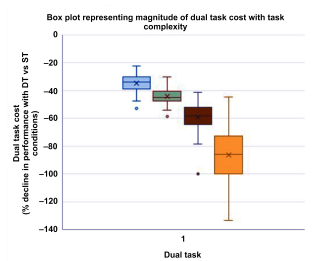
Background: Obesity is the over accumulation of fat in the body and represents a major priority for healthcare systems due to its social, clinical and economic burdens. The prevalence of obesity in India is 40.3% which is increasing faster than the world average and it is higher among middle aged adults over 40 than under 40, where as in Kerala the prevalence rate is about 40.7% with a female preponderance. Midlife obesity is associated with decrements in cognitive function as well as motor function, and this could potentially compromise a person’s memory, attention, concentration and decision-making abilities that impacts daily functioning. Dual task involves the simultaneous incorporation of cognitive as well as motor components and it is found to be affected in obese adults. So there may exist a scope of association between the cognition and dual task performance of obese patients, and thus this study aims to find out the association between cognition and dual task performance in sedentary middle aged obese adults. Objective: To find out the linear relationship between cognition and dual task performance in sedentary middle aged obese adults. Methods: Community dwelling sedentary middle aged obese individuals with MoCA score between 18 - 30 were recruited for the study. They were instructed to perform two single tasks: six-meter self-selected walking speed test and the timed up and go test. Each single task was then repeat under two dual task conditions: self-selected walking speed test and verbal fluency test, self-selected walking speed test and serial 3 subtraction test, timed up and go test and verbal fluency test, and timed up and go test and serial 3 subtraction test. Dual task cost was calculated for each dual task to explore the percentile decline in dual task performance. ((difference between dual task and single task motor erformance)/single task motor performance] ×100) Results and Discussion: Regression analysis was done and found a significant linear relationship of cognition with dual task performance and dual task cost in sedentary middle aged obese adults (p<0.05). Moderate linear relationship (β=0.65) was found for timed up and go serial 3 subtractions which was the most difficult task and a weak linear relationship (β=0.22) for self-selected walking speed verbal fluency the simplest one. The results concluded that as the task complexity increases dual task cost increases which indicates a direct relationship between cognition and dual task performance. The prefrontal cortex plays a major role during single and dual-task gait functions and this activation corresponds to the complexity of the task. Reduced brain volume, grey matter atrophy, impaired synaptic plasticity, all of which may contribute to changes in cognitive and motor domain. These evidence may correspond to the linear relationship exists between cognition with dual task performance and dual task cost in the current study. Conclusion: Findings of this study implies that there is a linear relationship between cognition and dual task performance in sedentary middle aged obese adults.
References
- 1. Müller M.J., Geisler C. Defining obesity as a disease. Eur J Clin Nutr. 2017; 71(11): 1256–8.
- 2. Obesity and overweight. Who. [cited 2022 Jun 14]
- 3. Verma M., Das M., Sharma P., Kapoor N., Kalra S. Epidemiology of overweight and obesity in Indian adults: A secondary data analysis of the National Family Health Surveys. Diabetes Metab Syndr. 2021; 15(4): 102166.
- 4. Venkatrao M., Nagarathna R., Majumdar V., Patil S.S., Rathi S., Nagendra H. Prevalence of obesity in India and its neurological implications: A multifactor analysis of a Dona Shaji, Manju Unnikrishnan, Reethu Elsa Baby, et al. Relationship of Cognition and Dual Task Performance in Sedentary Middle Aged Obese Adults: A Cross Sectional Study310 POTJ/Volume 18 Number 4 / October - December 2025 Physiotherapy and Occupational Therapy Journal nationwide cross-sectional study. Ann Neurosci. 2020; 27(3–4): 153–61.
- 5. Ahirwar R., Mondal P. Prevalence of obesity in India: A systematic review. Diabetes & Metabolic Syndrome: Clinical Research & Reviews. 2019; 13(1): 318-321.
- 6. Sohini Das. Nearly one fourth of all men and women in India are now obese: NFHS. Public health. 2022; 06.
- 7. Sugathan T.N., Soman C.R., Sankaranarayanan K. Behavioural risk factors for noncommunicable diseases among adults in Kerala, India. Indian J Med Res. 2008; 127(6): 555–63.
- 8. Smith, E., Hay, P., Campbell, L., & Trollor, J. N. A review of the association between obesity and cognitive function across the lifespan: implications for novel approaches to prevention and treatment: Obesity and cognitive function across lifespan. Obesity Reviews: An Official Journal of the International Association for the Study of Obesity. 2011; 12(9), 740–755.
- 9. Dye L., Boyle N.B., Champ C., Lawton C. The relationship between obesity and cognitive health and decline. Proc Nutr Soc. 2017; 76(4): 443–54.
- 10. Wang C., Chan J.S.Y., Ren L., Yan J.H. Obesity reduces cognitive and motor functions across the lifespan. Neural Plast. 2016; 2016: 2473081.
- 11. Benito-León J., Mitchell A.J., Hernández-Gallego J., Bermejo-Pareja F. Obesity and impaired cognitive functioning in the elderly: a populationbased cross-sectional study (NEDICES). Eur J Neurol. 2013; 20(6): 899–906, e76-7
- 12. Tabue-Teguo M., Perès K., Simo N., Le Goff M., Perez Zepeda M.U., Féart C., et al. Gait speed and body mass index: Results from the AMI study. PLoS One 2020; 15(3): e0229979.
- 13. Mendes, J., Borges, N., Santos, A., Padrão, P., Moreira, P., Afonso, C., Negrão, R., & Amaral, T.F. Nutritional status and gait speed in a nationwide population-based sample of older adults. Scientific Reports. 2018; 8(1), 4227-29.
- 14. Osofundiya O., Benden M.E., Dowdy D., Mehta R.K. Obesity-specific neural cost of maintaining gait performance under complex conditions in community-dwelling older adults. Clin Biomech (Bristol, Avon). 2016; 35: 42–8.
- 15. Berke E.M., Koepsell T.D., Moudon A.V., Hoskins R.E., Larson E.B. Association of the built environment with physical activity and obesity in older persons. Am J Public Health. 2007; 97(3): 486–92.
- 16. Christofoletti G., Andrade L.P. de, Beinotti F., Borges G. Cognition and dual-task performance in older adults with Parkinson’s and Alzheimer’s disease. Int J Gen Med. 2014; 7: 383–8.
- 17. Venema D.M., Bartels E., Siu K.C. Tasks matter: a cross-sectional study of the relationship of cognition and dual-task performance in older adults. J Geriatr Phys Ther. 2013; 36(3): 115–22. 18. Chan J.S.Y., Yan J.H., Payne V.G. The impact of obesity and exercise on cognitive aging. Front Aging Neurosci. 2013; 5: 97
- 19. Lentoor A.G., Myburgh L. Correlation between body mass index (BMI) and performance on the Montreal Cognitive Assessment (MoCA) in a cohort of adult women in South Africa. Behav Neurol. 2022; 2022: 8994793.
- 20. Ward M.A., Carlsson C.M., Trivedi M.A., Sager M.A., Johnson S.C. The effect of body mass index on global brain volume in middle-aged adults: a cross sectional study. BMC Neurol. 2005; 5(1): 23.
- 21. Verstynen T.D., Weinstein A.M., Schneider WW, Jakicic J.M., Rofey D.L., Erickson K.I. Increased body mass index is associated with a global and distributed decrease in white matter microstructural integrity. Psychosom Med. 2012; 74(7): 682–90.
- 22. Gustafson D.R., Bäckman K., Waern M., Ostling S., Guo X., Zandi P., et al. Adiposity indicators and dementia over 32 years in Sweden. Neurology. 2009; 73(19): 1559–66.
- 23. Watson K.K., Platt M.L. Social signals in primate orbitofrontal cortex. Curr Biol. 2012; 22(23): 2268–73.
- 24. Squire L.R. Memory and the hippocampus: a synthesis from findings with rats, monkeys, and humans. Psychol Rev. 1992; 99(2): 195–231
- 25. Doya K. Complementary roles of basal ganglia and cerebellum in learning and motor control. Curr Opin Neurobiol. 2000; 10(6): 732–9.
- 26. Karlsoon I.K., Gatz M., Aprawong T.E., Dahl Aslan A.K., Reynolds C.A. The dynamic association between body mass index and cognition from midlife through late-life, and the effect of sex and genetic influences.Sci Rep. 2021; 11(1): 7206.
- 27. Bliss T.V., Collingridge G.L. A synaptic model of memory: long-term potentiation in the hippocampus. Nature. 1993; 361(6407): 31–9.
- 28. Farr S.A., Yamada K.A., Butterfield D.A., Abdul H.M., Xu L., Miller N.E., et al. Obesity and hypertriglyceridemia produce cognitive311 POTJ/Volume 18 Number 4 / October - December 2025 impairment. Endocrinology. 2008; 149(5): 2628–36.
- 29. Banks W.A., Farr S.A., Salameh T.S., Niehoff M.L., Rhea E.M., Morley J.E., et al. Triglycerides cross the blood–brain barrier and induce central leptin and insulin receptor resistance. Int J Obes (Lond) 2018; 42(3): 391–7
- 30. Lee Y.H., Martin J.M., Maple R.L., Tharp W.G., Pratley R.E. Plasma amyloid-beta peptide levels correlate with adipocyte amyloid precursor protein gene expression in obese individuals. Neuroendocrinology. 2009; 90(4): 383–9.
- 31. Su G.C., Arendash G.W., Kalaria R.N., Bjugstad K.B., Mullan M. Intravascular infusions of soluble beta-amyloid compromise the bloodbrain barrier, activate CNS glial cells and induce peripheral hemorrhage. Brain Res 1999; 818(1): 105–17.
- 32. Messier C., Teutenberg K. The role of insulin, insulin growth factor, and insulin-degrading enzyme in brain aging and Alzheimer’s disease. Neural Plast. 2005; 12(4): 311–28
- 33. Carro E., Trejo J.L., Gomez-Isla T., LeRoith D., Torres-Aleman I. Serum insulin-like growth factor I regulates brain amyloid-β levels. Nat Med. 2002; 8(12): 1390–7
- 34. Spielman L.J., Little J.P., Klegeris A. Inflammation and insulin/IGF-1 resistance as the possible link between obesity and neurodegeneration. J Neuroimmunol 2014; 273(1–2): 8–21
- 35. Noble E.E., Billington C.J., Kotz C.M, Wang C. The lighter side of BDNF. Am J Physiol Regul Integr Comp Physio. 2011; 300(5): R1053-69
- 36. Park H.R., Park M., Choi J., Park K.Y., Chung H.Y., Lee J. A high-fat diet impairs neurogenesis: involvement of lipid peroxidation and brainderived neurotrophic factor. Neurosci Lett. 2010; 482(3): 235–9
- 37. Luchsinger J.A., Gustafson D.R. Adiposity and Alzheimer’s disease. Curr Opin Clin Nutr Metab Care. 2009; 12(1): 15–21
- 38. Sellbom K.S., Gunstad J. Cognitive function and decline in obesity. J Alzheimers Dis. 2012; 30 Suppl 2(s2): S89-95.
- 39. Pinteaux E., Inoue W., Schmidt L., MolinaHolgado F., Rothwell N.J., Luheshi G.N. Leptin induces interleukin-1beta release from rat microglial cells through a caspase 1 independent mechanism: Leptin-induced IL-1 synthesis in microglia. J Neurochem. 2007; 102(3): 826–33.
- 40. Diano S., Horvath T.L. Anticonvulsant effects of leptin in epilepsy. J Clin Invest. 2008; 118(1): 26–8.
- 41. Lisbona González M.J., Reyes Botella C., Muñoz Soto E., Olmedo Gaya M.V., Moreno Fernández J., Díaz Castro J. Body composition, mineral metabolism, and endocrine function of adipose tissue: influence of a nutritional supplement of propolis. Nutr Hosp. 2021; 38(3): 585–9 42. Knopman D.S., Roberts R. Vascular risk factors: imaging and neuropathologic correlates. J Alzheimers Dis. 2010; 20(3): 699–709.
- 43. Lee J.J., Hong D.W., Lee S.A., Soh Y., Yang M., Choi K.M., et al. Relationship between obesity and balance in the community-dwelling elderly population: A cross-sectional analysis: A cross-sectional analysis. Am J Phys Med Rehabil. 2020; 99(1): 65–70.
- 44. Plummer P., Eskes G., Wallace S., Giuffrida C, Fraas M., Campbell G., et al. Cognitive-motor interference during functional mobility after stroke: state of the science and implications for future research. Arch Phys Med Rehabil. 2013; 94(12): 2565-2574. e6.
Data Sharing Statement
There are no additional data available. All raw data and code are available upon request.
Funding
This research received no funding.
Author Contributions
All authors contributed significantly to the work and approve its publication.
Ethics Declaration
This article does not involve any human or animal subjects, and therefore does not require ethics approval.
Acknowledgements
We would like to express our gratitude to the patients, their families, and all those who have contributed to this study.
Conflicts of Interest
No conflicts of interest.
About this article

Cite this article
Shaji D, Unnikrishnan M, Baby RE, et al. Relationship of Cognition and Dual Task Performance in Sedentary Middle Aged Obese Adults: A Cross Sectional Study. Therapy Jr. 2025;18(4):301-311
Licence:
Attribution-Non-commercial 4.0 International (CC BY-NC 4.0)This license enables reusers to distribute, remix, adapt, and build upon the material in any medium or format for noncommercial purposes only, and only so long as attribution is given to the creator.
| Received | Accepted | Published |
|---|---|---|
| June 09, 2025 | July 21, 2025 | December 30, 2025 |
DOI: https://doi.org/10.21088/potj.0974.5777.18425.3
Keywords
CognitionSingle taskDual taskDual task performanceDual task costTask complexitySedentary middle aged obese adultsSearch for Similar Articles
Similar Articles
- Leadership in Physiotherapy: A Narrative Review
- Effectiveness of Low Level Laser Theapy in the Management of Temporomandibular J...
- The Impact of Air Pollution on Cardiopulmonary Health: Molecular Mechanisms, Pre...
- Efectiveness of Physiotherapy in Postpartum Women with Diastasis Recti: A Review
- Pain Neuroscience Education: Transforming Physiotherapy Practice
Article Level Metrics
Last UpdatedSaturday 24 October 2026, 19:01:02 (IST)
4392
Accesses
51
739
00
Citations
NA
NA
NA
Download citation
Article Keywords
Keyword Highlighting
Highlight selected keywords in the article text.
Timeline
| Received | June 09, 2025 |
| Accepted | July 21, 2025 |
| Published | December 30, 2025 |
licence
Attribution-Non-commercial 4.0 International (CC BY-NC 4.0)
This license enables reusers to distribute, remix, adapt, and build upon the material in any medium or format for noncommercial purposes only, and only so long as attribution is given to the creator.