Full Text (PDF)
Indian Journal of Ancient Medicine and Yoga 19(1):p 21-30, Jan-March 2026. | DOI: https://doi.org/10.21088/ijamy.2455.8621.19126.3
Original Article
Reimagining Yoga Sadhana: The Bhagavad Gita's Spiritual Vision in Contemporary Global Discourse
Santosh Kumar Sahu, Radha Madhab Dash, Ajaya Kumar Sahoo, Diptiranjan Mohanty
Author Information
Licence:
Attribution-Non-commercial 4.0 International (CC BY-NC 4.0)This license enables reusers to distribute, remix, adapt, and build upon the material in any medium or format for noncommercial purposes only, and only so long as attribution is given to the creator.
Indian Journal of Ancient Medicine and Yoga 19(1):p 21-30, Jan-March 2026. | DOI: https://doi.org/10.21088/ijamy.2455.8621.19126.3
How Cite This Article:
Sahu SK, Dash RM, Sahoo AK, et al. Reimagining yoga sadhana: The Bhagavad Gita's spiritual vision in contemporary global discourse. Ind J Anct Med Yoga. 2026;19(1):21-30.Timeline
Received : September 16, 2025
Accepted : October 22, 2025
Published : March 30, 2026
Abstract
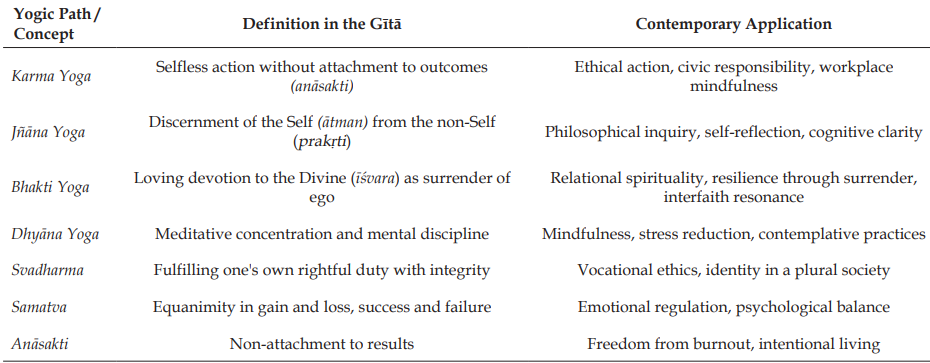
This article explores the Bhagavad Gita (BG)’s integrative vision of Yoga Sadhana (YS) as a spiritually grounded path of ethical action, inner transformation, and contemplative insight. While contemporary global yoga discourse often emphasizes physical well-being, the BG advances a multidimensional synthesis of karma, jnana, bhakti, and dhyāna yoga, supported by foundational principles such as svadharma, samatva, and anasakti. Employing a hermeneutical-philosophical method, this study engages classical commentaries and modern interpretations to reframe the BG’s teachings in light of contemporary existential, ethical, and psychological concerns. The findings suggest that the BG offers a dynamic, nonsectarian model of spiritual practice that supports psychological resilience, ethical discernment, and interreligious dialogue. Rather than proposing withdrawal from the world, the BG invites sustained engagement through disciplined selfknowledge and selfless action. This reimagining of YS reveals the BG’s continuing relevance as a resource for individual and collective spiritual flourishing in the contemporary world.
References
- 1. Deutsch E. Advaita Vedānta: A Philosophical Reconstruction. Pbk. ed. Honolulu: East-West Center Press; 1985.
- 2. Zaehner RC. The Bhagavad-Gītā: With a Commentary Based on the Original Sources. Oxford: Clarendon Press; 1969.
- 3. Ghose A. Essays on the Gita. 9th ed. Pondicherry: Sri Aurobindo Ashram; 1996.
- 4. Radhakrishnan S, editor. The Bhagavadgītā: With an Introductory Essay, Sanskrit Text, English Translation and Notes. 2nd impression. London: George Allen & Unwin; 1949.
- 5. Jain AR. Selling Yoga: From Counterculture to Pop Culture. Oxford: Oxford University Press; 2015. doi:10.1093/acprof:oso/9780199390236.001.0001.
- 6. Singleton M. Yoga Body: The Origins of Modern Posture Practice. Oxford: Oxford University Press; 2010. doi:10.1093/acprof:oso/9780195395358.001.0001.
- 7. Clooney FX. Hindu God, Christian God: How Reason Helps Break down the Boundaries between Religions. Oxford: Oxford University Press; 2010.
- 8. Rambachan A. The Advaita Worldview: God, World, and Humanity. Albany: State University of New York Press; 2006.
- 9. Prabhupāda ACB Swami. The Bhagavad Gita as It Is. Abridged ed. Los Angeles: Bhaktivedanta Book Trust; 2002.
- 10. Easwaran E. The Bhagavad Gita. Tomales: Nilgiri Press; 2007.
- 11. Patton LL, editor. The Bhagavad Gita. 1st publ. London: Penguin; 2008.
- 12. Sargeant W. The Bhagavad Gītā. 25th anniversary edition. New York: Excelsior ed; 2009.
- 13. Kapoor S. Sacred Sanskrit Literature. New Delhi: Cosmo; 2003.
- 14. Radhakrishnan S. The Bhagavadgitā: With an Introductory Essay, Sanskrit Text, English Translation and Notes. Noida: HarperCollins Publishers India; 2010.
- 15. Clooney FX. Comparative Theology: Deep Learning across Religious Borders. Malden: Wiley-Blackwell; 2010.
- 16. Feuerstein GA. The Yoga Tradition: Its History, Literature, Philosophy and Practice. 3rd ed. Chino Valley: Hohm press; 2008.
- 17. Rao KR, Paranjpe AC. Psychology in the Indian Tradition. 1st ed. New Delhi: Springer; 2016. doi:10.1007/978-81-322-2440-2.
- 18. Theodor I, editor. The Bhagavad-Gītā: A Critical Introduction. London: Routledge; 2021.
- 19. Desbordes G, Gard T, Hoge EA, et al. Moving beyond Mindfulness: Defining Equanimity as an Outcome Measure in Meditation and Contemplative Research. Mindfulness. 2014;5(4):356-372. doi:10.1007/s12671-013-0269-8.
- 20. Sarma D. Classical Indian Philosophy: A Reader. New York: Columbia University Press; 2011.
- 21. Gupta A. Exploring and Applying a Socially Progressive Hermeneutical Lens in Hindu Thought. Religions. 2021;12(8):595. doi:10.3390/rel12080595.
Data Sharing Statement
There are no additional data available. All raw data and code are available upon request.
Funding
This research received no funding.
Author Contributions
Whether all authors contributed significantly to the work and approve its publication.
Ethics Declaration
This article does not involve any human or animal subjects, and therefore does not require ethics approval.
Acknowledgements
We would like to express our gratitude to the patients, their families, and all those who have contributed to this study.
Conflicts of Interest
The authors report no conflicts of interest in this work.
About this article

Cite this article
Sahu SK, Dash RM, Sahoo AK, et al. Reimagining yoga sadhana: The Bhagavad Gita's spiritual vision in contemporary global discourse. Ind J Anct Med Yoga. 2026;19(1):21-30.
Licence:
Attribution-Non-commercial 4.0 International (CC BY-NC 4.0)This license enables reusers to distribute, remix, adapt, and build upon the material in any medium or format for noncommercial purposes only, and only so long as attribution is given to the creator.
| Received | Accepted | Published |
|---|---|---|
| September 16, 2025 | October 22, 2025 | March 30, 2026 |
DOI: https://doi.org/10.21088/ijamy.2455.8621.19126.3
Keywords
Bhagavad GitaYoga SadhanaKarma YogaSpirituality and ModernityCommodification of YogaComparative HermeneuticsSearch for Similar Articles
Similar Articles
- Efficacy of Katupila Ghrita in the Management of Itartha dagdha Vrana (Burn Woun...
- Clinical Outcomes of Ayurvedic Management in Acute Influenza Like Illness: A Cas...
- Effect of Ayurvedic Drugs on Scalp Psoriasis (Kitibha Kustha)
- Yogic Elements in the Brahma Mahapurana: A Textual and Comparative Study
- Management of Adenoid Hypertrophy: An Ayurvedic Perspective
Article Level Metrics
Last UpdatedMonday 13 July 2026, 18:50:12 (IST)
2256
Accesses
29
632
00
Citations
NA
NA
NA
Download citation
Article Keywords
Keyword Highlighting
Highlight selected keywords in the article text.
Timeline
| Received | September 16, 2025 |
| Accepted | October 22, 2025 |
| Published | March 30, 2026 |
licence
Attribution-Non-commercial 4.0 International (CC BY-NC 4.0)
This license enables reusers to distribute, remix, adapt, and build upon the material in any medium or format for noncommercial purposes only, and only so long as attribution is given to the creator.