Full Text (PDF)
Indian Journal of Ancient Medicine and Yoga 17(4):p 182-187, Oct - Dec. 2024. | DOI: https://doi.org/10.21088/ijamy.0974.6986.17424.3
Original Article
Ayurvedic Dietary Interventions and Nutritional Approaches in Haemorrhoids Management W.S.R. to Arshas
Pankaj Sharma, Saurabh Singh Thakur
Author Information
Licence:
Attribution-Non-commercial 4.0 International (CC BY-NC 4.0)This license enables reusers to distribute, remix, adapt, and build upon the material in any medium or format for noncommercial purposes only, and only so long as attribution is given to the creator.
Indian Journal of Ancient Medicine and Yoga 17(4):p 182-187, Oct - Dec. 2024. | DOI: https://doi.org/10.21088/ijamy.0974.6986.17424.3
How Cite This Article:
Saurabh Singh Thakur, Pankaj Sharma. Ayurvedic Dietary Interventions and Nutritional Approaches in Haemorrhoids Management W.S.R. to Arshas. Ind J Anct Med Yoga. 2024;17(4):182–187.Timeline
Received : September 27, 2024
Accepted : December 02, 2024
Published : December 25, 2024
Abstract
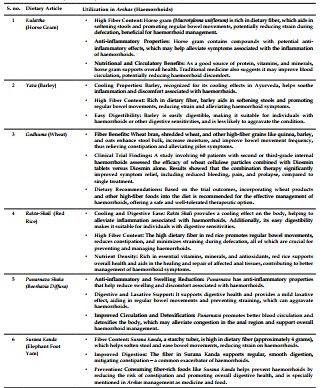
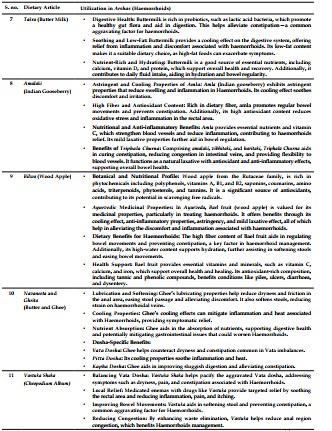
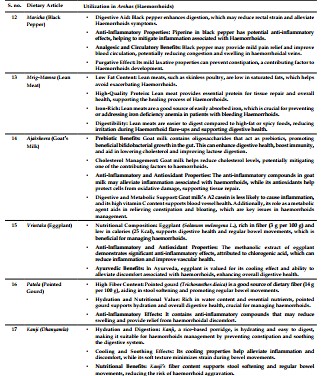
Background: Haemorrhoids, affecting 20-50% of the global population, significantly impact healthcare systems. In India, the prevalence is nearly 75%, exacerbated by inadequate preventive measures. This study explores the efficacy of Ayurvedic management for haemorrhoids, integrating dietary and herbal interventions to reduce incidence and severity. Material: Ayurvedic texts such as Charaka Samhita and Sushruta Samhita recommend dietary modifications and herbal remedies, emphasizing high-fiber foods and avoidance of vitiating factors. Result: The research evaluates a standardized dietary regimen in-corporating Ayurvedic and modern nutritional principles, focusing on fiber intake, hydration, and the role of herbs like Amalaki, Surana, Punarnava and Triphala. Methodology includes a review of dietary articles and development of a master chart for clinical and household use, aligned with Ayurvedic principles. Conclusion: Findings suggest that a holistic dietary approach, combining Ayurvedic practices with modern nutrition, offers an effective strategy for managing haemorrhoids.
References
- 1. Ashtanga Hridayam. Nidana Sthana [Internet]. 2023 Sep 07 [cited 2024 Sep 15]. Available from: http://ayurvidya.net/shastra/hridayam/
- 2. Ashtanga Hridayam. Chikitsa Sthana [Internet]. 2023 Sep 07 [cited 2024 Sep 15]. Available from: http://ayurvidya.net/shastra/hridayam/
- 3. Sushruta Samhita. Nidana Sthana [Internet]. 2023 Oct 04 [cited 2024 Sep 15]. Available from: https://niimh.nic.in/ebooks/esushruta/
- 4. Sushruta Samhita. Chikitsa Sthana [Internet]. 2023 Oct 04 [cited 2024 Sep 15]. Available from: https://niimh.nic.in/ebooks/esushruta/
- 5. Charaka Samhita. Chikitsa Sthana [Internet]. 2023 Oct 05 [cited 2024 Sep 15]. Available from: https://niimh.nic.in/ebooks/ecaraka/
- 6. Thakur S.S. Analysis of the impact of dietary changes in management of Haemorrhoids W.S.R. to Arshas in Ayurveda [DNHE Dissertation]. New Delhi: Indira Gandhi National Open University; 2023.
Data Sharing Statement
There are no additional data available. All raw data and code are available upon request.
Funding
This research received no funding.
Author Contributions
All authors contributed significantly to the work and approve its publication.
Ethics Declaration
This article does not involve any human or animal subjects, and therefore does not require ethics approval.
Acknowledgements
We would like to express our gratitude to the patients, their families, and all those who have contributed to this study.
Conflicts of Interest
No conflicts of interest in this work.
About this article

Cite this article
Saurabh Singh Thakur, Pankaj Sharma. Ayurvedic Dietary Interventions and Nutritional Approaches in Haemorrhoids Management W.S.R. to Arshas. Ind J Anct Med Yoga. 2024;17(4):182–187.
Licence:
Attribution-Non-commercial 4.0 International (CC BY-NC 4.0)This license enables reusers to distribute, remix, adapt, and build upon the material in any medium or format for noncommercial purposes only, and only so long as attribution is given to the creator.
| Received | Accepted | Published |
|---|---|---|
| September 27, 2024 | December 02, 2024 | December 25, 2024 |
DOI: https://doi.org/10.21088/ijamy.0974.6986.17424.3
Keywords
AyurvedaHaemorrhoidsNutritionSearch for Similar Articles
Similar Articles
- A Critical Review on the Pramehahara dravyas of Dhanwantari Nighantu
- Potential of Ayurveda in ‘Post Hospitalization Syndrome’ W.S.R. Mental Health Ma...
- Ayurvedic Management of Tinea Corporis (Dadru Kustha): A Case Study
- A Case Study: Ayurvedic Bhagna Chikitsa in Traumatic Fracture
- The Ways Understand Yoga: An Integrated Approach
Article Level Metrics
Last UpdatedThursday 22 October 2026, 19:29:32 (IST)
5473
Accesses
5
995
00
Citations
NA
NA
NA
Download citation
Article Keywords
Keyword Highlighting
Highlight selected keywords in the article text.
Timeline
| Received | September 27, 2024 |
| Accepted | December 02, 2024 |
| Published | December 25, 2024 |
licence
Attribution-Non-commercial 4.0 International (CC BY-NC 4.0)
This license enables reusers to distribute, remix, adapt, and build upon the material in any medium or format for noncommercial purposes only, and only so long as attribution is given to the creator.