Full Text (PDF)
Indian Journal of Anesthesia and Analgesia 12(3):p 183-197, July-Sept. 2025. | DOI: https://doi.org/10.21088/ijaa.2349.8471.12325.4
Original Article
Preoperative Clinical and Sonographic Assessment of Airway and its Correlation with Cormack–Lehane Grading During Intubation in Predicting Difficult Airway
Bijitha V.K., Biju M.L., Sajil M.S.
Author Information
Licence:
Attribution-Non-commercial 4.0 International (CC BY-NC 4.0)This license enables reusers to distribute, remix, adapt, and build upon the material in any medium or format for noncommercial purposes only, and only so long as attribution is given to the creator.
Indian Journal of Anesthesia and Analgesia 12(3):p 183-197, July-Sept. 2025. | DOI: https://doi.org/10.21088/ijaa.2349.8471.12325.4
How Cite This Article:
Bijitha V.K., Biju M.L., Sajil M.S. Preoperative Clinical and Sonographic Assessment of Airway and its Correlation with Cormack–Lehane Grading During Intubation in Predicting Difficult Airway. Ind J Anesth Analg. 2025; 12(3): 183-197.Timeline
Received : March 12, 2025
Accepted : May 30, 2025
Published : September 30, 2025
Abstract
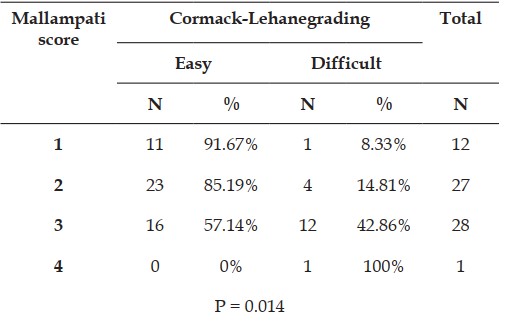
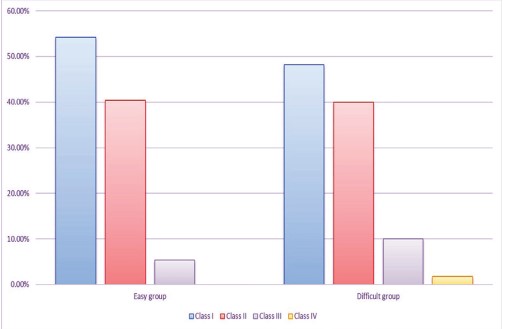
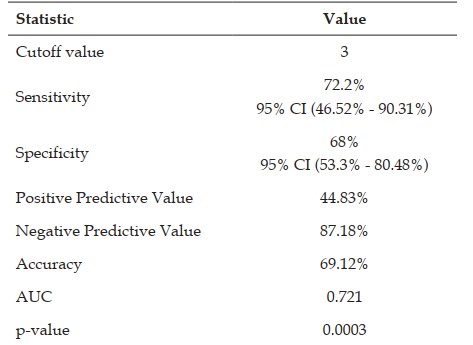
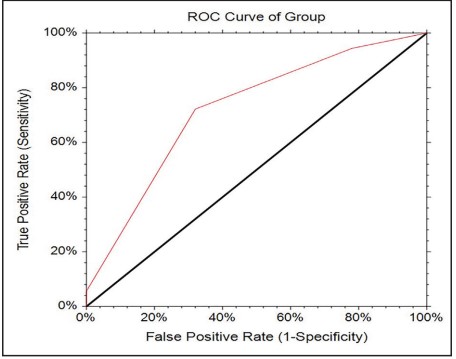
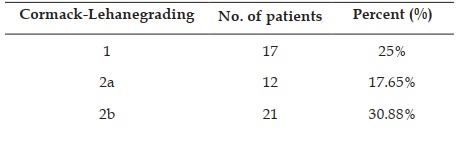
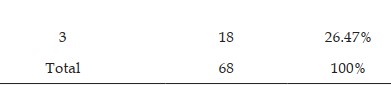
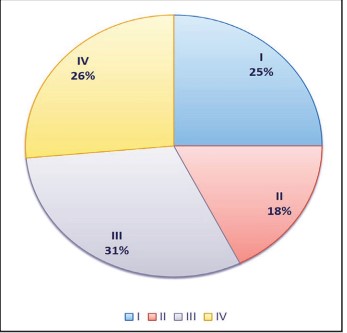
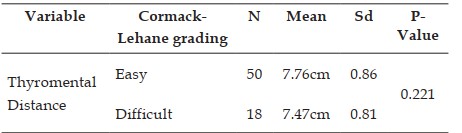
Background and Objectives: Unexpected difficult airway is a major challenge in general anesthesia, associated with significant morbidity and mortality. Ineffective airway management can lead to rapid deterioration of oxygenation and ventilation, resulting in severe consequences such as brain injury and death. The preanesthetic evaluation of the airway is typically conducted using a variety of assessment techniques. However, these techniques often lack discriminative value when used in isolation and perform better when combined with other tests. Ultrasound, when used alongside other risk assessment methods at different levels of the neck, may help identify predictors of a difficult airway, including challenging laryngoscopy, thus enabling faster and more accurate airway assessments in both routine and emergency situations. Aim: • To assess the effectiveness of ultrasonography in preoperative airway evaluation for predicting difficult airway. Objectives: • To evaluate the correlation between preoperative sonographic airway assessment and laryngoscopic CL grading. • To identify the sonographic parameter with better predictability of difficult airway. Methods: This prospective observational study was conducted with 68 patients presenting to Travancore Medical College, Kollam, for elective surgery under general anesthesia with endotracheal intubation. The three parameters anterior neck soft tissue thickness at the level of the hyoid, anterior neck soft tissue thickness at the level of the vocal cords, and the hyomental distance ratio, which is calculated by dividing the hyomental distance in the extended position by the hyomental distance in the neutral position (HMDe/HMDn) and three physical criteria the Modified Mallampati (MPC) class, thyromental distance (TMD), and sternomental distance (SMD) were assessed and correlated with the Cormack-Lehane grading. Results and Discussion: The optimal cutoff value for ANS-Hyoid to predict difficult laryngoscopy was >0.89 cm, with 22.2% sensitivity and 96% specificity (AUC = 0.6489). For ANS-VC, the best cutoff value was >0.87 cm, showing 22.2% sensitivity and 98% specificity (AUC = 0.695). The ideal cutoff value for HMDR was <1.15, with 38.89% sensitivity and 96% specificity (AUC = 0.75). Our findings suggest that while ANS-Hyoid has high specificity, its low sensitivity indicates it may not alone be sufficient for identifying difficult intubation. The correlation between greater anterior neck soft tissue thickness at the vocal cord level and higher CL grades supports the use of sonographic measurements in predicting difficult laryngoscopy. HMDR demonstrated the best combination of sensitivity and specificity, highlighting its potential utility in improving the accuracy of pre-operative airway assessments. Conclusion: Our study found that among the USG parameters evaluated, the Hyomental Distance Ratio (HMDr) provided the most reliable prediction of difficult intubation. In summary, integrating ultrasonography (USG) with both traditional and novel assessment tools is likely to enhance preoperative evaluations and lead to more effective management of difficult airway.
References
No records found.
Data Sharing Statement
There are no additional data available. All raw data and code are available upon request.
Funding
This research received no funding.
Ethics Declaration
This article does not involve any human or animal subjects, and therefore does not require ethics approval.
Acknowledgements
We would like to express our gratitude to the patients, their families, and all those who have contributed to this study.
Conflicts of Interest
No conflicts of interest in this work.
About this article

Cite this article
Bijitha V.K., Biju M.L., Sajil M.S. Preoperative Clinical and Sonographic Assessment of Airway and its Correlation with Cormack–Lehane Grading During Intubation in Predicting Difficult Airway. Ind J Anesth Analg. 2025; 12(3): 183-197.
Licence:
Attribution-Non-commercial 4.0 International (CC BY-NC 4.0)This license enables reusers to distribute, remix, adapt, and build upon the material in any medium or format for noncommercial purposes only, and only so long as attribution is given to the creator.
| Received | Accepted | Published |
|---|---|---|
| March 12, 2025 | May 30, 2025 | September 30, 2025 |
DOI: https://doi.org/10.21088/ijaa.2349.8471.12325.4
Keywords
Difficult airwayGeneral anesthesiaUltrasonographyPreoperative assessmentCormack-Lehane gradingSonographic parametersAirway management Hyomental distance ratioAnterior neck soft tissue thicknessLaryngoscopySearch for Similar Articles
Similar Articles
- Comparison of Tricuspid Annular Systolic Excursion Measurement between Transthor...
- Clinical Comparison between Baska Mask and I-gel in Short Surgical Procedures: A...
- Comparison of Effects of Levobupivacaine vs Ropivacaine vs Bupivacaine in Phacoe...
- Comparison Between Levobupivacaine vs Ropivacaine in Thoracic Epidural Anaesthes...
- Anaesthetic Management of Child with Congenital Heart Disease Posted for Non-car...
Article Level Metrics
Last UpdatedSaturday 24 October 2026, 16:36:48 (IST)
13345
Accesses
0
1119
00
Citations
NA
NA
NA
Download citation
Article Keywords
Keyword Highlighting
Highlight selected keywords in the article text.
Timeline
| Received | March 12, 2025 |
| Accepted | May 30, 2025 |
| Published | September 30, 2025 |
licence
Attribution-Non-commercial 4.0 International (CC BY-NC 4.0)
This license enables reusers to distribute, remix, adapt, and build upon the material in any medium or format for noncommercial purposes only, and only so long as attribution is given to the creator.