Full Text (PDF)
International Journal of Neurology and Neurosurgery 17(2):p 70-79, May-August 2025. | DOI: 10.21088/ijnns.0975.0223.17225.2
Review Article
Predicting the Impact of Viral Infections on Neuronal Aging and Cognitive Decline Using AI-Based Brain Transcriptomics
Author Information
Licence:
Attribution-Non-commercial 4.0 International (CC BY-NC 4.0)This license enables reusers to distribute, remix, adapt, and build upon the material in any medium or format for noncommercial purposes only, and only so long as attribution is given to the creator.
International Journal of Neurology and Neurosurgery 17(2):p 70-79, May-August 2025. | DOI: 10.21088/ijnns.0975.0223.17225.2
How Cite This Article:
Amaan Arif, Prachi Srivastava. Unusual Cradle Hook Injury with Full Thickness Upper Eyelid Loss on A 3 year Old Boy. International Journal of Neurology and Neurosurgery. 2025; 17(2): 70-79.Timeline
Received : March 13, 2025
Accepted : May 01, 2025
Published : July 30, 2025
Abstract
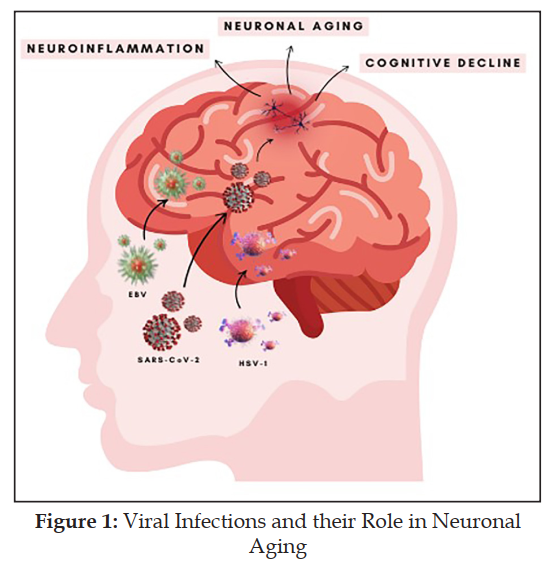
Neuronal aging is a complex process characterized by cognitive decline and susceptibility to neurodegenerative diseases, including AD, MS, and PD. As individuals age, brain undergoes structural and functional alterations, leading to impaired synaptic plasticity, neuroinflammation, and oxidative stress. Additionally, aging weakens immune response, ultimately CNS more vulnerable to latent viral infections and reactivations. HSV-1 and EBV have been strongly implicated in neurodegenerative pathologies. HSV-1, a neurotropic virus, has been found in postmortem brains of AD patients, suggesting a role in amyloidbeta accumulation and chronic uroinflammation. Similarly, EBV has been linked to MS, with viral reactivation triggering inflammatory cascades that contribute to demyelination and neurodegeneration. Other viruses, including CMV, HIV, and SARS-CoV-2, have also been associated with long-term neurological complications, worsening cognitive decline in aging individuals. By integrating deep learning and machine learning approaches, AI can predict disease progression, assess individual susceptibility to viral-induced neurodegeneration, and aid in early diagnosis. Brain transcriptomics, which involves RNA sequencing and gene expression profiling, provides insights into molecular pathways disrupted by viral infections. These technologies enhance our ability to identify biomarkers for neurodegenerative diseases, paving the way for targeted interventions. This study highlights the intersection of viral neuropathology, aging, and AI-based transcriptomics, emphasizing the need for computational tools to unravel the complexities of neurodegeneration. Understanding viral contributions to neuronal aging can lead to innovative therapeutic strategies, potentially mitigating the impact of chronic viral infections on cognitive health. As AI continues to evolve, its integration with
References
- 1. Verkhratsky, A. (2025). Neuroglial decline defines cognitive ageing. Ageing & Longevity, 1.2025, 6–21. https://doi.org/10.47855/jal9020-2025-1-2
- 2. Okenve-Ramos, P., Gosling, R., Chojnowska-Monga, M., Gupta, K., Shields, S., Alhadyian, H., Collie, C., Gregory, E., & Sanchez-Soriano, N. (2024). Neuronal ageing is promoted by the decay of the microtubule cytoskeleton. PLOS Biology, 22(3), e3002504. https://doi.org/10.1371/journal.pbio.3002504
- 3. Shafqat, A., Khan, S., Omer, M. H., Niaz, M., Albalkhi, I., AlKattan, K., Yaqinuddin, A., Tchkonia, T., Kirkland, J. L., & Hashmi, S. K. (2023). Cellular senescence in brain aging and cognitive decline. Frontiers in Aging Neuroscience. https://doi.org/10.3389/fnagi.2023.1281581
- 4. de Luzy, I. R., Lee, M. K., Mobley, W. C., & Studer, L. (2024). Lessons from inducible pluripotent stem cell models on neuronal senescence in aging and neurodegeneration. Nature Aging, 4(3), 309–318. https://doi.org/10.1038/s43587-024-00586-3
- 5. Gonzales, M. M., Garbarino, V. R., Pollet, E., Palavicini, J. P., Kellogg, D. L., Kraig, E., & Orr, M. E. (2022). Biological aging processes underlying cognitive decline and neurodegenerative disease. Journal of Clinical Investigation, 132. https://doi.org/10.1172/JCI158453
- 6. Ridderinkhof, K. R., &Krugers, H. J. (2022). Horizons in Human Aging Neuroscience: From Normal Neural Aging to Mental (Fr)Agility. Frontiers in Human Neuroscience, 16. https://doi.org/10.3389/fnhum.2022.815759
- 7. Chen, R., Ju, Z., Chen, J., Wang, L., Kang, R., & Tang, D. (2024). Immune aging and infectious diseases. Chinese Medical Journal. https://doi.org/10.1097/cm9.0000000000003410
- 8. Autio, A., Kettunen, J., Nevalainen, T. J., Kimura, B. Y., & Hurme, M. (2022). Herpesviruses and their genetic diversity in the blood virome of healthy individuals: effect of aging. Immunity & Ageing, 19(1). https://doi.org/10.1186/s12979-022-00268-x
- 9. Wrona, M. V., Ghosh, R., Coll, K., Chun, C., & Yousefzadeh, M. J. (2024). The 3 I’s of immunity and aging: immunosenescence, inflammaging, and immune resilience. Frontiers in Aging, 5. https://doi.org/10.3389/fragi.2024.1490302
- 10. Lee, K.-A., Flores, R., Jang, I. H., Saathoff, A., & Robbins, P. D. (2022). Immune Senescence, Immunosenescence and Aging. Frontiers in Aging, 3. https://doi.org/10.3389/fragi.2022.900028
- 11. Srivast, R., Agrawal, A., Vahed, H., &BenMohamed, L. (2023). Age-Related Impairment of Innate and Adaptive Immune Responses Exacerbate Respiratory Viral Infection in Older Mice. https://doi.org/10.21203/rs.3.rs-3133852/v1
- 12. Quiros-Roldan, E., Sottini, A., Natali, P. G., &Imberti, L. (2024). The Impact of Immune System Aging on Infectious Diseases. Microorganisms. https://doi.org/10.3390/microorganisms12040775
- 13. Hieber, C., Grabbe, S., & Bros, M. (2023). Counteracting Immunosenescence—Which Therapeutic Strategies Are Promising? Biomolecules, 13(7), 1085. https://doi.org/10.3390/biom13071085
- 14. Guo, J., Zhang, Y., Gao, Y., Li, S., Xu, G., Tian, Z., Xu, Q., Li, X., Li, Y., & Zhang, Y. (2023). Systematical analyses of large-scale transcriptome reveal viral infection-related genes and disease comorbidities. Artificial Cells Nanomedicine and Biotechnology, 51, 453–465. https://doi.org/10.1080/21691401.2023.2252477
- 15. Zhang, T., Li, Y., Pan, L., Sha, J., Bailey, M., Faure-Kumar, E., Williams, C. K., Wohlschlegel, J. A., Magaki, S., Niu, C., Lee, Y., Su, Y., Li, X., Vinters, H. V., & Geschwind, D. H. (2024). Brain-wide alterations revealed by spatial transcriptomics and proteomics in COVID-19 infection. Nature Aging, 4(11), 1598–1618. https://doi.org/10.1038/s43587-024-00730-z
- 16. Mavrikaki, M., Lee, J. D., Solomon, I. H., & Slack, F. J. (2022). Severe COVID-19 is associated with molecular signatures of aging in the human brain. Nature Aging, 2(12), 1130–1137. https://doi.org/10.1038/s43587-022-00321-w
- 18. Wu, W., Alexander, J.S., Booth, J. L., Miller, C., Metcalf, J.P., &Drevets, D.A. (2024). Influenza virus infection exacerbates gene expression related to neurocognitive dysfunction in brains of old mice. Immunity & Ageing, 21(1). https://doi.org/10.1186/s12979-024-00447-y .
- 19. Sarkar, A., & Ghosh, S. (2024). SARS-CoV-2 persistence: A potential catalyst for ageassociated neurodegenerative diseases. Advanced Neurology, 0(0), 4267. https://doi.
- 20. Cairns, D.M., Smiley, B.M., Smiley, J.A., Khorsandian, Y. A., Kelly, M., Itzhaki, R.F., &
- 21. Wang, Z., Liu, J., Han, J., Zhang, T., Li, S., Hou, Y., Su, H., Han, F., & Zhang, C. (2024). Herpes simplex virus 1 accelerates the progression of Alzheimer’s disease by modulating microglial phagocytosis and activating NLRP3 pathway. Journal of Neuroinflammation, 21(1). https:// doi.org/10.1186/s12974-024-03166-9.
- 23. Schreiner, T., Romanescu, C., Schreiner, O., &Nhambasora, F. (2024). New insights on
- 24. Zhang, N., Zuo, Y., Jiang, L., Peng, Y., Huang, X., & Zuo, L. (2022). Epstein-Barr Virus and Neurological Diseases. Frontiers in Molecular Biosciences, 8. https://doi.org/10.3389/ fmolb.2021.816098..
- 25. Naffaa, M.M. (2025). SARS-CoV-2 and its long-term neurological impact: Unraveling the mechanisms of neurodegeneration and cognitive decline. Advanced Neurology, 0(0), 4909. https://doi.org/10.36922/an.4909.
- 26. Sian-Hulsmann, J., & Riederer, P. (2024). Virus-induced brain pathology and the neuroinflammation-inflammation continuum: the neurochemists view. Journal of Neural Transmission. https://doi.org/10.1007/ s00702-023-02723-5
- 27. Römer, C. (2021). Viruses and Endogenous Retroviruses as Roots for Neuroinflammation and Neurodegenerative Diseases. Frontiers in Neuroscience, 15, 648629. https://doi. org/10.3389/FNINS.2021.648629.
- 28. Wylezinski, L.S., Sesler, C.L., Shaginurova, G., Grigorenko, E.V., Wohlgemuth, J. G., Cockerill, F.R., Racke, M.K., & Spurlock, C. F. (2024). Machine learning analysis using RNA-seq to distinguish neuromyelitis optica from multiple sclerosis and identify therapeutic candidates. The Journal of Molecular Diagnostics. https:// doi.org/10.1016/j.jmoldx.2024.03.003
- 29. Dasari, C.M., & Bhukya, R. (2021). Explainable deep neural networks for novel viral genome prediction. Applied Intelligence, 1–16. https:// doi.org/10.1007/S10489-021-02572-3
- 30. Rolfe, A. J., Bosco, D.B., Wang, J., Nowakowski, R.S., Fan, J., & Ren, Y. (2016). Bioinformatic analysis reveals the expression of unique transcriptomic signatures in Zika virus infected human neural stem cells. Cell & Bioscience, 6(1), 42. ttps://doi.org/10.1186/S13578-016- 0110-X
- 31. Guo, J., Zhang, Y., Gao, Y., Li, S., Xu, G., Tian, Z., Xu, Q., Li, X., Li, Y., & Zhang, Y. (2023). Systematical analyses of large-scale transcriptome reveal viral infection-related genes and disease comorbidities. Artificial Cells Nanomedicine and Biotechnology, 51, 453–465. https://doi.org/10.1 080/21691401.2023.2252477
- 32. Wang, Q., Readhead, B., Chen, K., Su, Y., Reiman, E.M., Dudley, J.T., & Dudley, J.T. (2021). Deep Learning-Based Brain Transcriptomic Signatures Associated with the Neuropathological and Clinical Severity of Alzheimer’s Disease. bioRxiv. https://doi. org/10.1101/2021.06.08.447615
- 33. Abir, A.R., Dip, S.A., & Zhang, L. (2024). UnCOT-AD: Unpaired Cross-Omics Translation Enables Multi-Omics Integration for Alzheimer’s Disease Prediction. https:// doi.org/10.1101/2024.10.28.620592
- 34. Bain, C., Ramamoorthy, D., & Fraenkel, E. (n.d.). Using Supervised Machine Learning Methods to Create a Gene-Based ALS Predictor from Postmortem Transcriptomics Data.
- 35. Park, M., Ahn, J., Lim, J., Han, M., Lee, J., Lee, J., Hwang, S., & Kim, K. (2024). A Transcriptomics-Based Machine Learning Model Discriminating Mild Cognitive Impairment and the Prediction of Conversion to Alzheimer’s Disease. Cells, 13(22), 1920. https://doi.org/10.3390/cells13221920
- 36. Ahammad, I., Lamisa, A. B., Bhattacharjee, A., Jamal, T. B., Arefin, Md. S., Chowdhury, Z. M., Hossain, M. U., Das, K. C., Keya, C. A., &Salimullah, M. (2024). AITeQ: a machine learning framework for Alzheimer’s prediction using a distinctive five-gene signature. Briefings in Bioinformatics, 25(4). https://doi. org/10.1093/bib/bbae291.
- 37. Chiricosta, L., D’Angiolini, S., Gugliandolo, A., & Mazzon, E. (2022). Artificial Intelligence Predictor for Alzheimer’s Disease Trained on Blood Transcriptome: The Role of Oxidative Stress. International Journal of Molecular Sciences, 23(9), 5237. https://doi.org/10.3390/ ijms23095237
- 38. Bakkar, N., Kovalik, T., Lorenzini, I., Spangler, S., Lacoste, A. M. B., Sponaugle, K., Ferrante, P., Argentinis, E., Sattler, R., & Bowser, R. (2018). Artificial intelligence in neurodegenerative disease research: use of IBM Watson to identify additional RNA-binding proteins altered in amyotrophic lateral sclerosis. Acta Neuropathologica, 135(2), 227–247. https:// doi.org/10.1007/S00401-017-1785-8
- 39. Usman, M., Varea, O., Radeva, P., Canals, J. M., Abante, J., & Guillot Ortiz, D. (2025). Explainable AI model reveals disease-related mechanisms in single-cell RNA-seq data. https://doi.org/10.48550/arxiv.2501.03923
Data Sharing Statement
There are no additional data available. All raw data and code are available upon request.
Funding
This research received no funding.
Author Contributions
All authors contributed significantly to the work and approve its publication.
Ethics Declaration
This article does not involve any human or animal subjects, and therefore does not require ethics approval.
Acknowledgements
We would like to express our gratitude to the patients, their families, and all those who have contributed to this study.
Conflicts of Interest
No conflicts of interest.
About this article

Cite this article
Amaan Arif, Prachi Srivastava. Unusual Cradle Hook Injury with Full Thickness Upper Eyelid Loss on A 3 year Old Boy. International Journal of Neurology and Neurosurgery. 2025; 17(2): 70-79.
Licence:
Attribution-Non-commercial 4.0 International (CC BY-NC 4.0)This license enables reusers to distribute, remix, adapt, and build upon the material in any medium or format for noncommercial purposes only, and only so long as attribution is given to the creator.
| Received | Accepted | Published |
|---|---|---|
| March 13, 2025 | May 01, 2025 | July 30, 2025 |
DOI: 10.21088/ijnns.0975.0223.17225.2
Keywords
Neuronal agingNeurodegenerationViral infectionsBrain transcriptomicsArtificial intelligenceSearch for Similar Articles
Similar Articles
- Intramedullary Capillary Hemangioma of Conus Medullaris: Case Report and Review...
- Atypical Miller Fisher Syndrome
- Therapeutic Potential of Passiflora incarnata in the Management of Neurological...
- Central or Axial Atlantoaxial Dislocation: Redefining Instability at the Craniov...
- Assessment of Neurocognitive Functions in Post-Acute Stroke Patients Undergoing...
Article Level Metrics
Last UpdatedTuesday 29 September 2026, 10:10:55 (IST)
2211
Accesses
24
272
00
Citations
NA
NA
NA
Download citation
Article Keywords
Keyword Highlighting
Highlight selected keywords in the article text.
Timeline
| Received | March 13, 2025 |
| Accepted | May 01, 2025 |
| Published | July 30, 2025 |
licence
Attribution-Non-commercial 4.0 International (CC BY-NC 4.0)
This license enables reusers to distribute, remix, adapt, and build upon the material in any medium or format for noncommercial purposes only, and only so long as attribution is given to the creator.