Full Text (PDF)
International Journal of Neurology and Neurosurgery 17(3):p 212-216, Sept. Dec. 2025. | DOI: 10.21088/ijnns.0975.0223.17325.2
Original Article
Assessment of Neurocognitive Functions in Post-Acute Stroke Patients Undergoing Endovascular Intervention or Decompression
Raman Kumar Shankar, Rinku Kumar Sharma, DP Sharma
Author Information
Licence:
Attribution-Non-commercial 4.0 International (CC BY-NC 4.0)This license enables reusers to distribute, remix, adapt, and build upon the material in any medium or format for noncommercial purposes only, and only so long as attribution is given to the creator.
International Journal of Neurology and Neurosurgery 17(3):p 212-216, Sept. Dec. 2025. | DOI: 10.21088/ijnns.0975.0223.17325.2
How Cite This Article:
Rinku Kumar Sharma, Raman Kumar Shankar, DP Sharma. Assessment of Neurocognitive Functions in PostAcute Stroke Patients Undergoing Endovascular Intervention or Decompression. Int. J Neuro Neurosurgery. 2025; 17(3): 212-216.Timeline
Received : October 16, 2025
Accepted : December 20, 2025
Published : December 30, 2025
Abstract
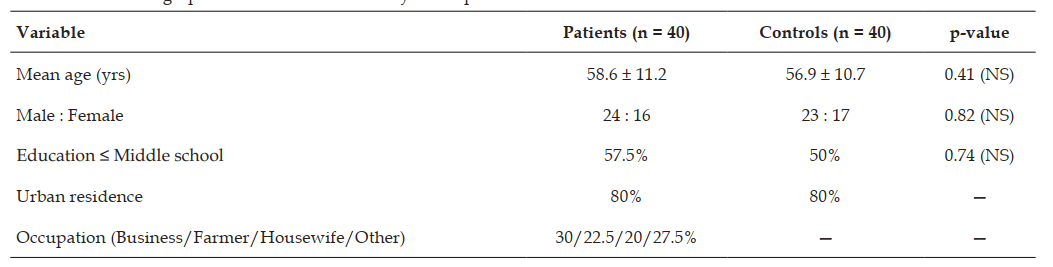
Background: Stroke is a leading cause of adult disability and mortality worldwide. Beyond motor and sensory deficits, cognitive dysfunction after stroke substantially affects independence and rehabilitation. Timely detection of post-stroke cognitive impairment (PSCI) allows early intervention. The present study assessed neurocognitive functions in post-acute stroke patients who underwent endovascular or decompressive surgical intervention and compared them with healthy controls using the Addenbrooke’s Cognitive Examination III (ACE-III). Methods: This hospital-based observational case–control study included 40 consecutive patients (18–80 years) with first-ever acute stroke (< 7 days) admitted to the Neurosciences Department, Santokba Durlabhji Memorial Hospital, Jaipur, and 40 age and sex-matched healthy controls. Cases underwent endovascular thrombectomy, aneurysm coiling, clipping, or decompressive craniectomy. Cognitive performance was evaluated at 3 and 6 months using the Hindi-adapted ACEIII assessing five domains attention/orientation, memory, fluency, language, and visuospatial abilities. Statistical analysis used SPSS v22; p < 0.05 was considered significant. Results: Mean patient age was 58.6 ± 11.2 years; 60%were male. Ischemic stroke comprised 72.5%of cases and haemorrhagic 27.5%. Hypertension (42.5%) and diabetes (27.5%) were the most frequent comorbidities. At 3 months, 72.5%of patients demonstrated cognitive impairment versus 62.5%at 6 months. Total ACE-III scores improved from 60.9 ± 10.9 to 74.5 ± 10.7 (p < 0.001). Memory and language domains were most affected initially. Cognitive outcomes did not differ significantly by stroke subtype.
References
- 1. Feigin VL et al. Global burden of stroke and risk factors, 1990-2019. Lancet Neurol. 2021;20(10):795-820.
- 2. World Health Organization. Definition and diagnosis of stroke. Geneva: WHO; 2010.
- 3. GBD Stroke Collaborators. Global, regional, and national burden of stroke. Lancet Neurol. 2021;20:913-924.
- 4. Pendlebury ST, Rothwell PM. Prevalence, incidence, and factors associated with PSCI. Stroke. 2019;50:161-169.
- 5. Sexton E et al. Cognitive impairment after stroke: systematic review. Age Ageing. 2019;48:134-140.
- 6. Gottesman RF et al. Cognitive impairment after stroke. Stroke. 2016;47:1316-1322.
- 7. Visser MM. Emotional and cognitive consequences of stroke. Neuropsychol Rev. 2002;12:145-158.
- 8. Mijajlovic MD et al. Post-stroke dementia: comprehensive review. BMC Med. 2017;15:11.
- 9. Pendlebury ST et al. Cognitive decline trajectories after stroke. Cerebrovasc Dis. 2018;45:1-13. 10. Pandian JD et al. Stroke epidemiology in India. Int J Stroke. 2022;17(6):650-658.
- 11. Nasreddine ZS et al. The Montreal Cognitive Assessment, MoCA. J Am Geriatr Soc. 2005;53:695-699.
- 12. Hsieh S et al. The Addenbrooke’s Cognitive Examination-III: psychometric validation. Neurology. 2013;81:102-108.
- 13. Tham W et al. Cognitive trajectory after stroke. J Neurol Sci. 2015;357:318-324.
- 14. Chaurasia RN et al. Cognitive impairment following stroke in Indian population. J Neurosci Rural Pract. 2020;11:203-210.
- 15. Renjen PN et al. Cognitive impairment after first-ever ischemic stroke. Ann Indian Acad Neurol. 2015;18:323-326.
- 16. Fiedorová M et al. Addenbrooke’s Cognitive Examination in stroke. J Clin Med. 2019; 8:1612.
- 17. Stern Y. Cognitive reserve and brain maintenance. Lancet Neurol. 2012;11: 1006-1012.
Data Sharing Statement
There are no additional data available. All raw data and code are available upon request.
Funding
This research received no funding.
Author Contributions
All authors contributed significantly to the work and approve its publication.
Ethics Declaration
This article does not involve any human or animal subjects, and therefore does not require ethics approval.
Acknowledgements
We would like to express our gratitude to the patients, their families, and all those who have contributed to this study.
Conflicts of Interest
No conflicts of interest.
About this article

Cite this article
Rinku Kumar Sharma, Raman Kumar Shankar, DP Sharma. Assessment of Neurocognitive Functions in PostAcute Stroke Patients Undergoing Endovascular Intervention or Decompression. Int. J Neuro Neurosurgery. 2025; 17(3): 212-216.
Licence:
Attribution-Non-commercial 4.0 International (CC BY-NC 4.0)This license enables reusers to distribute, remix, adapt, and build upon the material in any medium or format for noncommercial purposes only, and only so long as attribution is given to the creator.
| Received | Accepted | Published |
|---|---|---|
| October 16, 2025 | December 20, 2025 | December 30, 2025 |
DOI: 10.21088/ijnns.0975.0223.17325.2
Keywords
StrokeNeurocognitive ImpairmentAddenbrooke’s Cognitive Examination IiiEndovascular InterventionDecompressive CraniectomyCognitive RehabilitationPost-Stroke Dementia.Search for Similar Articles
Similar Articles
- Intramedullary Capillary Hemangioma of Conus Medullaris: Case Report and Review...
- Atypical Miller Fisher Syndrome
- Therapeutic Potential of Passiflora incarnata in the Management of Neurological...
- Central or Axial Atlantoaxial Dislocation: Redefining Instability at the Craniov...
- Role of Computational Biology in Diagnosing the probable causes of Nerve Damage
Article Level Metrics
Last UpdatedSunday 18 October 2026, 14:45:12 (IST)
2435
Accesses
21
281
00
Citations
NA
NA
NA
Download citation
Article Keywords
Keyword Highlighting
Highlight selected keywords in the article text.
Timeline
| Received | October 16, 2025 |
| Accepted | December 20, 2025 |
| Published | December 30, 2025 |
licence
Attribution-Non-commercial 4.0 International (CC BY-NC 4.0)
This license enables reusers to distribute, remix, adapt, and build upon the material in any medium or format for noncommercial purposes only, and only so long as attribution is given to the creator.