Full Text (PDF)
International Journal of Practical Nursing 13(3):p 75-79, Sept. Dec. 2025. | DOI: 10.21088 ijpn.2347.7083.13325.1
Original Article
Periodic Review of Benchmarks Contributing to Reduction of Healthcare Associated Infections: An Observational Study in a Tertiary Care Hospital
Krishnaveni Malisetti, Anil Kumar Bilolikar, Shiva Priya Eswaran, Rafath Fatima
Author Information
Licence:
Attribution-Non-commercial 4.0 International (CC BY-NC 4.0)This license enables reusers to distribute, remix, adapt, and build upon the material in any medium or format for noncommercial purposes only, and only so long as attribution is given to the creator.
International Journal of Practical Nursing 13(3):p 75-79, Sept. Dec. 2025. | DOI: 10.21088 ijpn.2347.7083.13325.1
How Cite This Article:
Krishnaveni Malisetti, Anil Kumar Bilolikar, Shiva Priya Eswaran et. al, Periodic review of Benchmarks contributing to reduction of Healthcare Associated Infections: An observational study in a Tertiary Care Hospital. Int J Practical Nurs. 2025; 13(3): 75-79.Timeline
Received : December 04, 2025
Accepted : January 07, 2025
Published : December 30, 2025
Abstract
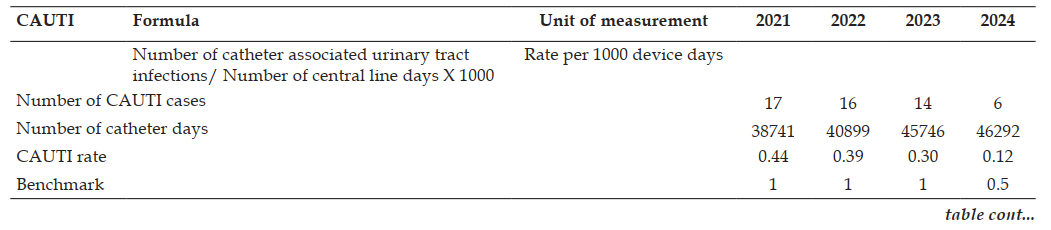
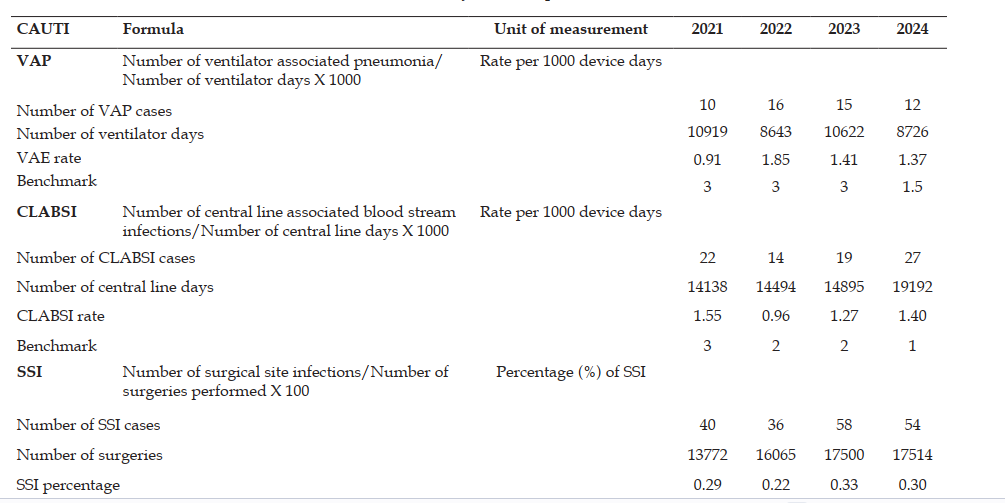
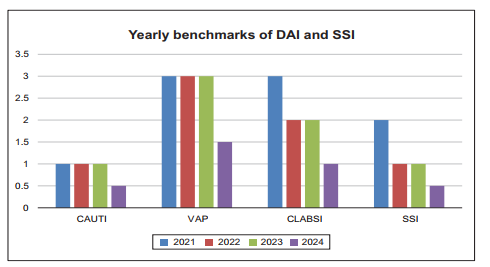
Purpose: The pattern of HAIs (Healthcare Associated Infections) [device associated infections such as Catheter Associated Urinary Tract Infection (CAUTI), Ventilator Associated Event (VAE), Central Line-Associated Bloodstream Infection (CLABSI) & Surgical Site Infection (SSI)] is analysed and their occurrences are compared to review benchmarks for HAIs in a tertiary care hospital for a period of 4 years. Methods: Passive surveillance data is collected by infection control nurses from the microbiology lab following reporting of culture specimens Active surveillance data is collected by the infection control nurses during their daily rounds in wards and ICUs. The data is compiled and analysed by the microbiologist and infection control officer. The data collection forms are prepared and updated as per Centers for Disease Control and Prevention (CDC) and National Healthcare Safety Network (NHSN) guidelines. Results: Over a four year period, the average of CAUTI rate is 0.31, VAE is 1.38, CLABSI is 1.29 & SSI is 1.1%. Following annual analysis of rates of healthcare associated infections, the benchmarks have been revised to 0.5 for CAUTI, 1.5 for VAE, 1 for CLABSI and 0.5% for SSI. Conclusions: Analysing institutional data periodically to establish in-house benchmarks enables scope for improvement in infection control practices, thereby, contributing to patient safety.
References
- 1. Ministry of Health and Family Welfare Government of India. National Guidelines for Infection Prevention and Control in Healthcare Facilities. National Centre for Disease Control, Directorate General of Health Services Ministry of Health and Family Welfare, Government of India, January 2020. Available from: https://cdn.who.int/media/docs/ default-source/searo/india/antimicrobialresistance/ipcguidelines-web-sep2020. pdf?sfvrsn=9e77fcb0_2.
- 2. National Healthcare Safety Network (NHSN) Patient Safety Component Manual. January 2024.
- 3. Centers for Disease Control and Prevention. National Healthcare Safety Network (NHSN). http://www.cdc.gov/nhsn/about.html 4. The International Nosocomial Infection Control Consortium (INICC) web site. http:// www.inicc.org/english/index.php 5. World Health Organization. Report on the Burden of Endemic Health Care-Associated Infection Worldwide. A systematic.
- 6. review of the literature; 2011. http://whqlibdoc. who.int/publications/2011/9789241501507 eng.pdf
- 7. Kay JF. Health care benchmarking. Medical Bulletin 2007;12.
- 8. Ettorchi-Tardy A, Levif M, Michel P. Benchmarking: a method for continuous quality improvement in health. Healthcare Policy 2012;7:e101—19.
- 9. Arias K. Surveillance. The association for professionals in infection control and epidemiology (APIC) text of infection control and epidemiology. 3rd ed. Washington, DC, USA: APIC; 2009.
- 10. Bilolikar AK, Banerjee J, Thomas KM. Device associated and surgical site infections, quality indicators in a tertiary care hospital: A 5 year study. J Med Sci Res. 2021; 9(3):132-146. DOI: http://dx.doi.org/10.17727/JMSR.2021/9-20.
- 11. WHO. Global report on infection prevention and control. Geneva: World Health Organization, 2022. 12. Rosenthal VD, Bat-Erdene I, Gupta D, et al. International Nosocomial Infection Control Consortium (INICC) report, data summary of 45 countries for 2012–2017: device-associated module. Am J Infect Control 2020; 48: 423–32.
- 13. Allegranzi B, Bagheri Nejad S, Combescure C, et al. Burden of endemic health-care-associated infection in developing countries: systematic review and meta-analysis. Lancet 2011; 377: 228–41.
- 14. Singhal T, Shah S, Thakkar P, Naik R. The incidence, aetiology and antimicrobial susceptibility of central line-associated bloodstream infections in intensive care unit patients at a private tertiary care hospital in Mumbai, India. Indian J Med Microbiol 2019; 37: 521–26.
Data Sharing Statement
There are no additional data available. All raw data and code are available upon request.
Funding
This research received no funding.
Author Contributions
All authors contributed significantly to the work and approve its publication.
Ethics Declaration
This article does not involve any human or animal subjects, and therefore does not require ethics approval.
Acknowledgements
We would like to express our gratitude to the patients, their families, and all those who have contributed to this study.
Conflicts of Interest
No conflicts of interest in this work.
About this article

Cite this article
Krishnaveni Malisetti, Anil Kumar Bilolikar, Shiva Priya Eswaran et. al, Periodic review of Benchmarks contributing to reduction of Healthcare Associated Infections: An observational study in a Tertiary Care Hospital. Int J Practical Nurs. 2025; 13(3): 75-79.
Licence:
Attribution-Non-commercial 4.0 International (CC BY-NC 4.0)This license enables reusers to distribute, remix, adapt, and build upon the material in any medium or format for noncommercial purposes only, and only so long as attribution is given to the creator.
| Received | Accepted | Published |
|---|---|---|
| December 04, 2025 | January 07, 2025 | December 30, 2025 |
DOI: 10.21088 ijpn.2347.7083.13325.1
Keywords
Healthcare-associated infections (HAIs)Infection controlBenchmarkingTertiary care hospitalObservational studyInfection preventionQuality improvementSearch for Similar Articles
Similar Articles
- Medical Negligence in India: One Breach, Many Laws
- A Study to assess Level of Stress and Coping Strategies among Bus Driver at Sel...
- Knowledge Regarding Food Taboos of Children Among Mothers of Under-Five Children
- Beyond Retirement: Clinical Perspectives on Optimizing the Aging Phase of Life
- Knowledge and Practice of FAST HUG BID among ICU Nursing Officers: A Cross-Sect...
Article Level Metrics
Last UpdatedSaturday 01 August 2026, 18:09:59 (IST)
751
Accesses
23
88
00
Citations
NA
NA
NA
Download citation
Article Keywords
Keyword Highlighting
Highlight selected keywords in the article text.
Timeline
| Received | December 04, 2025 |
| Accepted | January 07, 2025 |
| Published | December 30, 2025 |
licence
Attribution-Non-commercial 4.0 International (CC BY-NC 4.0)
This license enables reusers to distribute, remix, adapt, and build upon the material in any medium or format for noncommercial purposes only, and only so long as attribution is given to the creator.