Full Text (PDF)
Indian Journal of Ancient Medicine and Yoga 16(2):p 73-79, April–June 2023. | DOI: https://doi.org/10.21088/ijamy.0974.6986.16223.3
Original Article
Performance in the Trail making Test following High Frequency Yoga Breathing and Breath Awareness
Shirley Telles, Kumar Gandharva, Sachin Kumar Sharma
Author Information
Licence:
Attribution-Non-commercial 4.0 International (CC BY-NC 4.0)This license enables reusers to distribute, remix, adapt, and build upon the material in any medium or format for noncommercial purposes only, and only so long as attribution is given to the creator.
Indian Journal of Ancient Medicine and Yoga 16(2):p 73-79, April–June 2023. | DOI: https://doi.org/10.21088/ijamy.0974.6986.16223.3
How Cite This Article:
Gandharva K, Sharma SK, Telles S. Performance in the Trail Making Test following High Frequency Yoga Breathing and Breath Awareness. Indian J Ancient Yoga. 2023;16(2):73-79.Timeline
Received : March 02, 2023
Accepted : March 28, 2023
Published : April 30, 2023
Abstract
Background: A combination of yoga breathing techniques including high frequency yoga breathing practiced over 12 weeks resulted in improved performance in trail making test (TMT). However it is not studied whether a brief session of yoga breathing techniques will cause similar results in TMT performance.
Aims: This study intended to assess the effect of a brief session of high frequency yoga breathing or breath awareness separately on the TMT performance.
Settings and Design: Self as control study.
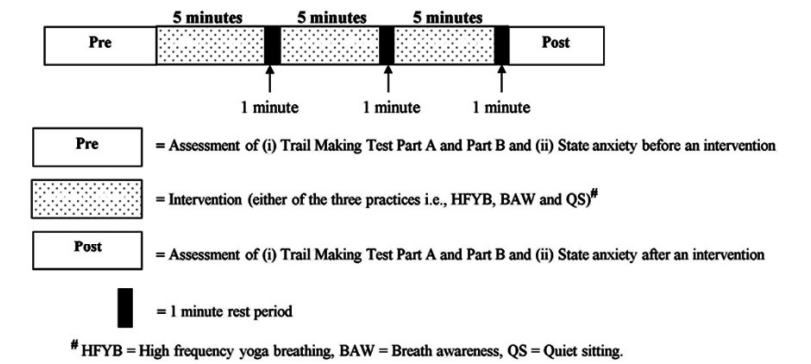
Methods and Material: Fifty three participants (aged between 18 and 46 years; group average 26.0 (SD = 7.3) years; all males were recruited in north India. They were randomly assigned to three sessions on three separate days at the same time of the day. These were HFYB or BAW or Quiet sitting (QS). Both parts, A and B of the TMT, with the STAI-S were determined before and after each session.
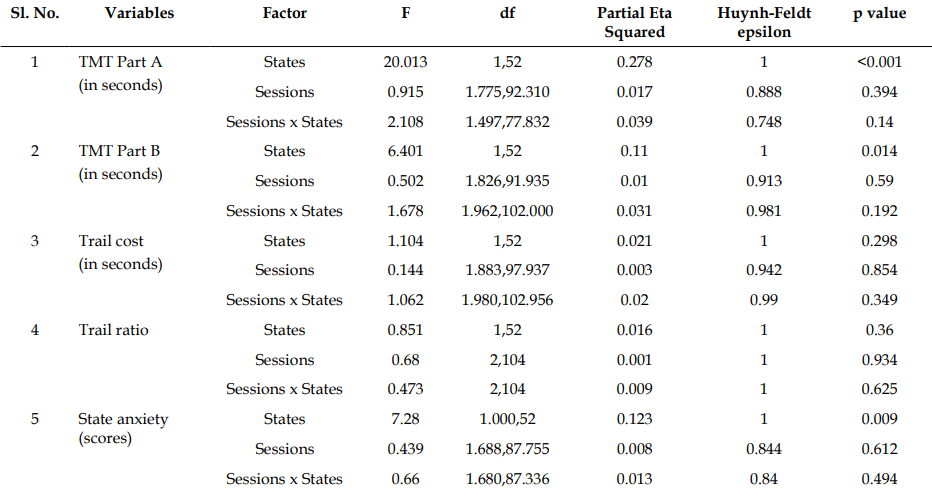
Statistical Analysis used: Analyses were repeated measures ANOVA, with post-hoc multiple comparisons carried out using SPSS Version 18. There were 2 within-subject factors: (i) Sessions (HFYB, BAW and QS) and (ii) States (before and after).
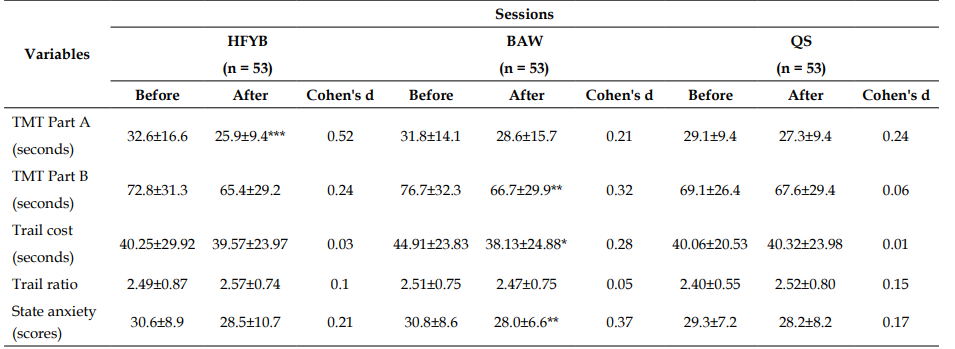
Results: Following the HFYB session TMT-A time reduced (P = 0.001). After BAW TMT-B time reduced (P = 0.01), and the STAI-S scores also decreased (P = 0.01). Both voluntarily regulated yoga breathing techniques, i.e., HFYB and BAW improved the performance in the TMT. HFYB improved psychomotor speed and ability to keep attention sustained while visually scanning the worksheet.
Conclusions: BAW improved flexibility in thinking, working memory and shifting strategies, while reducing state anxiety.
References
- 1. Saoji AA, Raghavendra BR, Manjunath N K. Effects of yogic breath regulation: A narrative review of scientific evidence. J Ayurveda Integr Med. 2019;10:50-58.
- 2. Arbuthnott K, Frank J. Trail making test, part B as a measure of executive control: validation using a set-switching paradigm. J Clin Exp Neuropsychol. 2000;22:518-28.
- 3. Jain R, Tonpay PS. Effect of pranayama on cognitive functions of medical students. Indian J Basic Appl Med Res. 2016;6:471-76.
- 4. Sharma V K, Rajajeyakumar M, Velkumary S, Subramanian SK, Bhavanani AB, et al. Effect of fast and slow pranayama practice on cognitive functions in healthy volunteers. J Clin Diagn Res. 2014;8:10-13.
- 5. Joshi M, Telles S. A nonrandomized non-naive comparative study of the effects of kapalabhati and breath awareness on event-related potentials in trained yoga practitioners. J Altern Complement Med. 2009;15:281-85.
- 6. Telles S, Singh N, Balkrishna A. Finger dexterity and visual discrimination following two yoga breathing practices. Int J Yoga. 2012;5:37-41.
- 7. Telles S, Raghuraj P, Arankalle D, Naveen KV. Immediate effect of high-frequency yoga breathing on attention. Indian J Med Sci. 2008;62:20-22.
- 8. Erdfelder E, Faul F, Buchner A. GPOWER: A general power analysis program. Behav Res Methods Instrum Comput. 1996;28:1-11.
- 9. Sánchez-Cubillo I, Perianez JA, Adrover-Roig D, Rodriguez-Sanchez JM, Rios-Lago M, Tirapu J, et al. Construct validity of the trail making test: role of task-switching, working memory, inhibition/interference control, and visuomotor abilities. J Int Neuropsychol Soc. 2009;15:438-50.
- 10. Spielberger CD, Gorsuch RL, Lushene R. Manual for the State-Trait Anxiety Inventory. Palo Alto, CA: Consulting Psychologists Press; 1970.
- 11. Giovagnoli AR, Del Pesce M, Mascheroni S, Simoncelli M, Laiacona M, Capitani E. Trail making test: normative values from 287 normal adult controls. Ital J Neurol Sci. 1996;17:305-09.
- 12. Gothe NP, Kramer AF, McAuley E. Hatha yoga practice improves attention and processing speed in older adults: results from an 8-week randomized control trial. J Altern Complement Med. 2017;23:35-40.
- 13. Sánchez-Cubillo I, Perianez JA, Adrover-Roig D, Rodriguez-Sanchez JM, Rios-Lago M, Tirapu J et al. Construct validity of the trail making test: role of task-switching, working memory, inhibition/interference control, and visuomotor abilities. J Int Neuropsychol Soc. 2009;15:438-50.
- 14. Telles S, Gupta RK, Gandharva K, Vishwakarma B, Kala N, Balkrishna A. Immediate Effect of a Yoga Breathing Practice on Attention and Anxiety in Pre-Teen Children. Children (Basel, Switzerland). 2019;6:84.
- 15. Nilsoge D, Bagade A, Tumbigeremutt V, Kulkarni P, Rao SB, Arpitha M, et al. Evaluation of attention and verbal memory in yoga practicing pre-adolescents: A cross-sectional study. J Restor Med. 2016;5:3-13.
- 16. Vhavle SP, Rao RM, Manjunath NK. Comparison of yoga versus physical exercise on executive function, attention, and working memory in adolescent schoolchildren: A randomized controlled trial. Int J Yoga. 2019;12:172-73.
- 17. Shetkar RM, Hankey A, Nagendra HR, Pradhan B. Association between cyclic meditation and creative cognition: Optimizing connectivity between the frontal and parietal lobes. Int J Yoga. 2019;12:29-36.
- 18. Zelano C, Jiang H, Zhou G, Arora N, Schuele S, Rosenow J et al. Nasal respiration entrains human limbic oscillations and modulates cognitive function. J Neurosci. 2016;36:12448-67.
- 19. Canar HB, Pizzuto J, Compton RJ. Mindfulness-of-breathing exercise modulates EEG alpha activity during cognitive performance. Psychophysiology. 2016;53:1366-76.
- 20. Brefczynski-Lewis JA, Lutz A, Schaefer HS, Levinson DB, Davidson RJ. Neural correlates of attentional expertise in long-term meditation practitioners. Proc Natl Acad Sci U S A. 2007;104:11483-88.
- 21. Lutz A, Slagter HA, Dunne JD, Davidson RJ. Attention regulation and monitoring in meditation. Trends Cogn Sci. 2008;12:163-169.
- 22. Teper R, Inzlicht M. Meditation, mindfulness and executive control: The importance of emotional acceptance and brain-based performance monitoring. Soc Cogn Affect Neurosci. 2013;8:85-92.
Data Sharing Statement
There are no additional data available. All raw data and code are available upon request.
Funding
This research received no funding.
Author Contributions
Whether all authors contributed significantly to the work and approve its publication.
Ethics Declaration
This article does not involve any human or animal subjects, and therefore does not require ethics approval.
Acknowledgements
We would like to express our gratitude to the patients, their families, and all those who have contributed to this study.
Conflicts of Interest
The authors report no conflicts of interest in this work.
About this article

Cite this article
Gandharva K, Sharma SK, Telles S. Performance in the Trail Making Test following High Frequency Yoga Breathing and Breath Awareness. Indian J Ancient Yoga. 2023;16(2):73-79.
Licence:
Attribution-Non-commercial 4.0 International (CC BY-NC 4.0)This license enables reusers to distribute, remix, adapt, and build upon the material in any medium or format for noncommercial purposes only, and only so long as attribution is given to the creator.
| Received | Accepted | Published |
|---|---|---|
| March 02, 2023 | March 28, 2023 | April 30, 2023 |
DOI: https://doi.org/10.21088/ijamy.0974.6986.16223.3
Keywords
Breath awarenessHigh frequency yoga breathingTrail making test (TMT)Cognitive flexibilityState anxietySearch for Similar Articles
Similar Articles
- Efficacy of Katupila Ghrita in the Management of Itartha dagdha Vrana (Burn Woun...
- Clinical Outcomes of Ayurvedic Management in Acute Influenza Like Illness: A Cas...
- Effect of Ayurvedic Drugs on Scalp Psoriasis (Kitibha Kustha)
- Yogic Elements in the Brahma Mahapurana: A Textual and Comparative Study
- Management of Adenoid Hypertrophy: An Ayurvedic Perspective
Article Level Metrics
Last UpdatedTuesday 15 September 2026, 13:40:46 (IST)
4098
Accesses
10
833
00
Citations
NA
NA
NA
Download citation
Article Keywords
Keyword Highlighting
Highlight selected keywords in the article text.
Timeline
| Received | March 02, 2023 |
| Accepted | March 28, 2023 |
| Published | April 30, 2023 |
licence
Attribution-Non-commercial 4.0 International (CC BY-NC 4.0)
This license enables reusers to distribute, remix, adapt, and build upon the material in any medium or format for noncommercial purposes only, and only so long as attribution is given to the creator.