Full Text (PDF)
Indian Journal of Ancient Medicine and Yoga 18(2):p 57-62, April- June 2025. | DOI: https://doi.org/10.21088/ijamy.2455.8621.10125.1
Original Article
Patients’ Degree of Autonomy in Choosing to be Physically Active Predicts their Response to Yoga Therapy: A Convenience Sampling Survey
Sachin Kumar Sharma, Babita Vishwakarma, Shirley Telles
Author Information
Licence:
Attribution-Non-commercial 4.0 International (CC BY-NC 4.0)This license enables reusers to distribute, remix, adapt, and build upon the material in any medium or format for noncommercial purposes only, and only so long as attribution is given to the creator.
Indian Journal of Ancient Medicine and Yoga 18(2):p 57-62, April- June 2025. | DOI: https://doi.org/10.21088/ijamy.2455.8621.10125.1
How Cite This Article:
Sharma SK, Vishwakarma B, Telles S. Patients' Degree of autonomy in choosing to be Physically active Predicts their response to Yoga Therapy: A Convenience sampling Survey. Indian J Ancient Med Yoga. 2025;18(2):57-62.Timeline
Received : December 27, 2024
Accepted : March 06, 2025
Published : June 18, 2025
Abstract
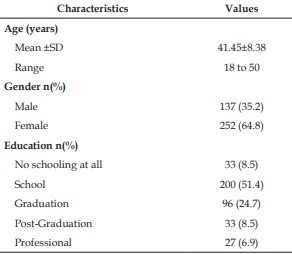
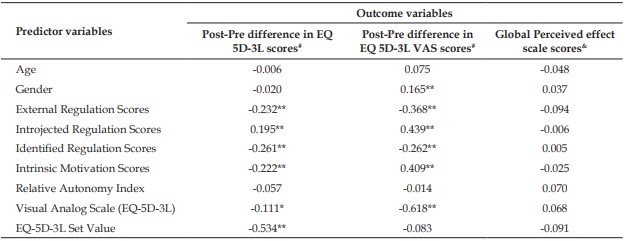
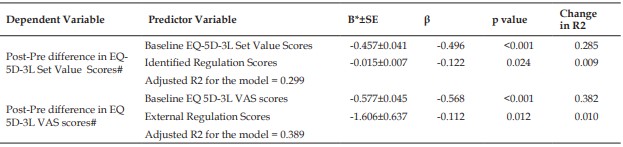
Background: Determining the predictors of patients’ intrinsic or extrinsic motivation for treatment assists in developing effective treatment strategies. The practice of yoga includes physical activity. Therefore, patients’ motivation for physical activity during yoga therapy may be expected to influence their involvement in the yoga program and, hence, their treatment outcome. Objective: With this background, the study aimed to determine the association of motivation for physical activity with treatment outcomes in patients receiving yoga therapy. Materials & Methods: Patients were recruited from a yoga therapy centre (n=389, F:M=252:137, 18-50 years; most often with diseases of the (i) musculoskeletal system or connective tissue (21.3%) or (ii) endocrine, nutritional or metabolic diseases (18.8%) (ICD-11). Assessments included (i) motivation for physical activity at baseline and (ii) treatment outcomes at baseline and after seven days of yoga and allied therapies using (i) the EQ-5D-3L and (ii) global perceived effect (GPE) scale. The intervention included yoga and allied treatments (e.g., hydrotherapy). Multivariable regression analyses (controlled for confounding variables) showed a significant negative association between (i) identified regulation for physical activity and the change in the EQ-5D-3L scores (Beta = -0.496) and (ii) external regulation for physical activity and change in EQ-5D-3L VAS scores (Beta = -0.568). Conclusion: In summary, higher extrinsic motivation for physical activity predicted less improvement after YT. Strategies to enhance the intrinsic motivation for physical activity components of yoga as therapy are suggested, targeting increasing patients’ inherent favorable experience of being physically active structured knowledg equestionnaire. Analysis and Interpretation: The data were analysed and interpreted in light of objective and hypothesis. The descriptive and inferential statistics in term of mean standard deviation, and paired ‘t’test were used for analysis of data.Theme an difference of knowledge of group was 12.73. In group, the calculated paired ‘t’value of level of knowledge is 24.30 and tabulated ‘t’ valueis 2.00. It reveals that the calculated paired ‘t’value is greater than tabulated ‘t’ value at 0.05 level of significance. Conclusion: This research study shows that the post test scores are more than pre-test score. Therefore, it can be concluded that planned teaching programme is effective among primary school teachers. Hence research hypothesis is accepted.
References
- 1. Uimonen M, Repo JP, Gronroos K, Hakkinen A, Walker S. Validity and reliability of the motivation for physical activity (RM4-FM) questionnaire. J Exerc Rehabil 2021;17:103-111.
- 2. EuroQol Group. EuroQol--a new facility for the measurement of health-related quality of life. HPP 1990;16:199-208.
- 3. Aaltonen S, Rottensteiner M, Kaprio J, Kujala UM. Motives for physical activity among active and inactive persons in their mid‐30s. Scand J Med Sci Sports 2014;24: 727-735.
- 4. Ishwar V, Basavaraddi. Yoga history: Yoga: Its Origin, History and Development. India: Government of India; 2024.
- 5. Yang K, James KA. Yoga as a transitional platform to more active lifestyle: a 6-month pilot study in the USA. Health Promot Int 2014;31:423-429.
- 6. Kumari S, Dahiya N, Rain M, Kumar R, Singh G. The ROLE of Yoga Practice in Management of Coronary Artery Disease. IMCR 2022;3.
- 7. Golicki D, Niewada M, Karlińska A, Buczek J, Kobayashi A, Janssen M F et al. Comparing responsiveness of the EQ-5D 5L, EQ-5D-3L and EQ EQ-5D-3L VAS in stroke patients. Qual Life Res 2015;24:1555-1563.
- 8. Kamper SJ, Ostelo RW, Knol DL, Maher CG, de Vet HC, Hancock MJ. Global Perceived Effect scales provided reliable assessments of health transition in people with musculoskeletal disorders, but ratings are strongly influenced by current status. J Clin Epidemiol 2010;63:760-66.
- 9. Guillemin F, Bombardier C, Beaton D. Crosscultural adaptation of health-related quality of life measures: Literature review and proposed guidelines. J Clin Epidemiol 1993; 46:1417– 1432.
- 10. Beaton D, Bombardier C, Guillemin F, Ferraz MB. Recommendations for the Cross-Cultural Adaptation of the DASH and Quick DASH Outcome Measures. Toronto, Canada: Institute for Work and Health;2007.
- 11. Sala R. In Climate Changes in the Holocene: Interaction of Climate, Environment and Humans in North and Central Asia during the Late Glacial and Holocene. United States: Boca Raton Florida;2019.
- 12. Rabin R, Charro F de. EQ-5D: a measure of health status from the EuroQol Group. Ann Med 2001;33:337-43.
- 13. Segar M. No sweat: how the simple science of motivation can bring you a lifetime of.
- 14. fitness. United States: NY: AMACOM;2015.
- 15. Acland D, Levy MR. Naiveté, projection bias, and habit formation in gym attendance. Manag Sci 2015;61:146-160.
- 16. Fishbach A, Choi J. When thinking about goals undermines goal pursuit. Organ Behav Hum Decis Process 2012;118: 99-107.
- 17. Golec de Zavala A, Lantos D, Bowden D. Yoga poses increase subjective energy and state selfesteem in comparison to power poses. Front Psychol 2017;8:752.
- 18. Höchli B, Brügger A, Messner C. How focusing on superordinate goals motivates broad,
- 19. long-term goal pursuit: A theoretical perspective. Front Psychol 2018;9: 1879.
Data Sharing Statement
There are no additional data available.
Funding
This research received no funding.
Author Contributions
All authors contributed significantly to the work and approve its publication.
Ethics Declaration
This article does not involve any human or animal subjects, and therefore does not require ethics approval.
Acknowledgements
Information not provide.
Conflicts of Interest
The authors report no conflicts of interest in this work.
About this article

Cite this article
Sharma SK, Vishwakarma B, Telles S. Patients' Degree of autonomy in choosing to be Physically active Predicts their response to Yoga Therapy: A Convenience sampling Survey. Indian J Ancient Med Yoga. 2025;18(2):57-62.
Licence:
Attribution-Non-commercial 4.0 International (CC BY-NC 4.0)This license enables reusers to distribute, remix, adapt, and build upon the material in any medium or format for noncommercial purposes only, and only so long as attribution is given to the creator.
| Received | Accepted | Published |
|---|---|---|
| December 27, 2024 | March 06, 2025 | June 18, 2025 |
DOI: https://doi.org/10.21088/ijamy.2455.8621.10125.1
Keywords
Motivation for physical activityYoga therapyOutcomes of yoga therapyPatientsRegression analysesSearch for Similar Articles
Similar Articles
- Efficacy of Katupila Ghrita in the Management of Itartha dagdha Vrana (Burn Woun...
- Clinical Outcomes of Ayurvedic Management in Acute Influenza Like Illness: A Cas...
- Effect of Ayurvedic Drugs on Scalp Psoriasis (Kitibha Kustha)
- Yogic Elements in the Brahma Mahapurana: A Textual and Comparative Study
- Management of Adenoid Hypertrophy: An Ayurvedic Perspective
Article Level Metrics
Last UpdatedWednesday 16 September 2026, 15:18:04 (IST)
4112
Accesses
17
834
00
Citations
NA
NA
NA
Download citation
Article Keywords
Keyword Highlighting
Highlight selected keywords in the article text.
Timeline
| Received | December 27, 2024 |
| Accepted | March 06, 2025 |
| Published | June 18, 2025 |
licence
Attribution-Non-commercial 4.0 International (CC BY-NC 4.0)
This license enables reusers to distribute, remix, adapt, and build upon the material in any medium or format for noncommercial purposes only, and only so long as attribution is given to the creator.