Full Text (PDF)
International Journal of Practical Nursing 14(2):p 59-64, May-August 2026. | DOI: https://doi.org/10.21088 ijpn.2347.7083.14226.4
Review Article
Patient Acuity System
Author Information
Licence:
Attribution-Non-commercial 4.0 International (CC BY-NC 4.0)This license enables reusers to distribute, remix, adapt, and build upon the material in any medium or format for noncommercial purposes only, and only so long as attribution is given to the creator.
International Journal of Practical Nursing 14(2):p 59-64, May-August 2026. | DOI: https://doi.org/10.21088 ijpn.2347.7083.14226.4
How Cite This Article:
Ashish Anvikar. Patient Acuity System. Int J Practical Nurs. 2026; 14(2): 59-64Timeline
Received : May 22, 2026
Accepted : June 24, 2026
Published : August 30, 2026
Abstract
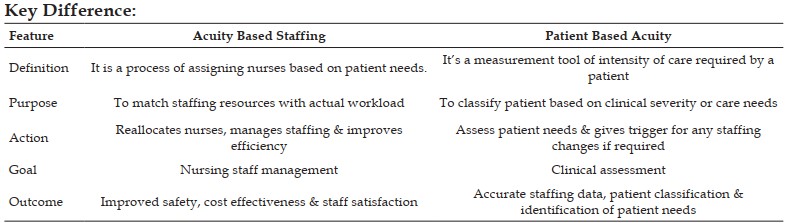
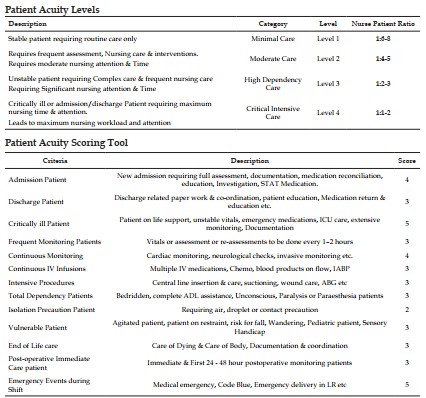
Patient acuity framework uses real-time patient data to make decisions about staffing levels and assignments. It allows for staff adjustments based on changes in patient condition during a shift. Various acuity system used in current health care sector is Patient based Acuity, Acuity based staffing & triaging. Prototype Tools, Nurse Patient Ratio system, Summative Care Tools & case based tool are some of the patient acuity tools used with a goal to assure the right number and type of staff needed to care for any given patient group. Self-designed patient acuity tool should be simple, efficient, indicators to be objective based & well defined operationally & keeping a tract of it by maintaining KPI. Adaptability & organizational support always pose a challenge in effective implementation of the patient acuity system. Benefits of having patient acuity system is that it ensures fair and equitable distribution of workloads when allocating patient assignments to a nurse of that shift, identifies service demand & allows for proper unit nursing staff planning.
References
- 1. https://share.google/bstAVvU5sRtP9rrhQ
- 2. https://share.google/Od1FNN1idjidwUnb2
- 3. Abdellah, F., Levine, E. (1979). Better patient care through nursing research. 2nd Ed., New York, NY: McMillan.
- 4. https://share.google/amQ9OKGMbe 5d7CC4N.
- 5. https://share.google/14tnjOGInOPjWULc7.
- 6. Charles C. Yancey; Maria C. O’Rourke, Emergency Department Triage, NIH.
- 7. De Groot, HA. (1989). Patient classification system evaluation: Essential system elements: part 1. Journal of Nursing Administration, 19(6), 30-35.
- 8. De Groot, HA. (1989). Patient classification system evaluation: System selection and implementation: part 2. Journal of Nursing Administration, 19(7), 24-30.
- 9. Bolton, L, Jones, D., Aydin, C., Donaldson, N., Brown, D., Lowe, M., McFarland, P., Harms, D., (2001). A response to California’s mandated nursing ratios. Journal of Nursing Scholarship, 33(2), 179- 184.
- 10. Acuity, nurse staffing and workforce, missed care and patient outcomes: A cluster-unit-level descriptive comparison J Nurs Manag. 2020 Jun 19;28 (8):2216–2229. doi: 10.1111/jonm.13040.
- 11. American Nurses Association. Principles for Nurse Staffing, 3rd ed. Silver Spring, MD: ANA; 2020.
- 12. American Association of Critical-Care Nurses. AACN Synergy Model for Patient Care. Aliso Viejo, CA: AACN.
- 13. “Validation of a new method for patient classification, the Oulu Patient Classification.” Journal of Advanced Nursing. 2000; 31(2): 481–490.
Data Sharing Statement
There are no additional data available. All raw data and code are available upon request.
Funding
This research received no funding.
Author Contributions
All authors contributed significantly to the work and approve its publication.
Ethics Declaration
This article does not involve any human or animal subjects, and therefore does not require ethics approval.
Acknowledgements
We would like to express our gratitude to the patients, their families, and all those who have contributed to this study.
Conflicts of Interest
No conflicts of interest in this work.
About this article

Cite this article
Ashish Anvikar. Patient Acuity System. Int J Practical Nurs. 2026; 14(2): 59-64
Licence:
Attribution-Non-commercial 4.0 International (CC BY-NC 4.0)This license enables reusers to distribute, remix, adapt, and build upon the material in any medium or format for noncommercial purposes only, and only so long as attribution is given to the creator.
| Received | Accepted | Published |
|---|---|---|
| May 22, 2026 | June 24, 2026 | August 30, 2026 |
DOI: https://doi.org/10.21088 ijpn.2347.7083.14226.4
Keywords
Patient Acuity SystemSelf-Designed ToolSearch for Similar Articles
Similar Articles
- From Artificial Limbs to Intelligent Limbs: Advances in Sensory-Enabled Prosthet...
- Pilot Study to Evaluate the Effectiveness of Novel Designed Nebulizer (NDN) on P...
- Periodic Review of Benchmarks Contributing to Reduction of Healthcare Associated...
- Forensic Nursing
- Women Empowerment in Rural Community
Article Level Metrics
Last UpdatedWednesday 21 October 2026, 07:41:32 (IST)
1795
Accesses
11
211
00
Citations
NA
NA
NA
Download citation
Article Keywords
Keyword Highlighting
Highlight selected keywords in the article text.
Timeline
| Received | May 22, 2026 |
| Accepted | June 24, 2026 |
| Published | August 30, 2026 |
licence
Attribution-Non-commercial 4.0 International (CC BY-NC 4.0)
This license enables reusers to distribute, remix, adapt, and build upon the material in any medium or format for noncommercial purposes only, and only so long as attribution is given to the creator.