Full Text (PDF)
Indian Journal of Research in Anthropology 10(2):p 115-121, July-December 2024. | DOI: http://dx.doi.org/10.21088/ijra.2454.9118.10224.2
Original Article
Nutritional Status among Dhurwa Tribal Pre-school Children Based on Clinical Assessment in Bastar District of Chhattisgarh, India
Swapan Kumar Kolay, Manoj Kumar Srivastava
Author Information
Licence:
Attribution-Non-commercial 4.0 International (CC BY-NC 4.0)This license enables reusers to distribute, remix, adapt, and build upon the material in any medium or format for noncommercial purposes only, and only so long as attribution is given to the creator.
Indian Journal of Research in Anthropology 10(2):p 115-121, July-December 2024. | DOI: http://dx.doi.org/10.21088/ijra.2454.9118.10224.2
How Cite This Article:
Kolay SK, Srivastava MK. Nutritional status among Dhurwa tribal pre-school children based on clinical assessment in Bastar district of Chhattisgarh, India. Ind J Res Anthropol. 2024;10(2):115-121.Timeline
Received : November 01, 2024
Accepted : December 06, 2024
Published : December 29, 2024
Abstract
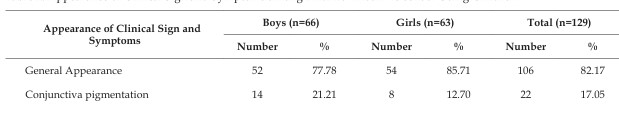
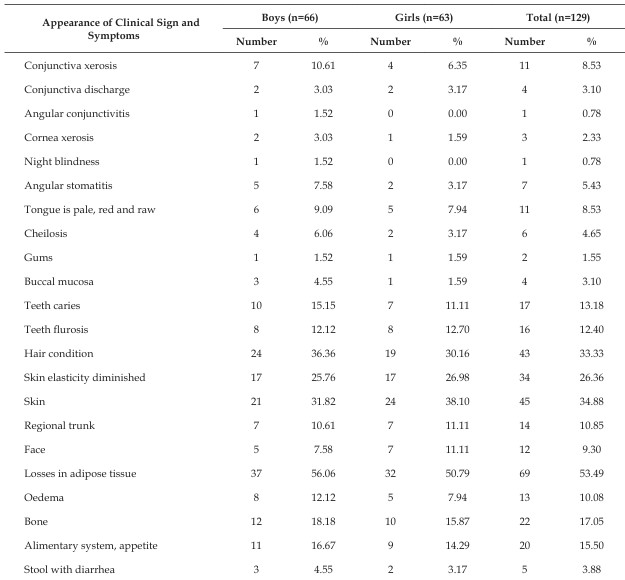
One way to diagnose different diseases or ascertain nutritional status is through a clinical examination. This method is very important feature from the view point of nutritional survey. It is the most practical and simple way to assess a group of children’s nutritional status or diagnose illnesses. By using this technique, one can quickly and simply determine a children’s physical or nutritional status through close observation and focused attention. It makes extensive use of both specific and general physical indicators and symptoms that are known to be connected to nutritional deficiencies, malnutrition, and both communicable and non-communicable diseases. Data from 129 Dhurwa tribal pre-school going children, ages 1 to 5, were gathered during post-covid-19 for this study using a pretested questionnaire in a community based cross sectional study. Data is gathered using a multistage cluster sampling approach using door-to-door surveys. The parent’s consent is required before any of their information is gathered, and the primary health center’s card or birth certificate is used to verify their age. Clinical indicators for various diseases caused by nutritional deficiencies as well as different infectious and non-communicable illnesses were noted. The prevalence of diseases affecting the mouth, eyes, skin, hair, oedema, bones, and overall appearance is higher. Based on the findings, it can be concluded that the children’s health is extremely poor and that they frequently experience the signs and symptoms of a variety of clinical conditions.
References
- 1. Abuya BA, Ciera JM, Kimani-Murage E. (2012) Effect of mother’s education on child’s nutritional status in the slums of Nairobi. BMC Pediatr. 12:80.
- 2. Asfaw M, Wondaferash M, Taha M, Dube L. (2015) Prevalence of undernutrition and associated factors among children aged between six to fifty nine months in Bule Hora district. South Ethiopia. BMC Pub Health. 15:41.
- 3. Bagchi T. (2019) Child Health in Five Tribal Societies of West Bengal. 7th Int. Conf, Dept. of Statistics, RU. 613-620.
- 4. Bhandari S, Ghosh M, Bose K. (2019) Socio Demographic Characteristics and Prevalence of Under Nutrition among Adult Sabars of Bankura District, West Bengal, India. Int J Adv Life Sci Res. 1: 01-10.
- 5. Bhattacharyya K, Sarkar TK. (2010) Nutritional Profile of Children Under 5 Years of Age in a Tribal Community in the District of Maldah, West Bengal. Journal of Primary Care & Community Health. 1(3): 184–186.
- 6. Bisai S, Mallick C. (2011) Prevalence of under nutrition among Kora- Mudi children aged 2-13 years in Paschim Medinipur District, West Bengal, India. World J Pediatr 7(1): 31-36.
- 7. Chakrabarty S, Bharati P. (2010) Nutritional status among the Shabar tribal children living in urban, rural and forest habitats of Orissa, India. Italian J Public health. 7(3):303-10.
- 8. Divakar SV, Balaji PA, Poornima S, Varne SR, Ali SS, Puttaswamy M. (2013) A comparative assessment of nutritional and health status between tribal and nontribal under five children of Mysore, India. Mullar J Med Sci Res. 4(2): 82-85.
- 9. Edward Saltzman, Kris M. Mogensen, (2013) Physical and Clinical Assessment of Nutrition Status, Chapter 3, Editor (s): Ann M. Coulston, Carol J. Boushey, Mario G. Ferruzzi, Nutrition in the Prevention and Treatment of Disease (Third Edition), Academic Press, 65-79.
- 10. Jayashree Dr. (2014) The effect and causes of protein energy malnutrition on pre school children in Bihar. International Journal of Research and Analytical Reviews. 1(2): 880-885.
- 11. Joshi K, Moharana G, Jeeva JC. (2016) Assessment of Nutritional Status of Tribal Children: A Case of Bhumija Munda tribe of Mayurbhanj. Journal of Agroecology and Natural Resource Management. 3(3): 329-332.
- 12. Kirubadevi.R, Sridevi Sivakami.P.L. (2015) Prevalence of nutritional deficiency among selected tribal children. Int J Health Sci Res. 5(5):375-380.
- 13. Mahapatra B, Dey J, Pal S Bose K. (2019) Prevalence of under nutrition among Santal Preschool Children of Two Districts of West Bengal, India. Human Biol Rev. 8(2): 179-96.
- 14. Mitra M, Sahu PK, Chakrabarty S, Bharati S, Bharati P. (2007) Nutritional and Health Status of Gond and Kawar Tribal Pre-school Children of Chhattisgarh, India. J. Hum. Ecol., 21(4): 293-299.
- 15. Mondal M, Nandi DK. (2018) Nutritional status of tribal pre-school children (sp. Reference to Bankura district, West Bengal, India). Journal of Emerging Technologies and Innovative Research. 5(2): 879-882.
- 16. Narayanappa D, Rajani HS, Jagadish Kumar K, Manjunath. VG. (2015) Nutritional and health status of jenukuruba tribal children in Mysore district. Pediatr Rev: Int J Pediatr Res 2(4):113-119.
- 17. Pelletier DL, Frongillo EA, Schroeder DG, Habicht JP. (1994) A methodology for estimating the contribution of malnutrition to child mortality in developing countries. J Nutr. 124 (suppl 10):2106S–22S.
- 18. Primary census abstract data highlights, census of India (2011) web site of the registrar general, India.
- 19. Rao DH, Rao KM, Radhaiah G, Rao NP. (1994) Nutritional status of tribal preschool children in three ecological zones of Madhya Pradesh. Indian Pediatr. 31(6):635-640.
- 20. Schroeder DG, Brown KH. (1994) Nutritional status as a predictor of child survival: summarizing the association and quantifying its global impact. Bull WHO. 72:569–79.
- 21. Sharma B, Mitra M, Chakrabarty S, Bharati P. (2006) Nutritional Status of Preschool Children of Raj Gond – a Tribal Population in Madhya Pradesh, India. Mal J Nutr. 12(2): 147-155.
- 22. Sinha R, Sharma B. (2013) Impact of Nutritional Intervention on the Selected Tribes in Jharkhand. Indian Res J Ext Edu. 13(1): 123-25.
- 23. Somawar BNR and Phuljhale S. (2015) A Study on Growth Pattern in Tribal Childrens (0-3.5years) of Dharamjaigarh Block of District Raigarh (C.G.) India. Indian journal of applied research. 5(10): 23-28.
- 24. World Health Organization (1973) Family Planning in Health Organization Practices (Tech. Rep. Ser. 476) World Health Organization, Geneva.
Data Sharing Statement
There are no additional data available.
Funding
This research received no funding.
Author Contributions
All authors contributed significantly to the work and approve its publication.
Ethics Declaration
This article does not involve any human or animal subjects, and therefore does not require ethics approval
Acknowledgements
Information Not Provided
Conflicts of Interest
No conflicts of interest in this work.
About this article

Cite this article
Kolay SK, Srivastava MK. Nutritional status among Dhurwa tribal pre-school children based on clinical assessment in Bastar district of Chhattisgarh, India. Ind J Res Anthropol. 2024;10(2):115-121.
Licence:
Attribution-Non-commercial 4.0 International (CC BY-NC 4.0)This license enables reusers to distribute, remix, adapt, and build upon the material in any medium or format for noncommercial purposes only, and only so long as attribution is given to the creator.
| Received | Accepted | Published |
|---|---|---|
| November 01, 2024 | December 06, 2024 | December 29, 2024 |
DOI: http://dx.doi.org/10.21088/ijra.2454.9118.10224.2
Keywords
Clinical examinationNutritional statusNutrient deficiencyMulti stage cluster samplingClinical condition.Multi stage cluster samplingNutritional statusNutrient deficiencyClinical condition.Search for Similar Articles
Similar Articles
- Indigenous Knowledge System in Formal Education
- Contemporary Issues and Challenges in Women’s Weavers in the Varanasi Silk Sare...
- Understanding through Traversing the Corridors of History: Richness of Indian He...
- Challenges and Opportunities in Digital Preservation of Intangible Culture Herit...
- Assessment of Nutritional Indicators: A Comparative Study among Pre-School Child...
Article Level Metrics
Last UpdatedWednesday 08 July 2026, 14:27:45 (IST)
807
Accesses
1
223
00
Citations
NA
NA
NA
Download citation
Article Keywords
Keyword Highlighting
Highlight selected keywords in the article text.
Timeline
| Received | November 01, 2024 |
| Accepted | December 06, 2024 |
| Published | December 29, 2024 |
licence
Attribution-Non-commercial 4.0 International (CC BY-NC 4.0)
This license enables reusers to distribute, remix, adapt, and build upon the material in any medium or format for noncommercial purposes only, and only so long as attribution is given to the creator.