Full Text (PDF)
Indian Journal of Ancient Medicine and Yoga 17(3):p 125-135, July - Sept. 2024. | DOI: https://doi.org/10.21088/ijamy.0974.6986.17324.2
Review Article
Modulation of Genetics and Epigenetics Factors in Male Infertility through Yoga-Based Lifestyle Intervention
Piyush Sharma, Nitin Kumar, Deepak Kothari
Author Information
Licence:
Attribution-Non-commercial 4.0 International (CC BY-NC 4.0)This license enables reusers to distribute, remix, adapt, and build upon the material in any medium or format for noncommercial purposes only, and only so long as attribution is given to the creator.
Indian Journal of Ancient Medicine and Yoga 17(3):p 125-135, July - Sept. 2024. | DOI: https://doi.org/10.21088/ijamy.0974.6986.17324.2
How Cite This Article:
Sharma P, Kumar N, Kothari D. Modulation of Genetics and Epigenetics Factors in Male Infertility through Yoga-Based Lifestyle Intervention. Indian J Ancient Med Yoga. 2024;17(3):125-135.Timeline
Received : March 27, 2024
Accepted : August 02, 2024
Published : September 08, 2024
Abstract
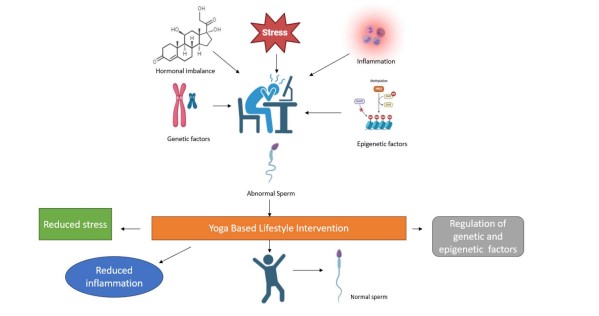
Male infertility, a complex condition affecting a significant proportion of couples worldwide, often involves genetic factors such as Y chromosome microdeletion, mutations in Azoospermia factor (AZF) genes, SRY gene, and Androgen receptor (AR) gene. These genetic abnormalities can lead to impaired spermatogenesis and resultant azoospermia or oligospermia. Understanding these genetic factors is crucial for diagnosis and management of male infertility. Yoga-based alternative therapies have gained attention for their potential in improving overall health and well-being, including reproductive health. Studies have suggested that yoga practices, encompassing physical postures (asanas), breathing techniques (pranayama), and meditation, can reduce stress, enhance hormonal balance, improve blood circulation, and modulate immune function. These benefits may contribute to ameliorating underlying causes of male infertility associated with genetic mutations. This review explores the role of Y chromosome microdeletion, AZF gene mutation, SRY gene mutation, and AR gene mutation in male infertility and reviews the potential of yoga-based alternative therapies in mitigating these genetic factors. Further research and clinical trials are warranted to validate the efficacy of yoga as a complementary approach to conventional treatments for male infertility.
References
- 1. Agarwal, A., and Allamaneni, S. (2004). The effect of sperm DNA damage on assisted reproduction outcomes. Minerva Ginecol 56(3), 235-245.
- 2. Ambulkar, P.S., Sigh, R., Reddy, M., Varma, P.S., Gupta, D.O., Shende, M.R., et al. (2014). Genetic risk of azoospermia factor (AZF) microdeletions in idiopathic cases of azoospermia and oligozoospermia in central Indian population. Journal of clinical and diagnostic research: JCDR 8(3), 88.
- 3. Bisht, S., Banu, S., Srivastava, S., Pathak, R.U., Kumar, R., Dada, R., et al. (2020). Sperm methylome alterations following yoga-based lifestyle intervention in patients of primary male infertility: A pilot study. Andrologia 52(4), e13551. doi: 10.1111/and.13551.
- 4. Bisht, S., and Dada, R. (2019). Yoga: Impact on sperm genome and epigenome - clinical consequences. Ann Neurosci 26(2), 49-51. doi: 10.5214/ans.0972.7531.260202.
- 5. Bonduelle, M., Camus, M., De Vos, A., Staessen, C., Tournaye, H., Van Assche, E., et al. (1999). Seven years of intracytoplasmic sperm injection and follow-up of 1987 subsequent children. Human Reproduction 14(suppl_1), 243-264.
- 6. Bondurand, N., and Southard-Smith, E.M. (2016). Mouse models of Hirschsprung disease and other developmental disorders of the enteric nervous system: old and new players. Developmental biology 417(2), 139-157.
- 7. Bor, P., Hindkjaer, J., Ingerslev, H.J., and Kølvraa, S. (2001). Multiplex PCR for screening of microdeletions on the Y chromosome. J Assist Reprod Genet 18(5), 291-298. doi: 10.1023/a:1016618418319.
- 8. Cerván-Martín, M., Castilla, J.A., PalominoMorales, R.J., and Carmona, F.D. (2020). Genetic landscape of nonobstructive azoospermia and new perspectives for the clinic. Journal of clinical medicine 9(2), 300.
- 9. Choi, D.K., Gong, I.H., Hwang, J.H., Oh, J.J., and Hong, J.Y. (2013). Detection of Y Chromosome Microdeletion is Valuable in the Treatment of Patients With Nonobstructive Azoospermia and Oligoasthenoteratozoospermia: Sperm Retrieval Rate and Birth Rate. Korean J Urol 54(2), 111-116. doi: 10.4111/kju.2013.54.2.111.
- 10. Cocuzza, M., Alvarenga, C., and Pagani, R. (2013). The epidemiology and etiology of azoospermia. Clinics (Sao Paulo) 68 Suppl 1(Suppl 1), 15-26. doi: 10.6061/ clinics/2013(sup01)03.
- 11. Colaco, S., and Modi, D. (2018). Genetics of the human Y chromosome and its association with male infertility. Reprod Biol Endocrinol 16(1), 14. doi: 10.1186/s12958-018-0330-5.
- 12. Cram, D.S., Ma, K., Bhasin, S., Ariasc, J., Pandjaitanc, M., Chu, B., et al. (2000). Y chromosome analysis of infertile men and their sons conceived through intracytoplasmic sperm injection: vertical transmission of deletions and rarity of de novo deletions. Fertility and Sterility 74(5), 909-915.
- 13. Dada, R., Gupta, N., and Kucheria, K. (2003). Semen cryoconservation in men with AZFc microdeletion. Clinical genetics 64(1), 74-75.
- 14. Dada, R., Kumar, R., Shamsi, M.B., Kumar, R., Kucheria, K., Sharma, R.K., et al. (2007). Higher frequency of Yq microdeletions in sperm DNA as compared to DNA isolated from blood. Asian J Androl 9(5), 720-722. doi: 10.1111/j.1745- 7262.2007.00274.x.
- 15. Dai, R., Sun, L., Yang, X., Li, L., Zhu, H., and Liu, R. (2012). Expansion and de novo occurrence of Y chromosome microdeletions occurring via natural vertical transmission in northeastern China. Journal of International Medical Research 40(3), 1182-1191.
- 16. Dhawan, V., Kumar, M., Deka, D., Malhotra, N., Dadhwal, V., Singh, N., et al. (2018). Meditation & yoga: Impact on oxidative DNA damage & dysregulated sperm transcripts in male partners of couples with recurrent pregnancy loss. Indian J Med Res 148(Suppl), S134-s139. doi: 10.4103/ijmr.IJMR_1988_17.
- 17. Eddy, E.M. (2002). Male germ cell gene expression. Recent Prog Horm Res 57, 103-128. doi: 10.1210/rp.57.1.103.
- 18. Edwards, R., and Bishop, C.E. (1997). On the origin and frequency of Y chromosome deletions responsible for severe male infertility. Molecular human reproduction 3(7), 549-554.
- 19. Evenson, D.P., Larson, K.L., and Jost, L.K. (2002). Sperm chromatin structure assay: its clinical use for detecting sperm DNA fragmentation in male infertility and comparisons with other techniques. Journal of andrology 23(1), 25-43.
- 20. Girardi, S.K., Mielnik, A., and Schlegel, P.N. (1997). Submicroscopic deletions in the Y chromosome of infertile men. Hum Reprod 12(8), 1635-1641. doi: 10.1093/ humrep/12.8.1635.
- 21. Gottlieb, B., and Trifiro, M.A. (2017). Androgen insensitivity syndrome.
- 22. Hagen, I., and Hagen, Ø. (2024). The impact of yoga on occupational stress and wellbeing: exploring practitioners’ experiences. Front Public Health 12, 1352197. doi: 10.3389/ fpubh.2024.1352197.
- 23. Handelsman, D.J. (2020). Androgen physiology, pharmacology, use and misuse. Endotext [Internet].
- 24. Henegariu, O., Hirschmann, P., Kilian, K., Kirsch, S., Lengauer, C., Maiwald, R., et al. (1994). Rapid screening of the Y chromosome in idiopathic sterile men, diagnostic for deletions in AZF, a genetic Y factor expressed during spermatogenesis. Andrologia 26(2), 97-106. doi: 10.1111/j.1439-0272.1994.tb00765.x.
- 25. Kashimada, K., and Koopman, P. (2010). Sry: the master switch in mammalian sex determination. Development 137(23), 3921- 3930.
- 26. Kent-First, M., Muallem, A., Shultz, J., Pryor, J., Roberts, K., Nolten, W., et al. (1999). Defining regions of the Y chromosome responsible for male infertility and identification of a fourth AZF region (AZFd) by Y chromosome microdeletion detection. Molecular Reproduction and Development: Incorporating Gamete Research 53(1), 27-41.
- 27. Kumar, N., and Singh, A.K. (2015). Trends of male factor infertility, an important cause of infertility: A review of literature. J Hum Reprod Sci 8(4), 191-196. doi: 10.4103/0974- 1208.170370.
- 28. Liu, X.-H., Yan, L.-Y., Lu, C.-L., Li, R., Zhu, X.- H., Jin, H.-Y., et al. (2014). ART do not increase the risk of Y chromosome microdeletion in 19 candidate genes at AZF regions. Reproduction, Fertility and Development 26(6), 778-786.
- 29. Ma, K., Inglis, J.D., Sharkey, A., Bickmore, W.A., Hill, R.E., Prosser, E.J., et al. (1993). A Y chromosome gene family with RNAbinding protein homology: candidates for the azoospermia factor AZF controlling human spermatogenesis. Cell 75(7), 1287-1295. doi: 10.1016/0092-8674(93)90616-x.
- 30. Marshall Graves, J.A. (2015). Weird mammals provide insights into the evolution of mammalian sex chromosomes and dosage compensation. Journal of genetics 94(4), 567- 574.
- 31. Mitchell, M.J., Metzler-Guillemain, C., Toure, A., Coutton, C., Arnoult, C., and Ray, P.F. (2017). Single gene defects leading to sperm quantitative anomalies. Clin Genet 91(2), 208- 216. doi: 10.1111/cge.12900.
- 32. Mittwoch, U. (1988). The race to be male. New Scientist 120(1635), 38-42.
- 33. Nailwal, M., and Chauhan, J.B. (2017). Azoospermia factor C subregion of the Y chromosome. Journal of human reproductive sciences 10(4), 256.
- 34. Organization, W.H. (2010). World health statistics 2010. World Health Organization.
- 35. Pandey, A., Tiwari, M., Godatwar, P., and Sevatkar, B. (2012a). Epidemiological Study of Klaibya in Hypertensive Patients. International Journal of Research in Ayurveda & Pharmacy 3(5).
- 36. Pandey, A., Tiwari, M., Godatwar, P., and Sevatkar, B. (2012b). OA01. 10. Clinical study of klaibya (male sexual dysfunctions) with special reference to hypertension. Ancient Science of Life 32(Suppl 1), S10.
- 37. Qureshi, S.J., Ross, A.R., Ma, K., Cooke, H.J., Intyre, M.A., Chandley, A.C., et al. (1996). Polymerase chain reaction screening for Y chromosome microdeletions: a first step towards the diagnosis of geneticallydetermined spermatogenic failure in men. Mol Hum Reprod 2(10), 775-779. doi: 10.1093/ molehr/2.10.775.
- 38. Sakthivel, P.J., and Swaminathan, M. (2008). Y chromosome microdeletions in sperm DNA of infertile patients from Tamil Nadu, south India. Indian J Urol 24(4), 480-485. doi: 10.4103/0970- 1591.44252.
- 39. Sen, S., Pasi, A.R., Dada, R., Shamsi, M.B., and Modi, D. (2013). Y chromosome microdeletions in infertile men: prevalence, phenotypes and screening markers for the Indian population. J Assist Reprod Genet 30(3), 413-422. doi: 10.1007/s10815-013-9933-0.
- 40. Sengupta, P., Chaudhuri, P., and Bhattacharya, K. (2013). Male reproductive health and yoga. Int J Yoga 6(2), 87-95. doi: 10.4103/0973- 6131.113391.
- 41. Shamsi, M.B., Kumar, K., and Dada, R. (2011). Genetic and epigenetic factors: Role in male infertility. Indian J Urol 27(1), 110-120. doi: 10.4103/0970-1591.78436.
- 42. Sharma, P., Chand, S., and Ratn, A. (2023). A Systematic Review Report on Impact of Yoga Practices on Immune Response with Special Reference to SARS-COV-2 Pandemic. Indian Journal of Ancient Medicine and Yoga 16(2).
- 43. Sharma, P., Yadav, R.K., Khadgawat, R., and Dada, R. (2022a). A 12-Week Yoga-Based Lifestyle Intervention Might Positively Modify Cellular Aging in Indian Obese Individuals: A Randomized-Controlled Trial. J Integr Complement Med 28(2), 168-178. doi: 10.1089/ jicm.2021.0215.
- 44. Sharma, P., Yadav, R.K., Khadgawat, R., and Dada, R. (2022b). Transcriptional modulation of inflammation, and aging in Indian obese adults following a 12-week yoga-based lifestyle intervention: A randomized controlled trial. Front Med (Lausanne) 9, 898293. doi: 10.3389/ fmed.2022.898293.
- 45. Suganthi, R., Vijesh, V.V., Vandana, N., and Benazir, J.F.A. (2014). Y choromosomal microdeletion screening in the workup of male infertility and its current status in India. International journal of fertility & sterility 7(4), 253.
- 46. Tan, M., Li, J., Xu, H.E., Melcher, K., and Yong, E.-l. (2015). Androgen receptor: structure, role in prostate cancer and drug discovery. Acta Pharmacologica Sinica 36(1), 3-23.
- 47. Veyrunes, F., Waters, P.D., Miethke, P., Rens, W., McMillan, D., Alsop, A.E., et al. (2008). Birdlike sex chromosomes of platypus imply recent origin of mammal sex chromosomes. Genome research 18(6), 965-973.
- 48. Vog, P., Edelmann, A., Kirsch, S., Henegariu, O., Hirschmann, P., Kiesewetter, F., et al. (1996). Human Y chromosome azoospermia factors (AZF) mapped to different subregions in Yq11. Human molecular genetics 5(7), 933-943.
- 49. Wang, R.-S., Yeh, S., Tzeng, C.-R., and Chang, C. (2009). Androgen receptor roles in spermatogenesis and fertility: lessons from testicular cell-specific androgen receptor knockout mice. Endocrine reviews 30(2), 119- 132.
- 50. Yadav, R.K., Magan, D., Mehta, M., Mehta, N., and Mahapatra, S.C. (2012). A shortterm, comprehensive, yoga-based lifestyle intervention is efficacious in reducing anxiety, improving subjective well-being and personality. Int J Yoga 5(2), 134-139. doi: 10.4103/0973-6131.98235.
- 51. Yoshida, A., Miura, K., and Shirai, M. (1997). Cytogenetic survey of 1,007 infertile males. Urol Int 58(3), 166-176. doi: 10.1159/000282975.
- 52. Yu, X.W., Wei, Z.T., Jiang, Y.T., and Zhang, S.L. (2015). Y chromosome azoospermia factor region microdeletions and transmission characteristics in azoospermic and severe oligozoospermic patients. Int J Clin Exp Med 8(9), 14634-14646.
Data Sharing Statement
There are no additional data available.
Funding
No fund received from any funding agency.
Author Contributions
All authors contributed significantly to the work and approve its publication.
Ethics Declaration
This article does not involve any human or animal subjects, and therefore does not require ethics approval.
Acknowledgements
The authors are grateful to the Head, P.G. Department of Zoology, Sanatan Dharm (P.G.) College, Muzaffarnagar-251001, for facilitating throughout the writing work. The cooperation of Professor Sudhir Kumar Pundir, Principal, Sanatan Dharm (P.G.) College, Muzaffarnagar-251001 is duly acknowledged.
Conflicts of Interest
The authors report no conflicts of interest in this work.
About this article

Cite this article
Sharma P, Kumar N, Kothari D. Modulation of Genetics and Epigenetics Factors in Male Infertility through Yoga-Based Lifestyle Intervention. Indian J Ancient Med Yoga. 2024;17(3):125-135.
Licence:
Attribution-Non-commercial 4.0 International (CC BY-NC 4.0)This license enables reusers to distribute, remix, adapt, and build upon the material in any medium or format for noncommercial purposes only, and only so long as attribution is given to the creator.
| Received | Accepted | Published |
|---|---|---|
| March 27, 2024 | August 02, 2024 | September 08, 2024 |
DOI: https://doi.org/10.21088/ijamy.0974.6986.17324.2
Keywords
Azoospermia factorAZF mutationcytogeneticMale infertilityY chromosome microdeletionSRY gene mutationYogaSearch for Similar Articles
Similar Articles
- Efficacy of Katupila Ghrita in the Management of Itartha dagdha Vrana (Burn Woun...
- Clinical Outcomes of Ayurvedic Management in Acute Influenza Like Illness: A Cas...
- Effect of Ayurvedic Drugs on Scalp Psoriasis (Kitibha Kustha)
- Yogic Elements in the Brahma Mahapurana: A Textual and Comparative Study
- Management of Adenoid Hypertrophy: An Ayurvedic Perspective
Article Level Metrics
Last UpdatedTuesday 15 September 2026, 15:27:13 (IST)
4098
Accesses
17
833
00
Citations
NA
NA
NA
Download citation
Article Keywords
Keyword Highlighting
Highlight selected keywords in the article text.
Timeline
| Received | March 27, 2024 |
| Accepted | August 02, 2024 |
| Published | September 08, 2024 |
licence
Attribution-Non-commercial 4.0 International (CC BY-NC 4.0)
This license enables reusers to distribute, remix, adapt, and build upon the material in any medium or format for noncommercial purposes only, and only so long as attribution is given to the creator.