Full Text (PDF)
Indian Journal of Emergency Medicine 11(3):p 159-162, July -Sept 2025. | DOI: https://doi.org/10.21088/ijem.2395.311X.11325.3
Case Report
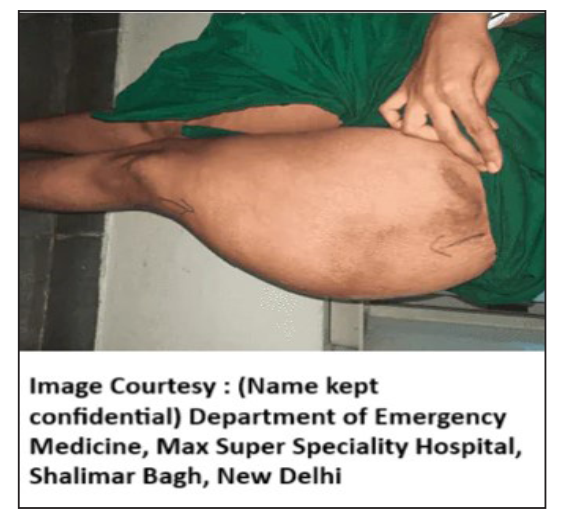
Mis-diagnosis of Morel-Lavallee-Lesion Causing Haemorrhagic Shock
Hemant Rathi, Gaurav Chauhan, Kishalay Datta, Anita Rawat
Author Information
Licence:
Attribution-Non-commercial 4.0 International (CC BY-NC 4.0)This license enables reusers to distribute, remix, adapt, and build upon the material in any medium or format for noncommercial purposes only, and only so long as attribution is given to the creator.
Indian Journal of Emergency Medicine 11(3):p 159-162, July -Sept 2025. | DOI: https://doi.org/10.21088/ijem.2395.311X.11325.3
How Cite This Article:
1. Chauhan G, Rathi H, Datta K, et al. Mis-diagnosis of Morel-Lavallee-Lesion Causing Haemorrhagic Shock. Ind J Emerg Med. 2025;11(3):159-162.Timeline
Received : April 24, 2025
Accepted : June 18, 2025
Published : September 30, 2025
Abstract
Haemorrhagic shock, resulting from rapid and significant blood loss, poses a serious threat in trauma care due to its impact on tissue oxygenation and organ function. Immediate identification of bleeding sources is crucial, yet internal injuries may remain undetected. One such underrecognized condition is the Morel-Lavallée lesion (MLL) a closed soft tissue injury typically caused by highimpact trauma. It occurs when the skin and subcutaneous layers are forcibly separated from the underlying fascia, creating a space that may fill with blood and bodily fluids. Although uncommon, MLL can serve as a concealed site of haemorrhage, contributing to shock if not promptly addressed. We present the case of a 24-year-old female who developed hypovolemic shock after sustaining injuries to physical assault, later diagnosed with MLL. This case highlights the importance of thorough imaging in patients to uncover hidden sources of bleeding and emphasizes the need for early recognition and appropriate treatment of MLL to improve outcomes.
References
- 1. Morel-Lavallée M. Decollements traumatiques de la peau et des couches sous jacentes French. Arch Gen Med. 1863; 1: 172-200.
- 2. Hak D.J., Olson S.A., Matta J.M. Diagnosis and management of closed internal degloving injuries associated with pelvic and acetabular fractures: The Morel-Lavallée lesion. J Trauma. 1997; 42(6): 1046-51.
- 3. Zairi F., Wang Z., Shedid D., et al. Lumbar Morel-Lavallée lesion: case report and review of the literature. Orthop Traumatol Surg Res. 2016; 102(4): 525-7.
- 4. Anakwenze O.A., Trivedi V., Goodman A.M., et al. Concealed degloving injury (the MorelLavallée lesion) in childhood sports: A case report. J Bone Joint Surg Am. 2011; 93(24): e148.
- 5. Yumoto T., Sato K., Ugawa T., et al. An unusual case of a patient who presented with haemorrhagic shock following massive subcutaneous haematomas of the lower back due to blunt trauma. BMJ Case Rep. 2015; 2015.
- 6. Mao R.D., Tan E.P., Goh H.K. An unusual cause of haemorrhagic shock from a subcutaneous haematoma: A Morel-Lavallée lesion. Singapore Med J. 2015; 56(4): e62-4.
- 7. Hudson D.A., Knottenbelt J.D., Krige J.E. Closed degloving injuries: results following conservative surgery. Plast Reconstr Surg. 1992; 89(5): 853-5.
- 8. Van Vugt J.L.A., Beks SBJC, Borghans RAP, et al. The Morel-Lavallée-lesion: delayed symptoms after trauma Dutch. Ned Tijdschr Geneeskd. 2013; 157(23): A5914.
- 9. Letournel E., Judet R. Fractures of the Acetabulum. 2nd ed. Berlin: Springer; 1993.
- 10. Singh R., Rymer B., Youssef B., et al. The MorelLavallée lesion and its management: A review of the literature. J Orthop. 2018; 15(4): 917-921.
- 11. Demirel M., Dereboy F., Ozturk A., et al. MorelLavallee lesion. Results of surgical drainage with the use of synthetic glue. Saudi Med J. 2007; 28(1): 65-7.
Data Sharing Statement
There are no additional data available. All raw data and code are available upon request.
Funding
This research received no funding.
Author Contributions
All authors contributed significantly to the work and approve its publication.
Ethics Declaration
This article does not involve any human or animal subjects, and therefore does not require ethics approval.
Acknowledgements
We would like to express our gratitude to the patients, their families, and all those who have contributed to this study.
Conflicts of Interest
No conflicts of interest.
About this article

Cite this article
1. Chauhan G, Rathi H, Datta K, et al. Mis-diagnosis of Morel-Lavallee-Lesion Causing Haemorrhagic Shock. Ind J Emerg Med. 2025;11(3):159-162.
Licence:
Attribution-Non-commercial 4.0 International (CC BY-NC 4.0)This license enables reusers to distribute, remix, adapt, and build upon the material in any medium or format for noncommercial purposes only, and only so long as attribution is given to the creator.
| Received | Accepted | Published |
|---|---|---|
| April 24, 2025 | June 18, 2025 | September 30, 2025 |
DOI: https://doi.org/10.21088/ijem.2395.311X.11325.3
Keywords
Haemorrhagic shockMorel-Lavalle lesion (MLL)Search for Similar Articles
Similar Articles
- Covid 19 Vaccine: Associated Henoch Schonlein Purpura in Young Adult Female
- A Rare Case of Intolerance to Medically Approved Dose of Sildenafil Citrate in a...
- Acute Mesenteric Ischemia: An Unusual Cause of Hematemesis in a 48 Year Old Man
- Brachial Artery Pseudoaneurysm Related Causally to Iatrogenic Coagulopathy in a...
- Combination Therapy for Acute Management of Yellow Oleander Poisoning: A Case Re...
Article Level Metrics
Last UpdatedSunday 06 September 2026, 20:50:40 (IST)
4083
Accesses
35
922
00
Citations
NA
NA
NA
Download citation
Article Keywords
Keyword Highlighting
Highlight selected keywords in the article text.
Timeline
| Received | April 24, 2025 |
| Accepted | June 18, 2025 |
| Published | September 30, 2025 |
licence
Attribution-Non-commercial 4.0 International (CC BY-NC 4.0)
This license enables reusers to distribute, remix, adapt, and build upon the material in any medium or format for noncommercial purposes only, and only so long as attribution is given to the creator.