Full Text (PDF)
New Indian Journal of Surgery 13(1):p 37-41, January_March 2022. | DOI: https://doi.org/10.21088/nijs.0976.4747.13122.6
Case Report
Long Standing Intercostal Drainage a Boon or a Curse: Our Experience
Ravi Kumar Chittoria, K Sri Harsha Reddy, Nishad K, Neljo Thomas
Author Information
Licence:
Attribution-Non-commercial 4.0 International (CC BY-NC 4.0)This license enables reusers to distribute, remix, adapt, and build upon the material in any medium or format for noncommercial purposes only, and only so long as attribution is given to the creator.
New Indian Journal of Surgery 13(1):p 37-41, January_March 2022. | DOI: https://doi.org/10.21088/nijs.0976.4747.13122.6
How Cite This Article:
K Sri Harsha Reddy, Ravi Kumar Chittoria, Nishad K, Neljo Thomas/Long Standing Intercostal Drainage a Boon or a Curse: Our Experience/New Indian J Surg.2022;13(1): 37-41.Timeline
Received : December 16, 2021
Accepted : February 01, 2022
Published : March 30, 2022
Abstract
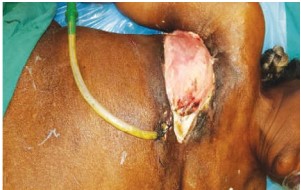
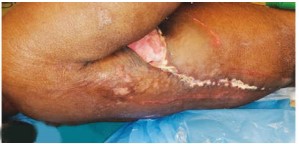
Seroma, wound infection, skin flap necrosis, nipple necrosis (after nipple-areolar sparing mastectomy [NSM]), are all complications of mastectomy. ICDs (intercostal chest drains) are frequently employed in medical, surgical, and critical care settings. Incorrect placement or management of intercostal chest drains can lead to significant morbidity and even mortality. The risk of acquired infection is directly proportional to the duration of ICD placement in-situ. For patients with sepsis and septic shock, therapeutic priorities include securing the airway (endotracheal intubation and mechanical ventilation), correcting hypoxemia, and establishing vascular access for the early administration of fluids and antibiotics. Hence, ICD tubes that are kept in-situ for a long duration must be managed according to the approved guidelines by qualified personnel and under adequate supervision.
References
- 1. Boostrom SY, Throckmorton AD, Boughey JC, et al. Incidence of clinically significant seroma after breast and axillary surgery. J Am Coll Surg 2009; 208:148.
- 2. van Bemmel AJ, van de Velde CJ, Schmitz RF, Liefers GJ. Prevention of seroma formation after axillary dissection in breast cancer: a systematic review. Eur J Surg Oncol 2011; 37:829.
- 3. Agrawal A, Ayantunde AA, Cheung KL. Concepts of seroma formation and prevention in breast cancer surgery. ANZ J Surg 2006; 76:1088.
- 4. Maxwell RA, Campbell DJ, Fabian TC, et al. Use of presumptive antibiotics following tube thoracostomy for traumatic hemopneumothorax in the prevention of empyema and pneumonia--a multi-center trial. J Trauma 2004; 57:742.
- 5. Ahmad T, Ahmed SW, Soomro NH, Sheikh KA. Thoracoscopic evacuation of retained posttraumatic hemothorax. J Coll Physicians Surg Pak 2013; 23:234.
- 6. Chatzidaki P, Mellos C, Briese V, Mylonas I. Perioperative complications of breast cancer surgery in elderly women (≥80 years). Ann Surg Oncol 2011; 18:923.
- 7. Sanguinetti A, Rosato L, Cirocchi R, et al. [Antibiotic prophylaxis in breast surgery. Preliminary resuls of a multicenter randomized study on 1400 cases]. Ann Ital Chir 2009; 80:275.
- 8. Vitug AF, Newman LA. Complications in breast surgery. Surg Clin North Am 2007; 87:431.
- 9. Sørensen LT, Hørby J, Friis E, et al. Smoking as a risk factor for wound healing and infection in breast cancer surgery. Eur J Surg Oncol 2002; 28:815.
- 10. Platt R, Zucker JR, Zaleznik DF, et al. Perioperative antibiotic prophylaxis and wound infection following breast surgery. J Antimicrob Chemother 1993; 31 Suppl B:43
- 11. Carlson GW, Bostwick J 3rd, Styblo TM, et al. Skinsparing mastectomy. Oncologic and reconstructive considerations. Ann Surg 1997; 225:570.
- 12. Rao R, Saint-Cyr M, Ma AM, et al. Prediction of post-operative necrosis after mastectomy: a pilot study utilizing optical diffusion imaging spectroscopy. World J Surg Oncol 2009; 7:91.
- 13. Chun YS, Verma K, Rosen H, et al. Use of tumescent mastectomy technique as a risk factor for native breast skin flap necrosis following immediate breast reconstruction. Am J Surg 2011; 201:160.
- 14. Kwiatt M, Tarbox A, Seamon MJ, et al. Thoracostomy tubes: A comprehensive review of complications and related topics. Int J Crit Illn Inj Sci 2014; 4:143.
- 15. Ball CG, Lord J, Laupland KB, et al. Chest tube complications: how well are we training our residents? Can J Surg 2007; 50:450.
- 16. Risks and pitfalls in chest tube placement – are we doing it safely?Dimos Karangelis.
- 17. www.npsa.nhs.uk/nrls/alerts-and-directives/ rapidrr/risks-of-chest-drain-insertion(accessed June 2009).
Data Sharing Statement
There are no additional data available. All raw data and code are available upon request.
Funding
This research received no funding.
Author Contributions
All authors contributed significantly to the work and approve its publication.
Ethics Declaration
This article does not involve any human or animal subjects, and therefore does not require ethics approval.
Acknowledgements
We would like to express our gratitude to the patients, their families, and all those who have contributed to this study.
Conflicts of Interest
No conflicts of interest in this work.
About this article

Cite this article
K Sri Harsha Reddy, Ravi Kumar Chittoria, Nishad K, Neljo Thomas/Long Standing Intercostal Drainage a Boon or a Curse: Our Experience/New Indian J Surg.2022;13(1): 37-41.
Licence:
Attribution-Non-commercial 4.0 International (CC BY-NC 4.0)This license enables reusers to distribute, remix, adapt, and build upon the material in any medium or format for noncommercial purposes only, and only so long as attribution is given to the creator.
| Received | Accepted | Published |
|---|---|---|
| December 16, 2021 | February 01, 2022 | March 30, 2022 |
DOI: https://doi.org/10.21088/nijs.0976.4747.13122.6
Keywords
MRM complicationsICD (Intercostal chest drains)SepsisTube ThoracostomySearch for Similar Articles
Similar Articles
- Role of Bates-Jenson Wound Assessment Tool (BJWAT) in Wound Management
- Role of New Antimicrobial Solution in the Management of a Chronic Left Foot Woun...
- Laparoscopic Excision of a Giant Retroperitoneal Benign Mesenteric Cyst Encasing...
- Endoscopic-Assisted Sural Nerve and Biceps Femoris Muscle Biopsy in a Young Woma...
- Amniotic Membrane in Wound Healing: Biological Basis, Clinical Evidence and Futu...
Article Level Metrics
Last UpdatedTuesday 24 November 2026, 13:40:05 (IST)
9659
Accesses
7
883
00
Citations
NA
NA
NA
Download citation
Article Keywords
Keyword Highlighting
Highlight selected keywords in the article text.
Timeline
| Received | December 16, 2021 |
| Accepted | February 01, 2022 |
| Published | March 30, 2022 |
licence
Attribution-Non-commercial 4.0 International (CC BY-NC 4.0)
This license enables reusers to distribute, remix, adapt, and build upon the material in any medium or format for noncommercial purposes only, and only so long as attribution is given to the creator.