Full Text (PDF)
Indian Journal of Communicable Diseases 11(1):p 13-17, Jan-Jun 2025. | DOI: https://doi.org/10.21088/ijcd.2395.6631.11125.2
Case Report
Intravenous Magnesium Sulphate Infusion in Treatment of Adult Tetanus: A Case Report
Princika Chauhan,, Vaibhav Shukla1,, Mohd. Mustahsin, Adnan Saeed Shamsi
Author Information
Licence:
Attribution-Non-commercial 4.0 International (CC BY-NC 4.0)This license enables reusers to distribute, remix, adapt, and build upon the material in any medium or format for noncommercial purposes only, and only so long as attribution is given to the creator.
Indian Journal of Communicable Diseases 11(1):p 13-17, Jan-Jun 2025. | DOI: https://doi.org/10.21088/ijcd.2395.6631.11125.2
How Cite This Article:
1. Chauhan P, Shamsi AS, et al. Intravenous Magnesium Sulphate Infusion in treatment of Adult Tetanus: A Case Report. Indian J Comm Dis. 2025;11(1):13-17.Timeline
Received : July 24, 2025
Accepted : August 18, 2025
Published : June 30, 2025
Abstract
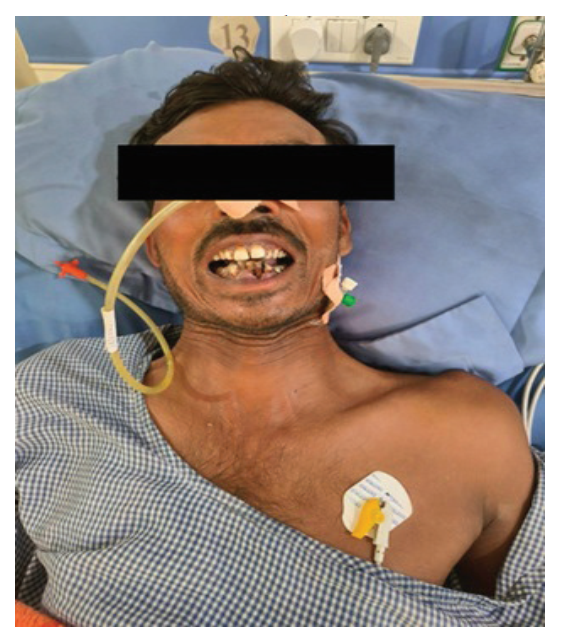
Tetanus remains a significant public health concern in low- and middle-income countries (LMICs), particularly among adults with incomplete immunization. This case report describes a 40-year-old male farmer from rural India who developed generalized tetanus following a puncture wound to the foot. Classical clinical features including trismus, generalized muscle spasms, and signs of autonomic dysfunction were present. The patient was managed in the intensive care unit with continuous intravenous magnesium sulphate (MgSO4) infusion at 1g/ hour, alongside supportive care and antibiotics. Notably, mechanical ventilation and sedative agents were not required throughout the hospital stay. Progressive improvement in muscle rigidity and spasms was observed by day two of treatment, and the patient was discharged after three weeks without complications. This case highlights the efficacy of magnesium sulphate as a neuromuscular depressant and autonomic stabilizer in moderate to severe tetanus. It underscores its potential to reduce the need for invasive ventilation, especially in resource-limited settings, and supports its use as a safe and cost-effective adjunct in tetanus management.
References
- 1. Ali A, Ahmed K, Farooq M, Mahmood S. Comparative study of magnesium sulfate versus diazepam in the management of tetanus. Pak Armed Forces Med J. 2011;61(3):372–376.
- 2. Attygalle D, Rodrigo N. Magnesium as first line therapy in the management of tetanus: a prospective study of 40 patients. Anaesthesia. 2002;57(8):811–817.
- 3. Boer M, de Voogd M, Niemeijer ND, van Hoeven L. Tetanus – a case report highlighting the challenges in diagnosis and treatment. Trop Dis Travel Med Vaccines. 2024;10(1):10.
- 4. Larrubia AL, Zafalon B, Bressan EM, Dos Santos HG, Cândido KV, Blaszak PR, Junior FD. Tétano acidental: uma revisão dos aspectos clínicos, epidemiológicos e neuroquímicos/ Accidental tetanus: a review of clinical, epidemiological and neurochemical aspects. Braz J Health Rev. 2021;4(3):12392–12401.
- 5. Mathew PJ, Samra T, Wig J. Magnesium sulphate for treatment of tetanus in adults. Anaesth Intensive Care. 2010;38(1):185–189.
- 6. Nepal G, Coghlan MA, Yadav JK, Kharel S, Ka Shing Y, Ojha R, Xing HS, Bo Y, Zhi Lan T. review. Trop Med Int Health. 2021;26(10):1200–1209.
- 7. Osalusi BS, Ogun SA, Ogunniyi A, Kolapo KO. Comparison of the efficacy of magnesium sulphate and diazepam in the control of tetanus spasms. Sci Res Essays. 2008;3(12):571–576.
- 8. Sikendar RI, Samad B, Ali A, Memon MI. Post traumatic tetanus and role of magnesium sulphate. J Ayub Med Coll Abbottabad. 2009;21(2):132–135.
- 9. Susanto TD. Magnesium sulphate for tetanus: review of two cases. Medicinus. 2020;8(2): 112–116.
- 10. Thwaites CL, Yen LM, Loan HT, Thuy TT, Thwaites GE, Stepniewska K, Magnesium sulphate for treatment of severe tetanus: a randomised controlled trial. Lancet. 2006;368(9545):1436–1443.
Data Sharing Statement
There are no additional data available. All raw data and code are available upon request.
Funding
This research received no funding.
Author Contributions
All authors contributed significantly to the work and approve its publication.
Ethics Declaration
This article does not involve any human or animal subjects, and therefore does not require ethics approval.
Acknowledgements
We thank the ICU team at ERAS Lucknow Medical College and Hospital for their clinical support and for their guidance in patient management.
Conflicts of Interest
No conflicts of interest.
About this article

Cite this article
1. Chauhan P, Shamsi AS, et al. Intravenous Magnesium Sulphate Infusion in treatment of Adult Tetanus: A Case Report. Indian J Comm Dis. 2025;11(1):13-17.
Licence:
Attribution-Non-commercial 4.0 International (CC BY-NC 4.0)This license enables reusers to distribute, remix, adapt, and build upon the material in any medium or format for noncommercial purposes only, and only so long as attribution is given to the creator.
| Received | Accepted | Published |
|---|---|---|
| July 24, 2025 | August 18, 2025 | June 30, 2025 |
DOI: https://doi.org/10.21088/ijcd.2395.6631.11125.2
Keywords
TetanusCost-EffectiveMagnesium SulphateSearch for Similar Articles
Similar Articles
- A Review on the Medicinal Properties, Phytoconstituents, and Biological Activiti...
- Rare Diseases in India: Burden, Health-System Response and Policy Implications f...
- Need Assessment for Planning HIV/AIDS Services in the Wake of World AIDS Day The...
- A Nation in the Grip of Dengue: How Climate, Pollution, and Urbanization are Fee...
- Emergence of Rabies Cases in Kerala: A Public Health Concern
Article Level Metrics
Last UpdatedSunday 06 September 2026, 00:44:06 (IST)
1117
Accesses
38
231
00
Citations
NA
NA
NA
Download citation
Article Keywords
Keyword Highlighting
Highlight selected keywords in the article text.
Timeline
| Received | July 24, 2025 |
| Accepted | August 18, 2025 |
| Published | June 30, 2025 |
licence
Attribution-Non-commercial 4.0 International (CC BY-NC 4.0)
This license enables reusers to distribute, remix, adapt, and build upon the material in any medium or format for noncommercial purposes only, and only so long as attribution is given to the creator.