Full Text (PDF)
RFP Indian Journal of Medical Psychiatry 8(1):p 17-25, Jan-June 2025. | DOI: https://doi.org/10.21088/ijmp.2395.311X.11225.2
Original Article
Internalizing and Externalizing Behaviours in Institutionalized Children in relation to Parental Living Status
Therissa Benerji, Madhavi Kodali
Author Information
Licence:
Attribution-Non-commercial 4.0 International (CC BY-NC 4.0)This license enables reusers to distribute, remix, adapt, and build upon the material in any medium or format for noncommercial purposes only, and only so long as attribution is given to the creator
RFP Indian Journal of Medical Psychiatry 8(1):p 17-25, Jan-June 2025. | DOI: https://doi.org/10.21088/ijmp.2395.311X.11225.2
How Cite This Article:
Therissa Benerji, Madhavi Kodali. Internalizing and Externalizing Behaviours in Institutionalized Children in relation to Parental Living Status. RFP Ind Jr of Med Psy. 2025; 8(1): 17-25.Timeline
Received : December 28, 2024
Accepted : February 03, 2025
Published : June 20, 2025
Abstract
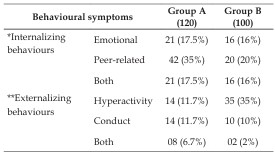
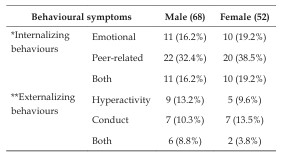
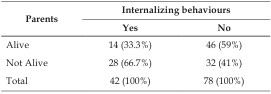
Context: Childhood development relies on stable caregiving, and disruptions like parental loss can impact emotional and behavioural outcomes. Institutionalized children, often deprived of parental care, are at greater risk for internalizing (e.g., anxiety, withdrawal) and externalizing (e.g., aggression, hyperactivity) behaviours. Understanding how parental living status affects these behaviours is key to improving their psychological well-being. Aims: This research aimed to study and compare the occurrence of internalizing and externalizing behavioural problems among institutionalized children in relation to their parental living status. Settings and Design: A cross-sectional observational study was conducted among school-going children in Krishna district, Andhra Pradesh, India. The sample included institutionalized (Group A, n=120) and non-institutionalized (Group B, n=100) children. Methods and Material: Behavioural assessments using the Strengths and Difficulties Questionnaire (SDQ) were administered to caretakers and teachers. Data on sociodemographics, parental living status, duration of stay, and sibling presence were collected. Statistical analysis used: Chi-square tests analysed associations between variables, with p ≤ 0.05 considered significant. Results: Internalizing behaviours showed no significant group differences (p=0.4224). However, externalizing behaviours, particularly hyperactivity, were lower in institutionalized children (p=0.0025). Parental loss was linked to higher internalizing behaviours (p=0.0074). Gender, duration of stay, and sibling presence were not statistically significant, although siblings showed a near-significant protective effect (p=0.0587). Conclusion: Parental loss heightens internalizing behaviours in institutionalized children. Emotional support, attachment-building, and maintaining sibling bonds may mitigate adverse effects. Targeted interventions are needed to address these children’s psychological needs.
References
- 1. Nsabimana E, Rutembesa E, Wilhelm P and Martin-Soelch C. Effects of institutionalization and parental living status on children’s selfesteem, and externalizing and internalizing problems in Rwanda. Front. Psychiatry 2019.
- 2. Hornor G. Attachment disorders. J Pediatr Health Care 2019;33:612-22.
- 3. Agrawal A, Sinha A, Gupta S, Kotwani P. A methodological study to determine emotional and behavioural problems with associated factors among children of institutional homes in Raipur, Chhattisgarh. Int J Community Med Public Health 2022;9:2652-59.
- 4. Tetzner J, Bondü R, Krahé B. Family risk factors and buffering factors for child internalizing and externalizing problems. Journal of Applied Developmental Psychology 2022.
- 5. Moreno-Manso JM, García-Baamonde ME, Guerrero-Barona E, Godoy-Merino MJ, Guerrero-Molina M, Barbosa-Torres C. Externalizing and internalizing symptoms and coping strategies in young victims of abuse. Curr Psychol 2023;42:5580–89.
- 6. Datta P, Ganguly S, Roy BN. The prevalence of behavioral disorders among children under parental care and out of parental care: A comparative study in India. Int J Pediatri Adolesc Med 2018;5:145-51.
- 7. Babicka-Wirkus A, Kozłowski P, Wirkus Ł, Stasiak K. Internalizing and externalizing disorder levels among adolescents: Data from Poland. Int J Environ Res Public Health 2023;20:2752-60.
- 8. Mota CP, Matos PM. Does sibling relationship matter to self-concept and resilience in adolescents under residential care? Children Youth Serv Rev 2015;56:97-106.
- 9. Rawat D, Malik P, Aarti, Sudiksha. Role of sibling relationship in human development. J Emerg Techn Innov Res 2024;11:a273-87.
- 10. Edels R, Naoufal M, Montreuil TC. The influence of sibling relationship quality on the social, emotional, and behavioral functioning of children and adolescents: a scoping review. J Fam Soc Work 2024;27:1–29.
- 11. Goodman R. The Strengths and Difficulties Questionnaire: A Research Note. J Child Psychol Psychiatry 1997;38:581-6.
- 12. Goodman. R. Psychometric properties of the strengths and difficulties questionnaire. J Am Acad Child Adolesc Psychiatry 2001;40:1337-45.
- 13. Yao S, Zhang C, Zhu X, Jing X, McWhinnie CM, Abela JRZ. Measuring adolescent psychopathology: Psychometric properties of the self-report strengths and difficulties questionnaire in a sample of Chinese adolescents. J Adolesc Health 2009;45:55–62.
- 14. Ismayilova L, Claypool E, Heidorn E. Trauma of separation: the social and emotional impact of institutionalization on children in a post-soviet country. BMC Public Health 2023;23:366-71.
- 15. Dubois-Comtois K, Bussières E, Cyr C, StOnge J, Baudry C, Milot T, et al. Are children and adolescents in foster care at greater risk of mental health problems than their counterparts? A meta-analysis. Children Youth Serv Rev 2021.
- 16. Kennedy M, Kreppner J, Knights N, Kumsta R, Maughan B, Golm D, et al. Early severe institutional deprivation is associated with a persistent variant of adult attention-deficit/ hyperactivity disorder: clinical presentation, developmental continuities and life circumstances in the English and Romanian Adoptees study. J Child Psychol Psychiatry 2016;57:1113-25.
- 17. Zilanawala A, Sacker A, Kelly Y. Internalising and externalising behaviour profiles across childhood: The consequences of changes in the family environment. Soc Sci Med 2019;226:207-16.
- 18. Deborah L. Best and Angelica R. Puzio. Gender and Culture. In: Matsumoto D, Hwang HC, editors. The Handbook of Culture and Psychology. Oxford: Oxford University Press; 2019. p. 235-91.
- 19. Gautam N, Rahman MM, Khanam R. Adverse childhood experiences and externalizing, internalizing, and prosocial behaviors in children and adolescents: A longitudinal study. J Affect Disord 2024;363:124-33.
- 20. Kaur R, VinnakotaA, Panigrahi S, Manasa RV. A descriptive study on behavioral and emotional problems in orphans and other vulnerable children staying in institutional homes. Indian J Psychol Med. 2018;40:161-8.
- 21. van IJzendoorn MH, Bakermans-Kranenburg MJ, Duschinsky R, Fox NA, Goldman PS, Gunnar MR, et al. Institutionalisation and deinstitutionalisation of children 1: a systematic and integrative review of evidence regarding effects on development. Lancet Psychiat 2020;7:703-20.
Data Sharing Statement
There are no additional data available. All raw data and code are available upon request.
Funding
This research received no funding
Author Contributions
All authors contributed significantly to the work and approve its publication
Ethics Declaration
This article does not involve any human or animal subjects, and therefore does not require ethics approval
Acknowledgements
We would like to express our gratitude to the patients, their families, and all those who have contributed to this study
Conflicts of Interest
No conflicts of interest in this work
About this article

Cite this article
Therissa Benerji, Madhavi Kodali. Internalizing and Externalizing Behaviours in Institutionalized Children in relation to Parental Living Status. RFP Ind Jr of Med Psy. 2025; 8(1): 17-25.
Licence:
Attribution-Non-commercial 4.0 International (CC BY-NC 4.0)This license enables reusers to distribute, remix, adapt, and build upon the material in any medium or format for noncommercial purposes only, and only so long as attribution is given to the creator
| Received | Accepted | Published |
|---|---|---|
| December 28, 2024 | February 03, 2025 | June 20, 2025 |
DOI: https://doi.org/10.21088/ijmp.2395.311X.11225.2
Keywords
Internalizing behavioursExternalizing behavioursInstitutionalized childrenParental living statusSearch for Similar Articles
Similar Articles
- Relationship Between Mmitral Valve Prolapse and Panic Disorder
- Late-Onset Mania in a 73-Year-Old Male: A Case Report
- Internet Derived Information Obstruction Treatment (IDIOT) Syndrome and its Impa...
- Multivariable Regression Analysis of Depression, Anxiety and Stress in Male Alco...
- A Study to Evaluate the Effectiveness of Supportive Psychotherapy among the Elde...
Article Level Metrics
Last UpdatedTuesday 08 September 2026, 18:54:34 (IST)
903
Accesses
17
155
00
Citations
NA
NA
NA
Download citation
Article Keywords
Keyword Highlighting
Highlight selected keywords in the article text.
Timeline
| Received | December 28, 2024 |
| Accepted | February 03, 2025 |
| Published | June 20, 2025 |
licence
Attribution-Non-commercial 4.0 International (CC BY-NC 4.0)
This license enables reusers to distribute, remix, adapt, and build upon the material in any medium or format for noncommercial purposes only, and only so long as attribution is given to the creator