Full Text (PDF)
Indian Journal of Ancient Medicine and Yoga 19(4):p 241-247, Oct - Dec. 2026. | DOI: https://doi.org/10.21088/ijamy.2455.8621.19426.3
Original Article
Impact of Nada-Bindu Upanisad on Holistic Health of University Staff
Author Information
Licence:
Attribution-Non-commercial 4.0 International (CC BY-NC 4.0)This license enables reusers to distribute, remix, adapt, and build upon the material in any medium or format for noncommercial purposes only, and only so long as attribution is given to the creator.
Indian Journal of Ancient Medicine and Yoga 19(4):p 241-247, Oct - Dec. 2026. | DOI: https://doi.org/10.21088/ijamy.2455.8621.19426.3
How Cite This Article:
Sunil Kumar Tiwari. Impact of Nada-Bindu Upanisad on Holistic Health of University Staff. Ind J Anct Med Yoga. 2026; 19(4): 241-247.Timeline
Received : September 12, 2026
Accepted : October 15, 2026
Published : December 30, 2026
Abstract
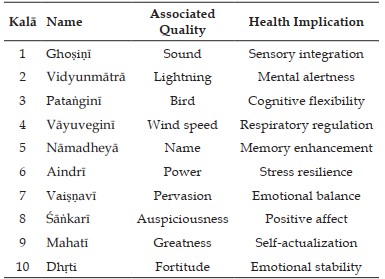
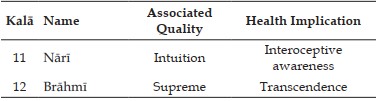
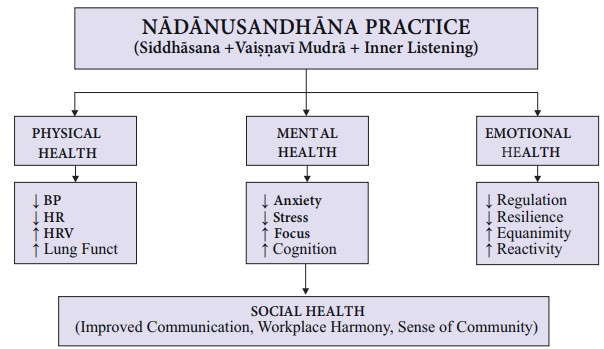
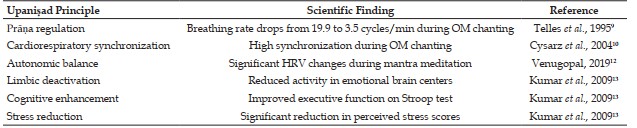
Background: University non-teaching staff face significant occupational stress, sedentary lifestyles, and work-life imbalance, leading to deteriorating physical and mental health. The Nada-Bindu Upanisad, an ancient Yoga Upanisad, presents a sophisticated philosophy of sound (Nada) and meditative absorption (bindu) that holds potential for addressing contemporary health challenges. Aim: This theoretical paper analyzes the philosophical principles of the NadaBindu Upanisad and examines their relevance to the holistic health of university non-teaching employees. Objectives: (1) To systematically analyze key philosophical concepts of the NadaBindu Upanisad; (2) To interpret these concepts in the context of occupational health challenges; (3) To develop a theoretical framework linking Nada-Yoga principles to measurable health outcomes; (4) To integrate contemporary psychophysiological research for empirical substantiation. Material: Primary source is the published edition of the Nada-Bindu Upanisad containing 56 verses with Sanskrit text, Hindi translation, and commentary. Secondary sources include peer-reviewed articles from PubMed, Scopus, Web of Science, and Google Scholar on OM chanting, mantra meditation, and occupational stress. Result: The Upanisad’steachings on the twelve kalas of Pranava, nadanusandhana in Siddhasana with Vaisnavi Mudra, progressive refinement of auditory perception, and dissolution of vasanas provide a comprehensive framework for understanding how sound-based meditation regulates the autonomic nervous system. Contemporary research substantiates these claims, demonstrating significant effects on heart rate variability, cardiorespiratory synchronization, and stress reduction. Conclusion: The Nada-Bindu Upanisad provides a philosophically grounded, practically applicable system that can theoretically reduce occupational stress and improve physical and mental health outcomes among university nonteaching staff. Empirical validation through controlled intervention studies is warranted. Key Message: The ancient practice of inner sound meditation from the Nada-Bindu Upanisad offers a cost-effective, accessible, and culturally resonant approach to mitigating occupational stress and enhancing holistic health among university non-teaching staff.
References
- 1. Kinman G, Court S. Psychosocial hazards in university staff: A comparison of academic and non-academic employees. J Occup Health Psychol. 2010;15(4):417-29.
- 2. Mark G, Smith AP. Occupational stress, job characteristics, coping, and the mental health of university staff. Br J Educ Psychol. 2012;82(1):87-104.
- 3. World Health Organization. Mental health in the workplace. Geneva: WHO; 2019.
- 4. World Health Organization. Constitution of the World Health Organization. Geneva: WHO; 1948.
- 5. Khalsa SB, Cohen L, McCall T, Telles S. The principles and practice of yoga in health care. Edinburgh: Handspring Publishing; 2016.
- 6. Nādabindu Upaniṣad. Shri Hindu Dharma Vaidik Education Foundation; n.d.
- 7. Kakade SK, Shirke UJ. Naad Bindu Upanishad: An ancient set of verses on Naad and its effect. J Appl Conscious Stud. 2024;12(1):65-7.
- 8. Naudiyal S. Uttarakhand ke yog sadhkon par Nād Yog sadhana ka mansik star par padne vale prabhav ka adhyayan [dissertation]. Uttarakhand Sanskrit University; 2022.
- 9. Telles S, Nagarathna R, Nagendra HR. Autonomic changes during ‘OM’ meditation. Indian J Physiol Pharmacol. 1995;39(4):418-20.
- 10. Cysarz D, von Bonin D, Lackner H, Heusser P, Moser M, Bettermann H. Oscillations of heart rate and respiration synchronize during poetry recitation. Am J Physiol Heart Circ Physiol. 2004;287(2):H579-87.
- 11. Feuerstein G. The Yoga Tradition: Its History, Literature, Philosophy and Practice. Prescott: Hohm Press; 2001.
- 12. Venugopal RD. Effects of mantra meditation on heart rate variability. Int J Yoga. 2019;12 (Suppl 1):S1-28.
- 13. Kumar S, Nagendra HR, Manjunath NK, Naveen KV, Telles S. Meditation on OM: Relevance from ancient texts and contemporary science. Int J Yoga. 2009;2(1):1-5.
- 14. Upadhyay P, Chang TFH, Hariri S, Rallabandi S, Yathavakilla S, Novack V, et al. The effect of Inner Engineering Online (IEO) program on reducing stress for information technology professionals: A randomized control study. Evid Based Complement Alternat Med. 2022;2022:9001828.
- 15. Bettermann H, von Bonin D, Frühwirth M, Cysarz D, Moser M. Effects of speech therapy with poetry on heart rate rhythmicity and cardiorespiratory coordination. Int J Cardiol. 2002;84(1):77-88.
Data Sharing Statement
There are no additional data available. All raw data and code are available upon request.
Funding
This research did not receive any specific grant from funding agencies in the public, commercial, or not-for-profit sectors.
Author Contributions
All authors contributed significantly to the work and approve its publication.
Ethics Declaration
This study is a theoretical analysis based on published sources and did not involve human or animal participants. Therefore, ethical approval was not required. The research was conducted with scholarly integrity, cultural sensitivity, and academic rigor.
Acknowledgements
We would like to express our gratitude to the patients, their families, and all those who have contributed to this study.
About this article

Cite this article
Sunil Kumar Tiwari. Impact of Nada-Bindu Upanisad on Holistic Health of University Staff. Ind J Anct Med Yoga. 2026; 19(4): 241-247.
Licence:
Attribution-Non-commercial 4.0 International (CC BY-NC 4.0)This license enables reusers to distribute, remix, adapt, and build upon the material in any medium or format for noncommercial purposes only, and only so long as attribution is given to the creator.
| Received | Accepted | Published |
|---|---|---|
| September 12, 2026 | October 15, 2026 | December 30, 2026 |
DOI: https://doi.org/10.21088/ijamy.2455.8621.19426.3
Keywords
Nada-Bindu UpanisadNada YogaHolistic HealthUniversity EmployeesOccupational StressPranavaMeditationOM ChantingSearch for Similar Articles
Similar Articles
- Role of Agnikarma in the Management of Calcaneal Spur (Vatakantaka): A Case Repo...
- Breast Milk Analysis of G2 of LSCS Third Day Mother with Widal Positive: Case R...
- Role of Matra Basti in Restoring Apana Vata Function in Pediatric Bowel Incontin...
- Restoring Cognitive Sovereignty: A Neurophysiological Perspective on Yoga Nidra...
- Mind and Mental Modifications (Chitta and Chitta-vrittis): A Synthesis of Yogic...
Article Level Metrics
Last UpdatedFriday 20 November 2026, 02:27:06 (IST)
6742
Accesses
11
1061
00
Citations
NA
NA
NA
Download citation
Article Keywords
Keyword Highlighting
Highlight selected keywords in the article text.
Timeline
| Received | September 12, 2026 |
| Accepted | October 15, 2026 |
| Published | December 30, 2026 |
licence
Attribution-Non-commercial 4.0 International (CC BY-NC 4.0)
This license enables reusers to distribute, remix, adapt, and build upon the material in any medium or format for noncommercial purposes only, and only so long as attribution is given to the creator.