Full Text (PDF)
Physiotherapy and Occupational Therapy Journal 15(3):p 113-120, July-September 2022. | DOI: https://doi.org/10.21088/potj.0974.5777.15322.2
Original Article
Immediate Effectiveness of Subscapularis Positional Release Technique in Unilateral Adhesive Capsulitis: A Comparative Study
Misbah Kaunain Khan, Girija Murugan, Vijay Krishna Kumar
Author Information
Licence:
Attribution-Non-commercial 4.0 International (CC BY-NC 4.0)This license enables reusers to distribute, remix, adapt, and build upon the material in any medium or format for noncommercial purposes only, and only so long as attribution is given to the creator.
Physiotherapy and Occupational Therapy Journal 15(3):p 113-120, July-September 2022. | DOI: https://doi.org/10.21088/potj.0974.5777.15322.2
How Cite This Article:
Girija Murugan, Misbah Kaunain Khan, Vijay Krishna Kumar. Immediate Effectiveness of Subscapularis Positional Release Technique in Unilateral Adhesive Capsulitis: A Comparative Study. Physiotherapy and Occupational Therapy Journal. 2022;15(3):113-120.Timeline
Received : April 20, 2022
Accepted : May 26, 2022
Published : September 25, 2022
Abstract
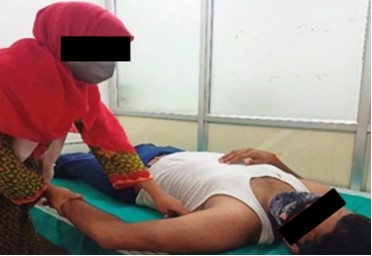
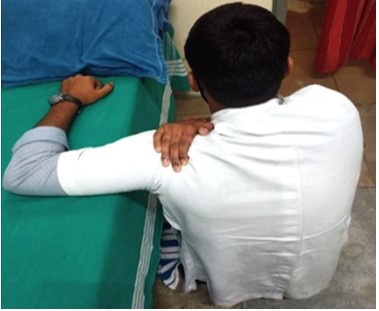
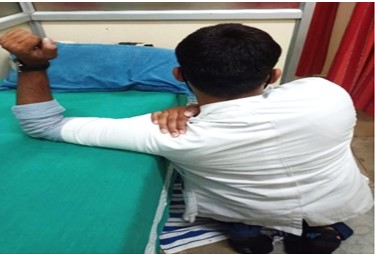
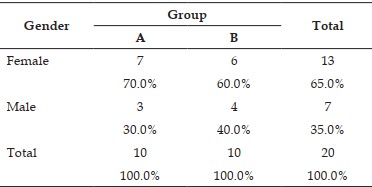
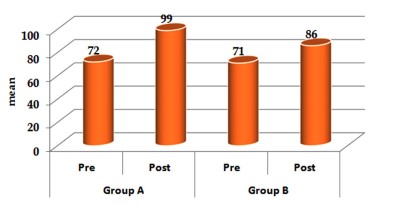
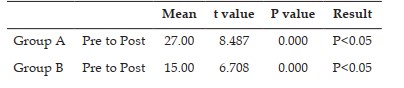
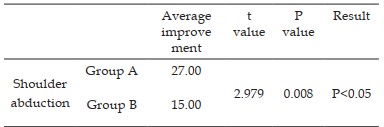
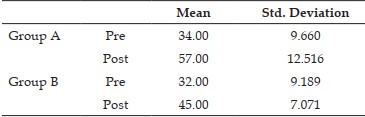
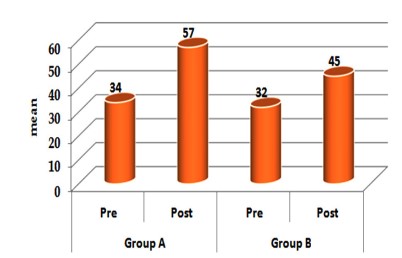
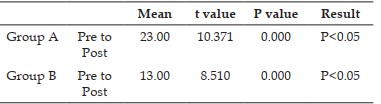
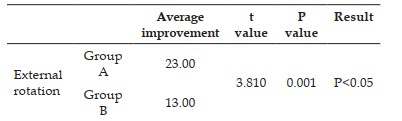
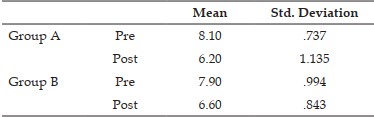
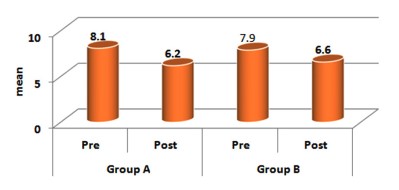
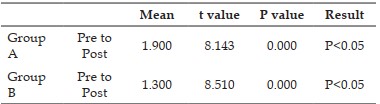
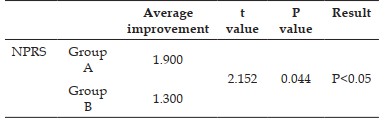
Background: In adhesive capsulitis, subscapularis, the largest and strongest muscle of the rotator cuff, undergoes tightness, which affects the abduction and external rotation of shoulder. There are many physiotherapy interventions used in treatment of adhesive capsulitis and among them, positional release technique is a method in which evaluation and treatment is done using tender/trigger points and a position of comfort to resolve the associated dysfunctions like pain and tightness. Objective: To compare the immediate effectiveness of subscapularis positional release technique in combination with shoulder capsular stretches over shoulder capsular stretches alone in patients with unilateral adhesive capsulitis. Methodology: 20 Patients with unilateral adhesive capsulitis were selected and divided into two groups based on the selection criteria. Group A received Subscapularis Positional Release Technique along with capsular stretches and Group B received capsular stretches alone. Numerical Pain Rating Scale and Active Shoulder range of motion using Goniometry were used as outcome measures pre and post treatment. Result: On comparing pre to post intervention values in Group A and Group B, there was significant improvement noted in terms of pain and shoulder ROM statistically, in both the both groups, but Group A showed more significant improvement. Conclusion: The present study concluded that both the groups showed improvement statistically and clinically in terms of pain and shoulder ROM, but the participants who were given Subscapularis Positional Release Technique with capsular stretches showed more improvement compared to participants who were given capsular stretches alone.
References
- 1. Dias R, Cutts S, Massoud S. Frozen shoulder. BMJ 2005; 331:1453-6.
- 2. Hakim AJ, Cherkas LF, sector TD, MacGregor AJ. Genetic associations between frozen shoulder and tennis elbow: a female twin study. Rheumatology (Oxford) 2003; 42:739_742.
- 3. Prestgaard TA. Frozen shoulder (adhesive capsulitis). http://www.uptodate.com/home. Accessed Jan. 22, 2015.
- 4. Kelley M, Mcclure P, Leggin B. Frozen shoulder: Evidence and a proposed model guiding rehabilitation. J Orthop Sports Phys Ther 2009; 39:135-148.
- 5. Noël E, Thomas T, Schaeverbeke T, Thomas P, Bonjean M, Revel M. Joint Bone Spine. 2000; 67(5):393-400.
- 6. Hand GC, Athanasou NA, Matthews T, Carr AJ. J Bone Joint Surg Br. 2007 Jul; 89(7):928- 32.
- 7. Sheridan MA, Hannafin JA. Orthop Clin North Am. 2006 Oct; 37(4):531-9.
- 8. Walmsley S, Rivett DA, Osmotherly PG. Adhesive capsulitis: Establishing consensus on clinical identifiers for stage 1 using the delphi technique. Phys Ther 2009; 89:906 - 917.
- 9. Cho CH, Song KS, Kim BS, Kim DH, Lho YM. Biological Aspect of Pathophysiology for Frozen Shoulder. Biomed Res Int. 2018; 2018:7274517.
- 10. JF Sarwark, ed: Essentials of Musculoskeletal Care, ed 4. Rosemont, IL, American Academy of Orthopaedic Surgeons, 2010.
- 11. Wu F, Kachooei AR, Ebrahimzadeh MH, Bagheri F, Hakimi E, Shojaie B, Nazarian A. Bilateral Arm-Abduction Shoulder Radiography to Determine the Involvement of the Scapulothoracic Motion in Frozen Shoulder. Arch Bone Jt Surg. 2018 May;6(3):225-232.
- 12. Kingston K, Curry EJ, Galvin JW, Li X. Shoulder adhesive capsulitis: epidemiology and predictors of surgery. J Shoulder Elbow Surg. 2018 Aug;27(8):1437-1443.
- 13. Lamplot JD, Lillegraven O, Brophy RH. Outcomes From Conservative Treatment of Shoulder Idiopathic Adhesive Capsulitis and Factors Associated with Developing Contralateral Disease. Orthop J Sports Med. 2018 Jul;6(7):2325967118785169.
- 14. Antony Paul, Joshua Samuel Rajkumar Clinical orthopaedics, and related research. 472(7), 2262-2268, 2014
- 15. Klapper, RC, Jobe, FW, Matsuura, P. The subscapularis muscle and its glenohumeral ligament-like bands. A histomorphologic study. Am J Sports Med. 1992; 20(3):307–310.
- 16. The Frozen Shoulder Syndrome Description of a new technique and five case reports using the subscapular nerve block and subscapularis trigger point infiltration, Acta Anaesth. Belg 2006. 57: 137-143.
- 17. Agurre K, Mudreae A, Kiel J. Anatomy, shoulder and upper limb, subscapularis muscle.Stat pearls 2020 Aug 10
- 18. Rajesh S, Monalisa Pattnaik and Dr Patitapaban Mohanty. 2016 “Effect of treating tight subscapularis in adhesive capsulitis”. International journal of current research, 8(10), 40682-40688.
- 19. DeLany JP 2002. Subscapularis: The Hidden Culprit NMT Center, St. Petersburg FL Revised 10/02
- 20. DeSantana JM, et al. Effectiveness of Transcutaneous Electrical Nerve Stimulation for treatment of hyperalgesia and pain. Current Rheumatology Reports. 2008; 10:492
- 21. Jewell DV, Riddle DL, Thacker LR. Interventions associated with an increased or decreased likelihood of pain reduction and improved function in patients with adhesive capsulitis: A retrospective cohort study. Phys Ther 2009; 89:419-429
- 22. Carel Bron et al. 2007. Treatment of myofascial trigger points in patients with chronic shoulder pain: a randomized, controlled trial BMC Musculoskeletal Disorders 8: 107.
- 23. Page, M.J., Green, S., Kramer, S., Johnston, R.V., McBain, B., Chau, M., & Buchbinder, R. Manual therapy and exercise for adhesive capsulitis (frozen shoulder). Cochrane Database Syst Rev. 2014 Aug 26;(8):CD011275. doi: 10.1002/14651858.CD011275.
- 24. Kery D Arnbrogio, George B Roth: Positional Release therapy: assessment and treatment of musculoskeletal dysfunction: mosby 1997.
- 25. Rupalia H, Patel S. Immediate effect of muscle energy technique and positional release therapy on SLR90-90, ankle dorsiflexion range and Y-balance test- an experimental study. Int J health Sci Res. 2019; 9(9):53-58.
- 26. L. Collebrusco, Open Journal of Therapy and Rehabilitation 2 (2014) 19-20
- 27. Weiselfish, S.: Manual Therapy for the Orthopedic and Neurologic Patient Emphasizing Strain and Counterstrain Technique. Hartford, CT, Regional Physical Therapy (self- published), 1993.
- 28. Ibanez-Garcia, J., Alburquerque-Sendin, F., Rodriguez-Blanco, C., Girao, D., AtienzaMeseguer, A., Planella-Abella, S. Changes in masseter muscle trigger points following straincounterstrain or neuro-muscular technique. J Bodyw Mov Ther; 13: 2-10, 2009.
- 29. Neeti Mishra, Anil Kumar Mishra and Kruti Goti. Effect of Capsular Stretch Versus Sleeper Stretch on Pain, ROM, and Shoulder Functions in Patients with Adhesive Capsulitis – A comparative study. International Journal Recent Science Research. 9(4), 25634-25637, 2018.
Data Sharing Statement
There are no additional data available. All raw data and code are available upon request.
Funding
This research received no funding.
Author Contributions
All authors contributed significantly to the work and approve its publication.
Ethics Declaration
This article does not involve any human or animal subjects, and therefore does not require ethics approval.
Acknowledgements
We would like to express our gratitude to the patients, their families, and all those who have contributed to this study.
Conflicts of Interest
No conflicts of interest in this work.
About this article

Cite this article
Girija Murugan, Misbah Kaunain Khan, Vijay Krishna Kumar. Immediate Effectiveness of Subscapularis Positional Release Technique in Unilateral Adhesive Capsulitis: A Comparative Study. Physiotherapy and Occupational Therapy Journal. 2022;15(3):113-120.
Licence:
Attribution-Non-commercial 4.0 International (CC BY-NC 4.0)This license enables reusers to distribute, remix, adapt, and build upon the material in any medium or format for noncommercial purposes only, and only so long as attribution is given to the creator.
| Received | Accepted | Published |
|---|---|---|
| April 20, 2022 | May 26, 2022 | September 25, 2022 |
DOI: https://doi.org/10.21088/potj.0974.5777.15322.2
Keywords
Adhesive capsulitisSubscapularisPositional release techniquePainROMSearch for Similar Articles
Similar Articles
- Leadership in Physiotherapy: A Narrative Review
- Effectiveness of Low Level Laser Theapy in the Management of Temporomandibular J...
- The Impact of Air Pollution on Cardiopulmonary Health: Molecular Mechanisms, Pre...
- Efectiveness of Physiotherapy in Postpartum Women with Diastasis Recti: A Review
- Pain Neuroscience Education: Transforming Physiotherapy Practice
Article Level Metrics
Last UpdatedFriday 23 October 2026, 16:18:09 (IST)
4358
Accesses
10
739
00
Citations
NA
NA
NA
Download citation
Article Keywords
Keyword Highlighting
Highlight selected keywords in the article text.
Timeline
| Received | April 20, 2022 |
| Accepted | May 26, 2022 |
| Published | September 25, 2022 |
licence
Attribution-Non-commercial 4.0 International (CC BY-NC 4.0)
This license enables reusers to distribute, remix, adapt, and build upon the material in any medium or format for noncommercial purposes only, and only so long as attribution is given to the creator.