Full Text (PDF)
Indian Journal of Ancient Medicine and Yoga 18(3):p 119-127, July -Sept 2025. | DOI: https://doi.org/10.21088/ijamy.2455.8621.18325.5
Review Article
Identification of Kapila Jalauka: Correlating Ancient Ayurvedic Descriptions with Modern Medicinal Leeches
Author Information
Licence:
Attribution-Non-commercial 4.0 International (CC BY-NC 4.0)This license enables reusers to distribute, remix, adapt, and build upon the material in any medium or format for noncommercial purposes only, and only so long as attribution is given to the creator.
Indian Journal of Ancient Medicine and Yoga 18(3):p 119-127, July -Sept 2025. | DOI: https://doi.org/10.21088/ijamy.2455.8621.18325.5
How Cite This Article:
Meghani YR, Dudhamal TS. Identification of Kapila Jalauka: Correlating Ancient Ayurvedic Descriptions with Modern Medicinal Leeches. Ind J Anct Med Yoga. 2025;18(3):119-127.Timeline
Received : May 07, 2025
Accepted : June 17, 2025
Published : September 30, 2025
Abstract
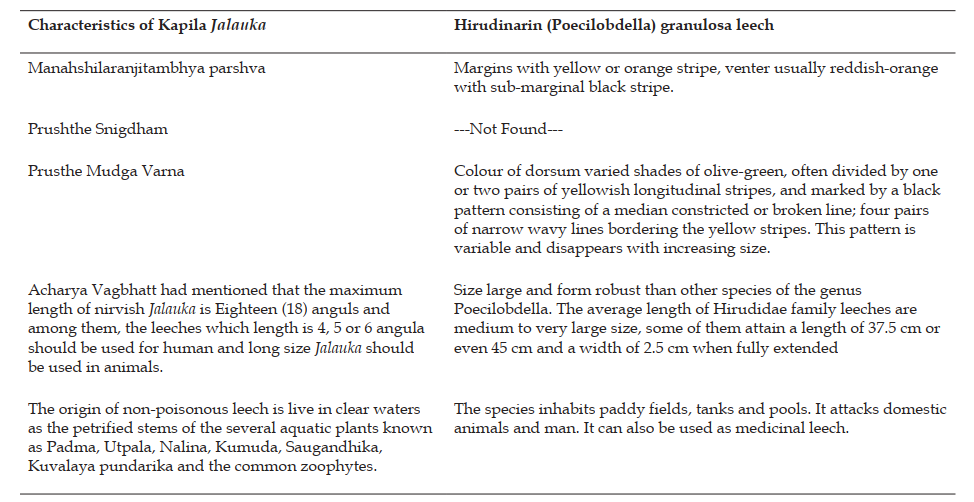
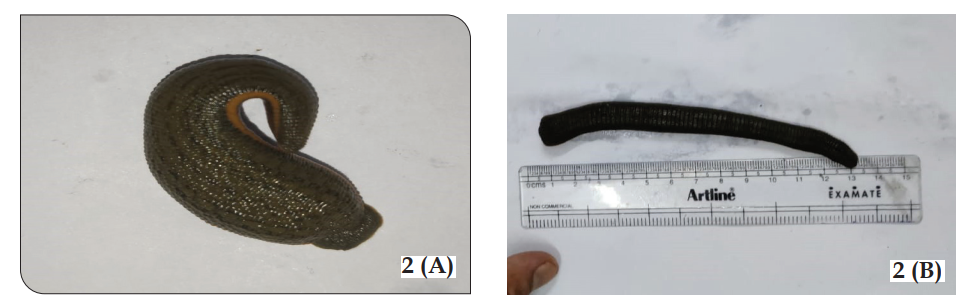
Jalauka (leech) is a water-dwelling organism used in Jalaukavcharan, a traditional Ayurvedic bloodletting therapy, particularly effective in pitta dosha vitiated disorders. Ancient Ayurvedic texts classify Jalaukas into two types: Savish (toxic) and Nirvish (non-toxic). Nirvish Jalauka was traditionally employed for therapeutic Raktamokshana (bloodletting). However, classical texts provide only limited descriptions of their characteristics, habitats, and procedures, and there is no documented scientific identification of the Nirvish Jalauka to date. Aim: To identify the closest modern biological equivalent of Kapila Jalauka described in Ayurvedic classics by comparing the characteristics of leeches from the Hirudidae family found in India and surrounding regions. Material and Methods: A comparative analysis was done among various species of the Hirudidae family native to India by the available sources and materials. The characteristics mentioned in classical literature for Kapila Jalauka such as Manahshilaranjitambhya parshva, prushthe snigdham, and prusthe mudga varna were used to identify this Jalauka. Results: Among the Hirudidae family leeches studied, Hirudinarin (Poecilobdella) granulosa exhibited the maximum resemblance to the classical description of Kapila Jalauka. This species is currently also the most commonly used medical leech in bloodletting procedures. Conclusion: It was found that Hirudinarin (Poecilobdella) granulosa leech has maximum characteristics of Kapila Jalauka and it is found the closet match.
References
- 1. Thakral KK, editor. Sushruta Samhita, Sutra Sthana 13/10, 11. 1st ed. Varanasi: Chaukhambha Orientalia. 2014:132.
- 2. Kailash Chandra, Gopi, K.C., Rao, D.V., Valarmathi, K. and Alfred, J.R.B., 2017. Current Status of Freshwater Faunal Diversity in India: 187 (Published by the Director, Zool. Surv. India, Kolkata).
- 3. Thakral KK, editor. Sushruta Samhita, Sutra Sthana 13/11. 1st ed. Varanasi: Chaukhambha Orientalia. 2014:133.
- 4. Thakral KK, editor. Sushruta Samhita, Sutra Sthana 13/12. 1st ed. Varanasi: Chaukhambha Orientalia. 2014:134.
- 5. Thakral KK, editor. Sushruta Samhita, Sutra Sthana 13/13. 1st ed. Varanasi: Chaukhambha Orientalia. 2014:135.
- 6. Thakral KK, editor. Sushruta Samhita, Sutra Sthana 13/14. 1st ed. Varanasi: Chaukhambha Orientalia. 2014:135.
- 7. Thakral KK, editor. Sushruta Samhita, Sutra Sthana 13/10, 12. 1st ed. Varanasi: Chaukhambha Orientalia. 2014:134.
- 8. Tripathi BN, editor. Astang Hrdayam, Sutra Sthana 26/38. Reprinted. Delhi: Chaukhambha Sanskrit Pratishthan. 2017: 289.
- 9. Sharma PV, editor. Ashtanga Sangraha of Vagbhata – Sutra Sthana, 35/ 3. 9th ed. Varanasi: Chaukhambha Orientalia; 2005 : 571.
- 10. Sharma PV, editor. Ashtanga Sangraha of Vagbhata – Sutra Sthana, 35/4. 9th ed. Varanasi: Chaukhambha Orientalia; 2005 : 572.
- 11. Chandra M, The Leeches of India-A Handbook, 7. 1st edition. Culcutta: The Bani Press, 1991: 80.
- 12. Chandra M, The Leeches of India-A Handbook, 7. 1st edition. Culcutta: The Bani Press, 1991: 80.
- 13. Chandra M, The Leeches of India-A Handbook, 7. 1st edition. Culcutta: The Bani Press, 1991: 81 to 96.
- 14. Nesemann H, Sharma S, Sharma G, Khanal SN, Pradhan B, Shah DN, Shah RDT. Aquatic Invertebrates of the Ganga River System. Reprint PDF: Annelida: Hirudinea. Volume 1. p. 182-188.
- 15. Chandra M. The Leeches of India: A Handbook. 1st ed. Calcutta: The Bani Press; 1991. p. 81-96.
- 16. Chandra K, Gopi KC, Rao DV, Valarmathi K, Alfred JRB. Current Status of Freshwater Faunal Diversity in India. Kolkata: Zoological Survey of India; 2017:189-193 p. ISBN: 978-81- 8171-462-6.
- 17. Kailash Chandra, Gopi KC, Rao DV, Valarmathi K, Alfred JRB. Current Status of Freshwater Faunal Diversity in India. Kolkata: Zoological Survey of India; 2017. p. 193.
- 18. Government of India, Ministry of Health & Family Welfare, Department of AYUSH. The Ayurvedic Pharmacopoeia of India. New Delhi: Government of India; 2008. Part I, Volume VI, 1st ed. Appendix 6. p. CCCLXXXV.
Data Sharing Statement
There are no additional data available. All raw data and code are available upon request.
Funding
This research received no funding.
Author Contributions
All authors contributed significantly to the work and approve its publication.
Ethics Declaration
This article does not involve any human or animal subjects, and therefore does not require ethics approval.
Acknowledgements
We would like to express our gratitude to the patients, their families, and all those who have contributed to this study.
Conflicts of Interest
No conflicts of interest.
About this article

Cite this article
Meghani YR, Dudhamal TS. Identification of Kapila Jalauka: Correlating Ancient Ayurvedic Descriptions with Modern Medicinal Leeches. Ind J Anct Med Yoga. 2025;18(3):119-127.
Licence:
Attribution-Non-commercial 4.0 International (CC BY-NC 4.0)This license enables reusers to distribute, remix, adapt, and build upon the material in any medium or format for noncommercial purposes only, and only so long as attribution is given to the creator.
| Received | Accepted | Published |
|---|---|---|
| May 07, 2025 | June 17, 2025 | September 30, 2025 |
DOI: https://doi.org/10.21088/ijamy.2455.8621.18325.5
Keywords
Hirudinarin (Poecilobdella) granulosaJalaukavcharanKapila JalaukaMedicinal LeechNirvish JalaukaSavish JalaukaSearch for Similar Articles
Similar Articles
- Efficacy of Katupila Ghrita in the Management of Itartha dagdha Vrana (Burn Woun...
- Clinical Outcomes of Ayurvedic Management in Acute Influenza Like Illness: A Cas...
- Effect of Ayurvedic Drugs on Scalp Psoriasis (Kitibha Kustha)
- Yogic Elements in the Brahma Mahapurana: A Textual and Comparative Study
- Management of Adenoid Hypertrophy: An Ayurvedic Perspective
Article Level Metrics
Last UpdatedWednesday 16 September 2026, 15:16:18 (IST)
4112
Accesses
16
834
00
Citations
NA
NA
NA
Download citation
Article Keywords
Keyword Highlighting
Highlight selected keywords in the article text.
Timeline
| Received | May 07, 2025 |
| Accepted | June 17, 2025 |
| Published | September 30, 2025 |
licence
Attribution-Non-commercial 4.0 International (CC BY-NC 4.0)
This license enables reusers to distribute, remix, adapt, and build upon the material in any medium or format for noncommercial purposes only, and only so long as attribution is given to the creator.