Full Text (PDF)
Journal of Psychiatric Nursing 11(3):p 105-109, September-December 2022. | DOI: https://doi.org/10.21088/jpn.2277.9035.11322.5
Original Article
Health Anxiety among Adults Attending Selected Health Centre, At UAE
Soney M. Varghese, Fathmah Mohamed Saleh Ahmed Al Saadi, Kalthoum Salem Rashed Al Kaabi, Aishah Saeed Hamdan Obaid Al Bdouli, Vimala Varatharajan
Author Information
Licence:
Attribution-Non-commercial 4.0 International (CC BY-NC 4.0)This license enables reusers to distribute, remix, adapt, and build upon the material in any medium or format for noncommercial purposes only, and only so long as attribution is given to the creator.
Journal of Psychiatric Nursing 11(3):p 105-109, September-December 2022. | DOI: https://doi.org/10.21088/jpn.2277.9035.11322.5
How Cite This Article:
Fathmah Mohamed Saleh Ahmed Al Saadi, Kalthoum Salem Rashed Al Kaabi, Aishah Saeed Hamdan Obaid Al Bdouli, et al./Health Anxiety among Adults Attending Selected Health Centre, At UAE/J Psychiatr Nurs. 2022;11(3):105–109.Timeline
Received : August 22, 2022
Accepted : September 25, 2022
Published : December 25, 2022
Abstract
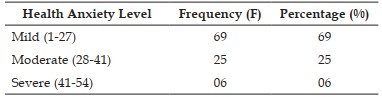
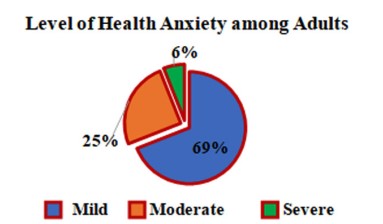
Introduction: As countries introduce measures to restrict movement as part of efforts to reduce the number of people infected with COVID-19, more and more of us are making huge changes to our daily routines. The new realities of working from home, temporary unemployment, home schooling of children, and lack of physical contact with other family members, friends and colleagues take time to get used to strated to develop anxiety among people. Considering the current trend conducted a study to assess health anxiety among adults attending selected hospitals in UAE. Objectives were to assess health anxiety among the adults and to associate level of health anxiety with selected demographic variables Materials and Methods: A Quantitative Research approach with a Cross sectional descriptive survey was used to assess the health anxiety among adults. Data were obtained from the adults using a structured questionnaire to elicit demographic profileof the adults along with a standardized questionnaire to assess level of health anxietyamong the adults. Sample participation was voluntary, complying with the consentprocedure in force, ensuring confidentiality and anonymity and the right to withdraw from the study at any given point during the study. A total of 100 valid responses were received. Descriptive statistics was used to analyse the frequency and percentage distribution of socio-demographic variables. Inferential statistics like chi square and Fishersexact test of association was used to associate anxiety with selected demographic variable of adults. Conclusionand Major Findings of the Study: The result relieved that Majority (56%) of the adults were between 31 to 40 years. Only (1%) of the adults were above 50 years. Majority (59%) of the adults were male and (41%) were females. Most of the adults (33%) were completed high school. Majority (62) of the adults were working in ministry job and few (22%)were unemployed and only (12%) were private company. Most of the adults (74%) were married. Few (19%) were unmarried and only (1%) were divorced. Majority (88%) were sleeping (6- 10 hrs). Few (10%) were sleeping Less than 5hrs and only (2%) were sleeping more than 10hrs. Most of the adults (86%) were having history of chronic illness. Majority (69%) of the adults had mildlevel of anxiety and only (6%) had severe level of health anxiety.
References
- 1. Holmes EA, O’Connor RC, Perry VH, Tracey I, Wessely S, Arseneault L, et al. Multidisciplinary research priorities for the COVID-19 pandemic: a call for action for mental health science. Lancet Psychiatry. (2020)7:547–60.doi: 10.1016 /S2215-0366 (20) 30168-1.
- 2. Shevlin M, McBride O, Murphy J, Miller JG, Hartman TK, Levita L, et al. Anxiety, depression, traumatic stress, and COVID-19 related anxiety in the UK General population during the COVID-19 pandemic. BJ Psych Open. (2020) 6:e125. doi: 10.1192 /bjo.2020.109.
- 3. Lei L, Huang X, Zhang S, Yang J, Yang L, Xu M. Comparison of prevalence and associated factors of anxiety and depression among people affected by versus people unaffected by quarantine during the COVID-19 epidemic in South western China. Med Sci Monit. (2020) 26:e924609.doi :10.12659 / MSM.924609.
- 4. Grey I, Arora T, Thomas J, Saneh A, Tomhe P, Abi-Habib R. The role of perceived social support ondepression and sleep during the COVID-19 pandemic. Psychiatry Res. (2020) 293:113452. doi:10.1016 / j. psychres . 2020.113452.
- 5. Pirutinsky S, Cherniak AD, Rosmarin DH. COVID-19, mental health, andreligious coping among american orthodox jews. J Religion Health. (2020)2020:1–14. doi: 10.1007/s10943-020-01070-z.
- 6. Shi L, Lu Z-A, Que J-Y, Huang X-L, Liu L, Ran M-S, et al. Prevalence of and risk factors associated with mental health symptoms among the general population in China during the corona virus disease 2019 pandemic. JAMA Network Open. (2020) 3:e2014053. doi:10.1001/ jamanet work open.2020.14053.
- 7. Chan SM, Chiu FK, Lam CW, Leung PY, Conwell Y. Elderly suicide and the 2003 SAR Sepidemicin Hong Kong. Int J Geriatr Psychiatry . (2006) 21:113– 8. doi: 10.1002/gps.1432.
- 8. Lee AM, Wong JG, Mc Alonan GM, Cheung V, Cheung C, Sham PC, et al. Stress and psychological distress among SARS survivors 1 year after the outbreak. Can J Psychiatry. (2007)52:233–40.doi: 10.1177 /070674370705200405.
- 9. MakI W, Chu CM, Pan PC, Yiu MG, Chan VL. Long-termpsy chiatricmorbidities among SARS survivors. Gen Hosp Psychiatry. (2009) 31:318–26. doi: 10.1016/j. genhosppsych.2009.03.001.
- 10. Hidaka BH. Depression as a disease of modernity: explanations for increasing prevalence. J Affect Disord. (2012)140:205–14.doi:10.1016/j. jad.2011.12.036.
- 11. Ferrari AJ, Charlson FJ, Norman RE, Patten SB, Freedman G, Murray CJL, et al. Burden of depress ssived is orders by country, sex, age, and year: findings from the global burden of disease study 2010. PLoS Med. (2013) 10:e1001547. doi:10.1371/ journal.pmed.1001547.
- 12. Abou-Saleh MT, Ghubash R, Daradkeh TK. Al Ain Community Psychiatric Survey. I. Prevalence and socio-demographic correlates. Social Psychiatry Psychiatric Epidemiol. (2001) 36:20–8. doi: 10.1007/ s001270050286.
- 13. Ghubash R, Daradkeh TK, Al-Muzafari SMA, El-Manssori ME, Abou-Saleh MT. Al Ain Community Psychiatric Survey IV:socio-cultural changes (traditionality-liberalism) and prevalence of psychiatric disorders. Social Psychiatry Psychiatric Epidemiol. (2001)36:565–70.doi :10.1007 s001270170008.
- 14. Ghubash R, El-Rufaie OE, Zoubeidi T, Al-Shboul QM, Sabri SM. Profile of mental disorders among the elderly United Arab Emirates population: socio demographic correlates. Int J Geriatric Psychiatry.2004:344–51.doi:10.1002/gps.1101.
- 15. Bener A, Ghuloum S, Abou-Saleh MT. Prevalence, symptom patterns and comorbidity of anxiety and depress sived is orders in primary care in Qatar. Social Psychiatry Psychiatric Epidemiol. (2012)47: 439–46.doi:10.1007 /s00127-011-0349-9.
- 16. Bristol-Rhys J. Emirati Women. London: C. Hurst & Co. (2010).
- 17. House T, Keeling MJ. House hold structure and infectious disease transmission. Epidemiol Infect. (2009)137 : 654–61.doi:10.1017/ S0950268808001416.
- 18. Williams JR, Manfredi P. Ageing populations and childhood infections: the potential impact on epidemic patterns and morbidity. Int J Epidemiol. (2004) 33:566–72. doi: 10.1093/ije/dyh098.
- 19. Funk S, Salathé M, Jansen VAA. Modelling the influence of human behavior on the spread of infectious diseases: a review. J Royal Soc Interface. (2010)7:1247–56. doi: 10.1098/rsif.2010.0142.
- 20. Prince Nelson SL, Ramakrishnan V, Nietert PJ, Kamen DL, Ramos PS, Wolf BJ. An evaluation of common methods for dichotomization of continuous variables to discriminate disease status. Commun Stat Theory Methods. (2017)46:10823–34. doi: 10.1080/03610926.2016.1248783.
- 21. Kroenke K, Strine TW, Spitzer RL, Williams JBW, Berry JT, Mokdad AH. The PHQ-8 as a measure of current depression in the general population. J Affective Disord. (2009) 114:163–73. doi: 10.1016/j. jad.2008.06.026.
- 22. Spitzer RL, Kroenke K, Williams JB, Löwe B. A brief measure for assessing generalized anxiety disorder : theGAD-7. Arch Intern Med. (2006)166:1092–7. doi: 10.1001/archinte.166.10.1092.
- 23. Löwe B, Decker O, Müller S, Brähler E, Schellberg D, Herzog W, et al. Validation and standardization of the Generalized Anxiety Disorder Screener (GAD- 7) in the general population. Med Care. (2008) 46:266–74.doi:10.1097 / MLR.0b013e318160d093.
- 24. R Core Team. R: A Language and Environment for Statistical Computing.Vienna: R Foundation for Statistical Computing (2020). Availableonlineat: https://www.R-project.org/.
- 25. Cowling BJ, Ng DMW, Ip DKM, LiaoQ, Lam WWT, WuJT, et al. Community psychological and behavioral responses through the first wave of the 2009 influenza A (H1N1) pandemic in Hong Kong. J Infect Dis. (2010)202:867–76. doi: 10.1086/655811.
- 26. Hawryluck L, Gold WL, Robinson S, Pogorski S, Galea S, Styra R. SARS control and psychological effects of quarantine, Toronto, Canada. Emerg Infect Dis. (2004) 10:1206–12. doi: 10.3201/eid1007.030703.
- 27. Kessler RC. The effects of stress full ifeeventsondepression. Annu Rev Psychol. (1997) 48:191–214. doi: 10.1146/annurev.psych.48.1.191.
Data Sharing Statement
There are no additional data available. All raw data and code are available upon request.
Funding
This research received no funding.
Author Contributions
All authors contributed significantly to the work and approve its publication.
Ethics Declaration
This article does not involve any human or animal subjects, and therefore does not require ethics approval.
Acknowledgements
We would like to express our gratitude to the patients, their families, and all those who have contributed to this study.
Conflicts of Interest
No conflicts of interest in this work.
About this article

Cite this article
Fathmah Mohamed Saleh Ahmed Al Saadi, Kalthoum Salem Rashed Al Kaabi, Aishah Saeed Hamdan Obaid Al Bdouli, et al./Health Anxiety among Adults Attending Selected Health Centre, At UAE/J Psychiatr Nurs. 2022;11(3):105–109.
Licence:
Attribution-Non-commercial 4.0 International (CC BY-NC 4.0)This license enables reusers to distribute, remix, adapt, and build upon the material in any medium or format for noncommercial purposes only, and only so long as attribution is given to the creator.
| Received | Accepted | Published |
|---|---|---|
| August 22, 2022 | September 25, 2022 | December 25, 2022 |
DOI: https://doi.org/10.21088/jpn.2277.9035.11322.5
Keywords
Covid 19AnxietyAdultsSearch for Similar Articles
Similar Articles
- Effectiveness of T’ai Chi Therapy on Depression
- Astudy to assess the Effect of Laughter Therapy on Anxiety
- A Cross Sectional Study to assess the pattern of mobile phone usage and effects...
- A Study to assess the Knowledge on Anti-Social Behaviour among Adolescent betwee...
- Effect of Structured Teaching Regarding Childhood Emotional and Behavioral Probl...
Article Level Metrics
Last UpdatedTuesday 18 August 2026, 17:45:11 (IST)
1289
Accesses
3
155
00
Citations
NA
NA
NA
Download citation
Article Keywords
Keyword Highlighting
Highlight selected keywords in the article text.
Timeline
| Received | August 22, 2022 |
| Accepted | September 25, 2022 |
| Published | December 25, 2022 |
licence
Attribution-Non-commercial 4.0 International (CC BY-NC 4.0)
This license enables reusers to distribute, remix, adapt, and build upon the material in any medium or format for noncommercial purposes only, and only so long as attribution is given to the creator.