Full Text (PDF)
Journal of Psychiatric Nursing 11(3):p 93-99, September-December 2022. | DOI: https://doi.org/10.21088/jpn.2277.9035.11322.3
Original Article
Effect of Structured Teaching Regarding Childhood Emotional and Behavioral Problems among Parents
Author Information
Licence:
Attribution-Non-commercial 4.0 International (CC BY-NC 4.0)This license enables reusers to distribute, remix, adapt, and build upon the material in any medium or format for noncommercial purposes only, and only so long as attribution is given to the creator.
Journal of Psychiatric Nursing 11(3):p 93-99, September-December 2022. | DOI: https://doi.org/10.21088/jpn.2277.9035.11322.3
How Cite This Article:
Chuneshwari Sahu/Effect of Structured Teaching Regarding Childhood Emotional and Behavioral Problems among Parents/J Psychiatr Nurs. 2022;11(3):93–99.Timeline
Received : August 26, 2022
Accepted : September 28, 2022
Published : December 25, 2022
Abstract
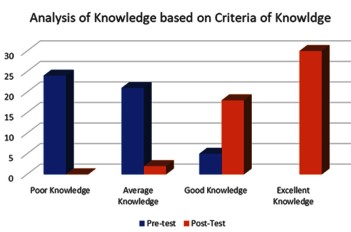
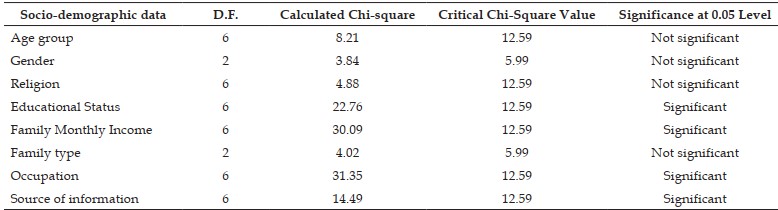
Background of Study: Emotional and behavioural problems are a common concern for guardians and family members. Emotional and behavioural problems in early childhood tend to continue into middle childhood and adolescence and can predict later social and academic problems or other difficulties such as substance use. Objectives: Assess the knowledge regarding Childhood Emotional and Behavioral Problems before the structured teaching program. Assess the knowledge regarding Childhood Emotional and Behavioral Problems after the structured teaching program. Assess the effectiveness of structured teaching on knowledge regarding childhood emotional and behavioural problems among parents. To find the association between knowledge with selected socio-demographic variables. Research Methodology: This research was a quantitative evaluatory study. A Pre-experimental study design was used to obtain an accurate and meaningful description of the study. The study population was parents of children. The setting for the present study is three villages. The nonprobability purposive sampling technique approach was brought to be most appropriate for the study. The sample size included in the study consist of 100 parents of children Parents having children age group 5–18 years were enrolled as study participants. Result: The pre-test mean score is 11.6, the Mean percentage is 29, and the standard deviation is ±6.45. The post-test mean score is 31.9, the Mean percentage is 79.75, and the standard deviation is ± 4.88. the majority of subjects, 48% (48) had poor knowledge regarding childhood emotional and behavioural disorders in the pre-test, 42% (42) had an average of knowledge, and only 10% (10) subjects had good knowledge in the pre-test. After one week of the planned teaching program, 60% (60) of the subject had excellent knowledge, 36% (36) had good knowledge, and 4% (4) had average knowledge. There is significant association between sociodemographic variable and knowledge score as the calculated chi-square value is greater than the table values at 0.05 level of significance. Conclusion: In our study, we found that the majority of subjects, 48%, had poor knowledge regarding childhood emotional and behavioural disorders in the pre-test, and 42% had an average of knowledge. Only 10% of subjects had good knowledge in the pre-test, and none of them had excellent knowledge regarding childhood emotional and behavioural disorders in the pre-test. After one week of the planned teaching program, 60% of the subject had excellent knowledge, 36% had good knowledge, and 4% had average knowledge. In this study, we found that parents gain knowledge about emotional and behavioural disorders.
References
- 1. Ogundele MO. Behavioural and emotional disorders in childhood: A brief overview for paediatricians. World J Clin Pediatr. 2018 Feb 8;7(1):9-26. doi: 10.5409/wjcp.v7.i1.9. PMID: 29456928; PMCID: PMC5803568.
- 2. Blanchard LT, Gurka MJ, Blackman JA. Emotional, developmental, and behavioral health of American children and their families: a report from the 2003 National Survey of Children’s Health. Pediatrics. 2006 Jun;117(6):e1202-12. doi: 10.1542/peds.2005- 2606. PMID: 16740820.
- 3. Hussein, S. A. (2008). Behavioral problems among children attending private and community schools in Karachi, Pakistan. Pakistan Journal of Psychological Research, 23(2). Pp 01 -11.
- 4. A., V. (1985, Jan). Psychiatric epidemiology in a sample of 1510 ten-year-old children--I. Prevalence. J Child Psychol Psychiatry, 26(1), 55-75. doi:10.1111/j.1469-7610.1985.tb01628.x.
- 5. Shaffer D, F. P.-S. (1996, July). he NIMH Diagnostic Interview Schedule for Children Version 2.3 (DISC- 2.3): description, acceptability, prevalence rates, and performance in the MECA Study. Methods for the Epidemiology of Child and Adolescent Mental Disorders Study. J Am Acad Child Adolesc Psychiatry., 35(7), 865-77. doi:10.1097/00004583- 199607000-00012.
- 6. Elnagar MN, M. P. (1971, May). Mental health in an Indian rural community. Br J Psychiatry, 118(546), 499-503. doi:10.1192/bjp.118.546.499.
- 7. Vardhini, R. P. (1990). Psychosocial problems among rural children-an epidemiological study. Bangalore University.
- 8. Chacko R. Psychiatric problems in children. Ind J Psychiatry. 1964;6:147. [Google Scholar]
- 9. Rohini D. Psychiatric problems in children with chronic renal diseases (dissertation) Univ of Pune; Pune: 1999. [Google Scholar].
- 10. Malhotra S, P. B.. Prevalence of child and adolescent psychiatric disorders in India: a systematic review and meta-analysis. Child Adolesc Psychiatry Ment Health., 2014, July 21, 8 (22). doi:10.1186/1753-2000- 8-22.
- 11. Prakash J, S. S.. Study of Behaviour Problems in a Paediatric Outpatient Department. Med J Armed Forces India, 2006, October (62), 339-41. doi:10.1016/ S0377-1237(06)80102-4.
- 12. Srinath S, Girimaji SC, Gururaj G, Seshadri S, Subbakrishna DK, Bhola P, Kumar N. Epidemiological study of child & adolescent psychiatric disorders in urban & rural areas of Bangalore, India. Indian J Med Res. 2005 Jul;122(1):67-79. PMID: 16106093.
- 13. Faizi N, Azmi SA, Ahmad A, Shah MS. Assessment of psychological problems in schoolgoing adolescents of Aligarh. Ind Psychiatry J. 2016 JulDec;25(2):184-188. doi: 10.4103/ipj.ipj_65_14. PMID: 28659698; PMCID: PMC5479092.
- 14. Sarda R, K. N. (2013, October-December). Prevalence of Psychiatric Disorders in Western U.P. RegionA School Based Study. International Journal of Scientific Study, 1(3), 70-76.
- 15. Keyho K, G. N. (2019). Prevalence of mental health status in adolescent school children of Kohima District, Nagaland. Ann Indian Psychiatry, 3(1), 39- 42. . doi:10.4103/aip.aip_52_18.
- 16. Rajpurohit A, H. M. Behavioural disorders amongst children of a rural community of Lucknow, India. Indian J Community Health, 28(2), (2016 , June 30, 192-5. Retrieved from www.iapsmupuk.org/ journal/index.php/IJCH/article/view/673.
- 17. Kunemund, R. (2009). Teacher-child rel cher-child relationships, in tionships, interactions, and tions, and problem beh problem behavior: a l vior: a longitudinal analysis examining sis examining bi-directional associations. Teacher-child rel cherchild relationships, in tionships, interactions, and tions, and problem beh problem behavior: a l vior: a longitudinal analysis examining sis examining bi-directional associations. Virginia Commonwealth University. Retrieved August 22, 2022, from https://scholarscompass.vcu.edu/cgi/ viewcontent.cgi?article=7075&context=etd.
- 18. Hernández-Alava M, P. G. (2017, April). Children’s Development and Parental Input: Evidence From the UK Millennium Cohort Study. Demography(2), 485-511. doi:10.1007/s13524-017-0554-6.
- 19. Kumari P., S. J. (2018). (Punjab), A Descriptive Study to Assess the Behavioral Problems among Preschool Children at Selected Anganwadi centers of Distt. Roopnagar. Asian J. Nursing Education and Research, 8(2), 220-224. doi:10.5958/2349- 2996.2018.00045.9.
- 20. Vikan A. Psychiatric epidemiology in a sample of 1510 ten-year-old children-I. Prevalence. J Child Psychol Psychiatry. 1985 Jan;26(1):55-75. doi: 10.1111/j.1469-7610.1985.tb01628.x.
Data Sharing Statement
There are no additional data available. All raw data and code are available upon request.
Funding
This research received no funding.
Author Contributions
All authors contributed significantly to the work and approve its publication.
Ethics Declaration
This article does not involve any human or animal subjects, and therefore does not require ethics approval.
Acknowledgements
We would like to express our gratitude to the patients, their families, and all those who have contributed to this study.
Conflicts of Interest
No conflicts of interest in this work.
About this article

Cite this article
Chuneshwari Sahu/Effect of Structured Teaching Regarding Childhood Emotional and Behavioral Problems among Parents/J Psychiatr Nurs. 2022;11(3):93–99.
Licence:
Attribution-Non-commercial 4.0 International (CC BY-NC 4.0)This license enables reusers to distribute, remix, adapt, and build upon the material in any medium or format for noncommercial purposes only, and only so long as attribution is given to the creator.
| Received | Accepted | Published |
|---|---|---|
| August 26, 2022 | September 28, 2022 | December 25, 2022 |
DOI: https://doi.org/10.21088/jpn.2277.9035.11322.3
Keywords
Emotional disorderBehavioural disorderChildhood mental problemsSearch for Similar Articles
Similar Articles
- Effectiveness of T’ai Chi Therapy on Depression
- Astudy to assess the Effect of Laughter Therapy on Anxiety
- A Cross Sectional Study to assess the pattern of mobile phone usage and effects...
- Health Anxiety among Adults Attending Selected Health Centre, At UAE
- A Study to assess the Knowledge on Anti-Social Behaviour among Adolescent betwee...
Article Level Metrics
Last UpdatedTuesday 18 August 2026, 17:46:41 (IST)
1289
Accesses
3
155
00
Citations
NA
NA
NA
Download citation
Article Keywords
Keyword Highlighting
Highlight selected keywords in the article text.
Timeline
| Received | August 26, 2022 |
| Accepted | September 28, 2022 |
| Published | December 25, 2022 |
licence
Attribution-Non-commercial 4.0 International (CC BY-NC 4.0)
This license enables reusers to distribute, remix, adapt, and build upon the material in any medium or format for noncommercial purposes only, and only so long as attribution is given to the creator.