Full Text (PDF)
International Journal of Food, Nutrition & Dietetics 13(2):p 63-74, May-August 2025. | DOI: 10.21088/ijfnd.2348.9987.161224.4
Original Article
Harnessing Traditional Knowledge for Infant Nutrition: A Review of Complementary Feeding Practices in India
Indresh Kumar, Sabavath Arun, Bhavna Dhingra
Author Information
Licence:
Attribution-Non-commercial 4.0 International (CC BY-NC 4.0)This license enables reusers to distribute, remix, adapt, and build upon the material in any medium or format for noncommercial purposes only, and only so long as attribution is given to the creator.
International Journal of Food, Nutrition & Dietetics 13(2):p 63-74, May-August 2025. | DOI: 10.21088/ijfnd.2348.9987.161224.4
How Cite This Article:
Kumar I, Arun S, Dhingra B. Harnessing Traditional Knowledge for Infant Nutrition: A Review of Complementary Feeding Practices in India. Int J Food Nutr Diet. 2025;13(2):63-74.Timeline
Received : July 25, 2025
Accepted : August 05, 2025
Published : August 20, 2025
Abstract
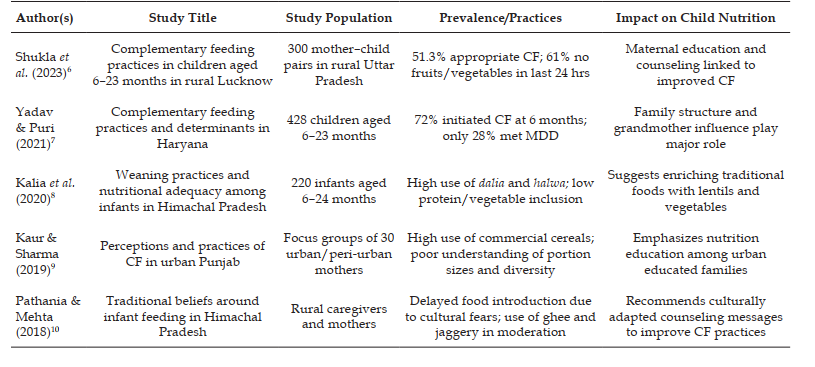
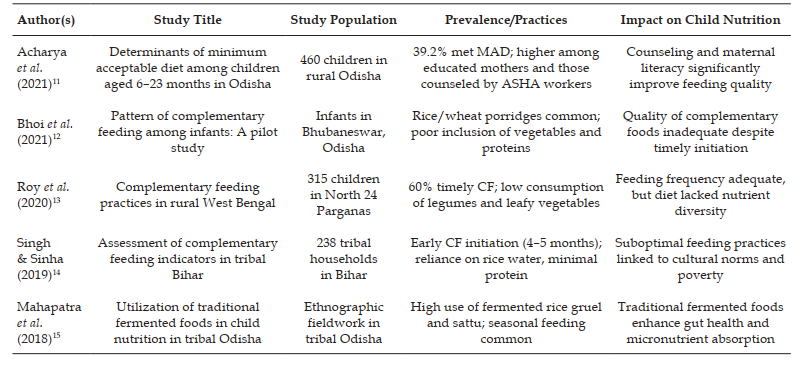
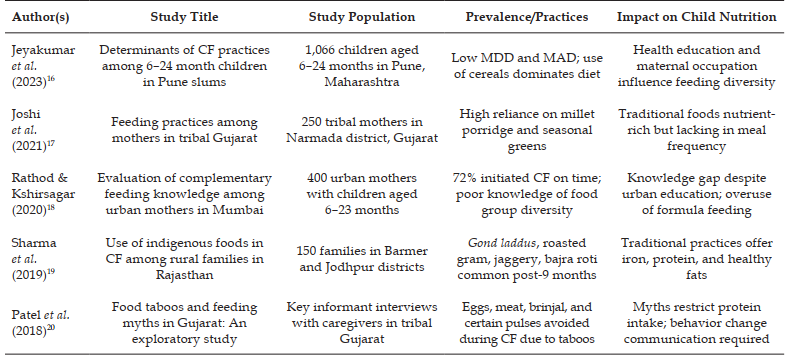
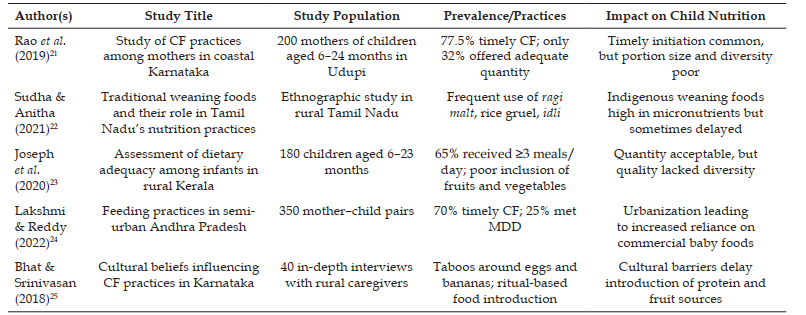
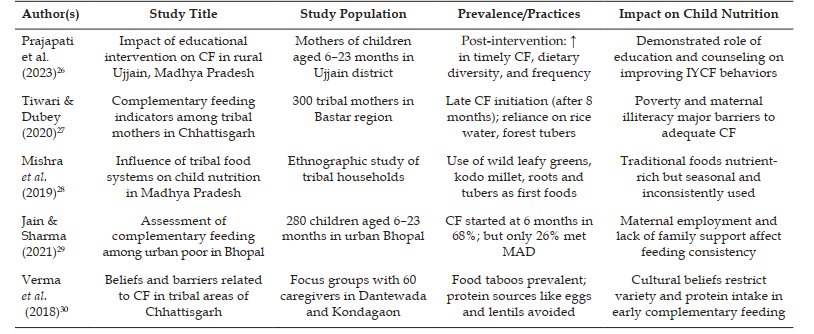
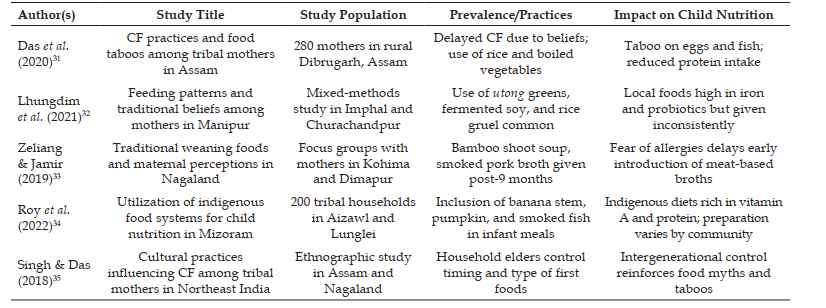
This narrative review explores region-specific complementary feeding (CF) practices and the role of traditional knowledge systems across six zones of India North, South, East, West, Central, and Northeast. Despite India’s cultural richness and availability of indigenous nutrient-dense foods, national data reveal that only 11.3% of children aged 6–23 months meet the Minimum Acceptable Diet (MAD) as per NFHS-5 (2019–21). A comprehensive literature search was conducted across four databases and grey literature sources to identify empirical studies published between 2015 and 2024. A total of 30 high-quality studies were selected and analyzed to examine dietary diversity, frequency, food types, and sociocultural factors influencing CF. The review highlights regionally diverse traditional practices, including the use of khichdi in North India, fermented rice in the East, ragi porridge in the South, gond laddus in the West, wild greens in Central India, and fermented soybean and bamboo shoots in the Northeast. While many of these foods align with WHO feeding recommendations, their potential is often underutilized due to maternal illiteracy, poverty, cultural taboos, inconsistent health counseling, and growing dependence on commercial baby foods. Findings suggest that integrating validated indigenous practices into national IYCF strategies can enhance child nutrition outcomes. The review advocates for culturally sensitive health education, empowerment of frontline workers, and incorporation of traditional foods into nutrition policies. Harnessing India’s culinary heritage, alongside scientific guidelines, presents a promising pathway toward sustainable reduction of undernutrition in children under two.
References
- 1. World Health Organization. Identification of severe acute malnutrition in children 6–59 months of age. Geneva: WHO; 2023. Accessed February 19, 2025. https://www.who.int/ tools/elena/interventions/sam-identification.
- 2. Kumar I. Child stunting in India: new figures with flagrant challenges. Int J Food Nutr Diet. 2023;11(1):9-13.
- 3. Ministry of Health and Family Welfare, Government of India. Participant manual for facility-based care of severe acute malnutrition. New Delhi: Ministry of Health and Family Welfare; 2013. Accessed February 19, 2025. https://www.nhm.gov.in/.
- 4. Markos M, Samuel B, Challa A. Minimum acceptable diet and associated factors among 6-23 months old children enrolled in outpatient therapeutic program in the Tulla district, Sidama region, Ethiopia: a community-based cross-sectional study. J Health Popul Nutr. 2024;43(1):106. doi:10.1186/s41043-024-00581-9.
- 5. Kumar I. Severe acute malnutrition (SAM) in pediatrics. Int J Food Nutr Diet. 2025;13(1):7-9.
- 6. Shukla R, Verma A, Kumar D. Complementary feeding practices in children aged 6–23 months in rural Lucknow: a cross-sectional study. J Pediatr Nutr. 2023;19(1):56-63.
- 7. Yadav S, Puri R. A study of complementary feeding practices and their determinants among mothers of under-two children in Haryana. Int J Community Med Public Health. 2021;8(4):1723-1729.
- 8. Kalia M, Thakur R, Chauhan G. Assessment of weaning practices and nutritional adequacy among infants in Himachal Pradesh. Indian J Community Health. 2020;32(2):295-300.
- 9. Kaur N, Sharma P. Perceptions and practices of complementary feeding among mothers in urban Punjab: a qualitative study. Indian J Nutr Diet. 2019;56(3):220-229.
- 10. Pathania D, Mehta R. Traditional feeding practices and beliefs in Himachal Pradesh: implications for child health. J Health Dev. 2018;14(1):45-52.
- 11. Acharya P, Sahoo H, Panda B. Determinants of minimum acceptable diet among children aged 6–23 months in Odisha. J Health Nutr Res. 2021;9(2):112-120.
- 12. Bhoi S, Patnaik S, Das M. Pattern of complementary feeding among infants: a pilot study. Indian J Child Health. 2021;8(1):32-36.
- 13. Roy A, Ghosh S, Das R. Complementary feeding practices in rural West Bengal: a communitybased study. Int J Pediatr. 2020;7(4):98-103.
- 14. Mahapatra R, Nayak B, Mishra S. Utilization of traditional fermented foods in child nutrition in tribal Odisha. J Ethnobiol Food Pract. 2018;12(3):211-218.
- 15. Singh P, Sinha S. Assessment of complementary feeding indicators in tribal Bihar. Indian J Nutr. 2019;6(1):14-21.
- 16. Jeyakumar A, Thomas B, Deshmukh P. Determinants of complementary feeding practices among children aged 6–24 months in urban slums of Pune, India. J Matern Child Health. 2023;7(1):22-30.
- 17. Joshi V, Bhagat S, Solanki R. Feeding practices among tribal mothers in Narmada district of Gujarat. Indian J Community Health. 2021;33(2):215-221.
- 18. Rathod P, Kshirsagar V. Evaluation of knowledge and practices regarding complementary feeding among urban mothers in Mumbai. Int J Child Dev. 2020;9(2):115-120.
- 19. Sharma R, Singh B, Dey M. Role of indigenous complementary foods in improving nutritional outcomes in Rajasthan. Indian J Public Health Res Dev. 2019;10(4):362-367.
- 20. Patel K, Sharma D, Dholakia H. Food taboos and feeding myths in Gujarat: an exploratory study. J Ethnonutr. 2018;12(3):78-85.
- 21. Rao N, Shetty A, D’Costa A. Study of complementary feeding practices among mothers of children aged six months to two years in coastal Karnataka. Indian J Public Health Res Dev. 2019;10(7):50-55.
- 22. Sudha R, Anitha P. Traditional weaning foods and their role in Tamil Nadu’s infant nutrition practices. J Tradit Knowl Child Care. 2021;15(1):89-96.
- 23. Joseph T, Mathew A, Varghese S. Assessment of dietary adequacy among infants and toddlers in rural Kerala. J Community Nutr. 2020;6(3):152-159.
- 24. Lakshmi G, Reddy D. Feeding practices among mothers in semi-urban Andhra Pradesh: a cross-sectional study. South Indian J Public Health. 2022;9(1):45-51.
- 25. Bhat S, Srinivasan S. Cultural beliefs and their influence on complementary feeding in rural Karnataka. Indian J Child Health. 2018;5(2): 107-112.
- 26. Prajapati K, Singh N, Solanki A. Impact of educational intervention on complementary feeding practices in rural Ujjain. J Community Nutr Health. 2023;9(1):25-33.
- 27. Tiwari D, Dubey M. Complementary feeding indicators among tribal mothers in Bastar region of Chhattisgarh. Indian J Matern Child Health. 2020;5(4):115-121.
- 28. Mishra M, Patel S, Rawat R. Influence of tribal food systems on child nutrition in Madhya Pradesh. J Tribal Health. 2019;6(1):44-52.
- 29. Jain R, Sharma P. Assessment of complementary feeding practices among the urban poor in Bhopal. Int J Public Health Stud. 2021;8(2):87-94.
- 30. Verma A, Chaudhary S, Nayak R. Beliefs and barriers to appropriate complementary feeding in tribal districts of Chhattisgarh. Indian J Soc Med. 2018;12(3):122-128.
- 31. Das R, Dutta P, Borah H. Complementary feeding practices and food taboos among tribal mothers in Assam. Indian J Child Nutr. 2020;7(1):25-31.
- 32. Lhungdim H, Singh P, Kipgen R. Feeding patterns and cultural beliefs influencing IYCF in Manipur: a mixed-methods study. J Tribal Health Nutr. 2021;9(2):76-84.
- 33. Zeliang L, Jamir M. Traditional weaning foods and maternal perceptions in Nagaland: a qualitative exploration. Indian J Matern Child Health. 2019;11(3):143-149.
- 34. Roy T, Lalnunthari Z, Tluanga L. Utilization of indigenous food systems for complementary feeding in Mizoram. Northeast India J Community Nutr. 2022;5(1):18-26.
- 35. Singh N, Das S. Cultural practices influencing complementary feeding among tribal mothers in Northeast India: an ethnographic study. J Ethnohealth Dietetics. 2018;12(2):90-98.
Data Sharing Statement
There are no additional data available.
Funding
This research received no funding.
Author Contributions
All authors contributed significantly to the work and approve its publication.
Ethics Declaration
This article does not involve any human or animal subjects, and therefore does not require ethics approval.
Acknowledgements
The authors gratefully acknowledge the contributions of researchers whose empirical studies formed the foundation of this review. Their work across diverse regions of India has provided invaluable insights into complementary feeding practices and traditional knowledge systems. We also extend our appreciation to the peer reviewers and academic mentors whose critical feedback helped enhance the clarity and rigor of this article.
Conflicts of Interest
The authors report no conflicts of interest in this work.
About this article

Cite this article
Kumar I, Arun S, Dhingra B. Harnessing Traditional Knowledge for Infant Nutrition: A Review of Complementary Feeding Practices in India. Int J Food Nutr Diet. 2025;13(2):63-74.
Licence:
Attribution-Non-commercial 4.0 International (CC BY-NC 4.0)This license enables reusers to distribute, remix, adapt, and build upon the material in any medium or format for noncommercial purposes only, and only so long as attribution is given to the creator.
| Received | Accepted | Published |
|---|---|---|
| July 25, 2025 | August 05, 2025 | August 20, 2025 |
DOI: 10.21088/ijfnd.2348.9987.161224.4
Keywords
Infant and Young Child Feeding (IYCF)Complementary FeedingTraditional KnowledgeIndigenous FoodsCultural BeliefsDietary DiversitySearch for Similar Articles
Similar Articles
- Assessment of Awareness and Sources of Information Regarding Polycystic Ovary Sy...
- Food Exchange List: A Powerful Tool for Weight Management
- Effect of Banana (Musa acuminata) Peel Flour Inclusion on the Quality Characteri...
- Rising Malnutrition in India: Epidemiology, Inequalities, and Policy Challenges...
- Development and Nutritional Evaluation of a Protein-Rich Red Lentil Spread as a...
Article Level Metrics
Last UpdatedFriday 17 July 2026, 06:06:41 (IST)
945
Accesses
21
107
00
Citations
NA
NA
NA
Download citation
Article Keywords
Keyword Highlighting
Highlight selected keywords in the article text.
Timeline
| Received | July 25, 2025 |
| Accepted | August 05, 2025 |
| Published | August 20, 2025 |
licence
Attribution-Non-commercial 4.0 International (CC BY-NC 4.0)
This license enables reusers to distribute, remix, adapt, and build upon the material in any medium or format for noncommercial purposes only, and only so long as attribution is given to the creator.