Full Text (PDF)
International Journal of Food, Nutrition & Dietetics 13(2):p 55-61, May-August 2025. | DOI: 10.21088/ijfnd.2348.9987.161224.3
Original Article
Fast Food Frequency and its Correlation with Sleep and Energy Levels
Author Information
Licence:
Attribution-Non-commercial 4.0 International (CC BY-NC 4.0)This license enables reusers to distribute, remix, adapt, and build upon the material in any medium or format for noncommercial purposes only, and only so long as attribution is given to the creator.
International Journal of Food, Nutrition & Dietetics 13(2):p 55-61, May-August 2025. | DOI: 10.21088/ijfnd.2348.9987.161224.3
How Cite This Article:
Bayaskar S. Fast Food Frequency and Its Correlation with Sleep and Energy Levels. Int J Food Nutr Diet. 2025;13(2):55-61.Timeline
Received : August 07, 2025
Accepted : August 19, 2025
Published : August 20, 2025
Abstract
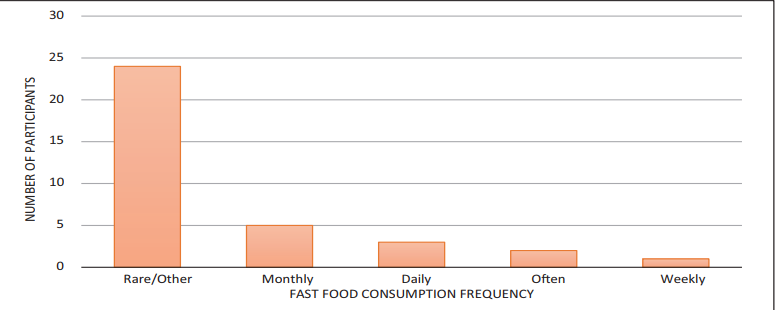
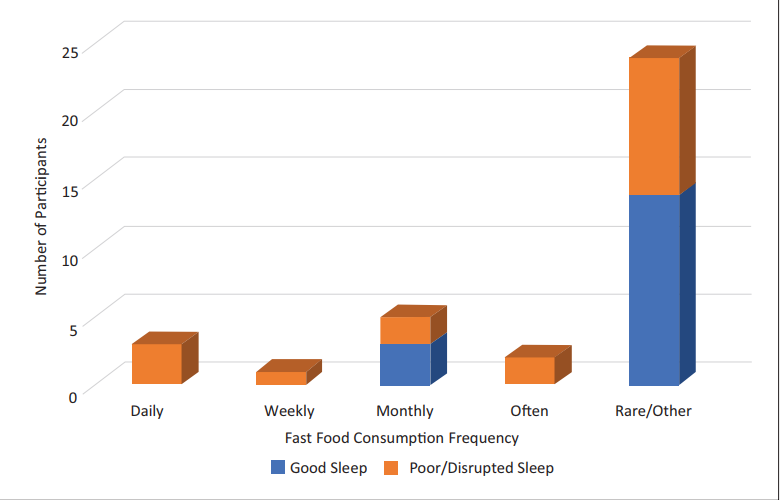
Background: Fast food consumption has become increasingly common, especially among young adults, raising concerns about its potential effects on sleep and energy regulation. While existing literature links fast food to various health issues, limited qualitative data exists exploring its behavioral and psychological consequences, particularly in relation to sleep quality and fatigue. Objectives: To explore the relationship between fast food consumption frequency and self-reported sleep patterns and energy levels among adults aged 18 to 45 years. Methodology: A qualitative, cross-sectional study was conducted using in-depth, semi-structured interviews with 35 participants from diverse educational and occupational backgrounds. Participants were categorized based on fast food intake frequency (daily, weekly, monthly, often, rare/occasional). Thematic analysis was applied to the transcribed interviews to identify recurring patterns in reported sleep and energy experiences. Results: The majority of participants (24) reported rare or occasional intake, with smaller numbers consuming fast food monthly (5), daily (3), often (2), or weekly (1). Frequent consumers often experienced disrupted sleep, daytime fatigue, poor digestion, and heaviness. In contrast, those who reduced or rarely consumed fast food reported improved sleep quality, better mood, sustained energy, and enhanced mental clarity. Conclusion: Frequent fast food consumption appears to be associated with poorer sleep quality and lower energy levels. Conversely, reduced intake may support better psychological and physical well-being, suggesting the need for dietary awareness and behavioral interventions focused on sleep and nutrition.
References
- 1. Bowman, S. A., & Vinyard, B. T. (2004). Fast food consumption of U.S. adults: Impact on energy and nutrient intakes and overweight status. Journal of the American College of Nutrition, 23(2), 163-168.
- 2. Pereira, M. A., Kartashov, A. I., Ebbeling, C. B., Van Horn, L., Slattery, M. L., Jacobs, D. R., & Ludwig, D. S. (2005). Fast-food habits, weight gain, and insulin resistance (the CARDIA study): 15-year prospective analysis. The Lancet, 365(9453), 36-42.
- 3. Rosenheck, R. (2008). Fast food consumption and increased caloric intake: A systematic review of a trajectory towards weight gain and obesity risk. Obesity Reviews, 9(6), 535-547.
- 4. St-Onge, M. P., Mikic, A., & Pietrolungo, C. E. (2016). Effects of diet on sleep quality. Advances in Nutrition, 7(5), 938-949.
- 5. Grandner, M. A., Kripke, D. F., Naidoo, N., & Langer, R. D. (2010). Relationships among dietary nutrients and subjective sleep, objective sleep, and napping in women. Sleep Medicine, 11(2), 180-184.
- 6. Tanaka, E., Yatsuya, H., Uemura, M., Murata, C., Otsuka, R., Toyoshima, H., & Tamakoshi, K. (2018). Associations of frequency of fast food consumption with sleep quality in Japanese adults. Journal of Nutritional Science and Vitaminology, 64(1), 43-50.
- 7. Lassale, C., Batty, G. D., Baghdadli, A., Jacka, F., Sánchez-Villegas, A., Kivimäki, M., & Akbaraly, T. (2019). Healthy dietary indices and risk of depressive outcomes: A systematic review and meta-analysis of observational studies. Molecular Psychiatry, 24(7), 965-986.
- 8. Jacka, F. N., Kremer, P. J., Berk, M., de SilvaSanigorski, A. M., Moodie, M., & Swinburn, B. A. (2010). A prospective study of diet quality and mental health in adolescents. PLoS ONE, 5(9), e2481.
- 9. Chaput, J. P. (2014). Sleep patterns, diet quality and energy balance. Physiology & Behavior, 134, 86-91.
- 10. Patel, S. R., & Hu, F. B. (2008). Short sleep duration and weight gain: A systematic review. Obesity, 16(3), 643-653.
- 11. Neumark-Sztainer, D., Story, M., Perry, C., & Casey, M. A. (1999). Factors influencing food choices of adolescents: Findings from focusgroup discussions with adolescents. Journal of the American Dietetic Association, 99(8), 929-937.
- 12. Larson, N. I., Neumark-Sztainer, D., Hannan, P. J., & Story, M. (2009). Trends in adolescent fruit and vegetable consumption, 1999-2004. American Journal of Preventive Medicine, 36(5), 411-417.
- 13. Hagger-Johnson, G., Sabia, S., Brunner, E. J., Shipley, M., Bobak, M., Marmot, M. G., & Kivimaki, M. (2013). Combined impact of smoking and heavy alcohol use on cognitive decline in early old age: Whitehall II prospective cohort study. British Journal of Psychiatry, 203(2), 120-125.
- 14. Nurul-Fadhilah, A., Teo, P. S., & Poh, B. K. (2016). Fast food consumption among Malaysian adolescents: Associations with dietary intake and body mass index. Asia Pacific Journal of Clinical Nutrition, 25(4), 776-783.
- 15. Buxton, O. M., & Marcelli, E. (2010). Short and long sleep are positively associated with obesity, diabetes, hypertension, and cardiovascular disease among adults in the United States. Social Science & Medicine, 71(5), 1027-1036.
- 16. Spiegel, K., Tasali, E., Penev, P., & Van Cauter, E. (2004). Brief communication: Sleep curtailment in healthy young men is associated with decreased leptin levels, elevated ghrelin levels, and increased hunger and appetite. Annals of Internal Medicine, 141(11), 846-850.
- 17. Taheri, S., Lin, L., Austin, D., Young, T., & Mignot, E. (2004). Short sleep duration is associated with reduced leptin, elevated ghrelin, and increased body mass index. PLoS Medicine, 1(3), e62.
- 18. Kant, A. K., & Graubard, B. I. (2004). Eating out in America, 1987–2000: Trends and nutritional correlates. Preventive Medicine, 38(2), 243-249.
- 19. Wansink, B., & Sobal, J. (2007). Mindless eating: The 200 daily food decisions we overlook. Environment and Behavior, 39(1), 106-123.
- 20. Leedo, E., Beck, A. M., Astrup, A., & Lassen, A. D. (2017). The effectiveness of healthy meals at work on employees’ dietary habits: A systematic review. Food & Nutrition Research, 61(1), 1325301.
Data Sharing Statement
There are no additional data available.
Funding
This research received no funding.
Author Contributions
All authors contributed significantly to the work and approve its publication.
Ethics Declaration
Ethical approval was obtained from the Institutional Ethics Committee before starting the study. Informed consent was secured from all participants, and confidentiality was strictly maintained. Participation was voluntary, and respondents could withdraw at any time without penalty.
Acknowledgements
Information not provide.
Conflicts of Interest
The authors report no conflicts of interest in this work.
About this article

Cite this article
Bayaskar S. Fast Food Frequency and Its Correlation with Sleep and Energy Levels. Int J Food Nutr Diet. 2025;13(2):55-61.
Licence:
Attribution-Non-commercial 4.0 International (CC BY-NC 4.0)This license enables reusers to distribute, remix, adapt, and build upon the material in any medium or format for noncommercial purposes only, and only so long as attribution is given to the creator.
| Received | Accepted | Published |
|---|---|---|
| August 07, 2025 | August 19, 2025 | August 20, 2025 |
DOI: 10.21088/ijfnd.2348.9987.161224.3
Keywords
Fast Food ConsumptionSleep QualityEnergy LevelsDietary HabitsQualitative StudyLifestyleAdult HealthCross-Sectional ResearchSearch for Similar Articles
Similar Articles
- Assessment of Awareness and Sources of Information Regarding Polycystic Ovary Sy...
- Food Exchange List: A Powerful Tool for Weight Management
- Effect of Banana (Musa acuminata) Peel Flour Inclusion on the Quality Characteri...
- Rising Malnutrition in India: Epidemiology, Inequalities, and Policy Challenges...
- Development and Nutritional Evaluation of a Protein-Rich Red Lentil Spread as a...
Article Level Metrics
Last UpdatedFriday 17 July 2026, 06:05:42 (IST)
945
Accesses
34
107
00
Citations
NA
NA
NA
Download citation
Article Keywords
Keyword Highlighting
Highlight selected keywords in the article text.
Timeline
| Received | August 07, 2025 |
| Accepted | August 19, 2025 |
| Published | August 20, 2025 |
licence
Attribution-Non-commercial 4.0 International (CC BY-NC 4.0)
This license enables reusers to distribute, remix, adapt, and build upon the material in any medium or format for noncommercial purposes only, and only so long as attribution is given to the creator.