Full Text (PDF)
Indian Journal of Research in Anthropology 10(1):p 79-94, January – June 2024. | DOI: http://dx.doi.org/10.21088/ijra.2454.9118.10124.9
Review Article
From Boom to Bust: Unpacking India’s Fertility Decline
Author Information
Licence:
Attribution-Non-commercial 4.0 International (CC BY-NC 4.0)This license enables reusers to distribute, remix, adapt, and build upon the material in any medium or format for noncommercial purposes only, and only so long as attribution is given to the creator.
Indian Journal of Research in Anthropology 10(1):p 79-94, January – June 2024. | DOI: http://dx.doi.org/10.21088/ijra.2454.9118.10124.9
How Cite This Article:
Nayana V, Sandeep J. From boom to bust: unpacking India’s fertility decline. Ind J Res Anthropol. 2024;10(1):79-94.Timeline
Received : April 22, 2024
Accepted : May 30, 2024
Published : June 28, 2024
Abstract
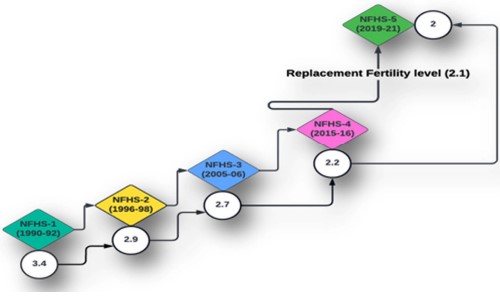
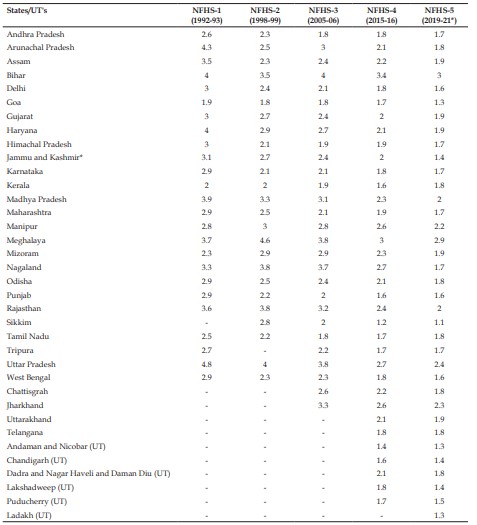
Astheworldgrappleswithshiftingdemographics,Indiastandsattheepicentreofaprofound transformation. This research delves into the intricate interplay of culture, fertility, and policy, dissecting the enigma of declining Total Fertility Rates (TFRs). Global trends are juxtaposed withtheIndiancontext.ThepaperchallengesthevalidityofMalthusianprinciplesandexplores the multifaceted causes behind India’s dwindling fertility rates. Consequences ripple across generations: an aging populace, labour shortages, and an impending birth crisis. Drawing insights from international experiences, the paper proposes tailored policy interventions. It advocates for the adoption of a nationwide Two-Child Policy in states with TFRs nearing or exceeding 2.0, while recommending a Three-Child Policy to promote sustainable growth in regions where rates fall below 1.0. As India navigates through this intricate terrain, the pursuit of equilibrium emerges as the overarching goal a future where cultural heritage, fertility aspirations, and pragmatic policy converge harmoniously.
References
- 1. Agarwal, A., & et al. (2015). A unique view on male infertility around the globe. Reprod Biol Endocrinol, 37.
- 2. Aitken, R. (2020a). The male is significantly implicated as the cause of unexplained infertility. Semin Reprod Med, 3-20.
- 3. Aitken, R. J. (2022). The changing tide of human fertility. Human Reproduction, 37(4), 629-638. Retrieved from https://doi.org/10.1093/humrep/ deac011.
- 4. Ambwani, M. V. (2023, July 28). Shrinking households: 50% of Indian families are nuclear. The Hindhu: Bussiness Line. Retrieved from https:// www.thehindubusinessline.com/economy/ shrinking-households-50-of-indian-families-are nuclear/article67126676.ece.
- 5. Bussiness Standand. (2024, March 26). Lancet projects further fall in India's fertility rate, raises concern. Retrieved from www.business-standard. com: https://www.business-standard.com/ india-news/lancet-projects-further-fall-in-india-s fertility-rate-raises-concern-124032500413_1.html
- 6. Cleland, J. (2008). Trends in Human Fertility. International Encyclopedia of Public Health, Second Edition, 2, 212-218. Retrieved from http://dx.doi. org/10.1016/B978-0-12-803678-5.00470-7
- 7. Dyson, T. (2010). Population and Development: The Demographic Transition. London, UK: Zed Books.
- 8. Govt of India. (2022, March). National Family Health Survey(NFHS-5), 2019–21(NFHS- 5)India Report. Retrieved from ruralindiaonline.org: https:// ruralindiaonline.org/en/library/resource/ national-family-health-survey-nfhs-5-2019-21 india/
- 9. Ha Park, E. (2020). Ultra-low Fertility and Policy Response in South Korea: Lessons from the Case of Japan. Ageing International, 45, 191-205.
- 10. Haub, C. (2009). Fertility in India: Trends and Prospects. Population Reference Bureau.
- 11. Jiyeon Yoon, K., Sunghee Kim, H., & Jihyun Jang. (2022). The relationship between changes in the korean fertility rate and policies to encourage fertility. BMC Public Health, 22.
- 12. Kearney, A., & White, K. (2016). Examining the psychosocial determinants of women’s decisions to delay childbearing. Hum Reprod, 1776-1787.
- 13. Kurashima, S., & Asahi, Y. (2022). Analysis of Declining Fertility Rate in Japan by Focusing on TFR and Women Moving. Human Interface and the Management of Information: Visual and Information Design, 337-353.
- 14. Lan, M., & Kuang , Y. (2021). Evolutionary trends in fertility among Chinese women, 1990–2015. Reproductive Health.
- 15. Lee,S., &HyojinChoi.(2015).Lowest-LowFertility and Policy Responses in South Korea. Low and lower fertility, 107-123.
- 16. Levine,H.,&et al.(2017). Temporal trends in sperm count: a systematic review and meta-regression analysis. Hum Reprod, 646-659.
- 17. Liu, D.,&Raftery, A. (2020). How do education and family planning accelerate fertility decline? Popul Dev Rev, 409-441.
- 18. Lv, M., & et al. (2021). Temporal trends in semen concentration and count among 327 373 Chinese healthy menfrom 1981 to2019: a systematic review. Hum Reprod, 751-775.
- 19. Majumdar, K. (2021, February 28). The decision not to have a kid is personal—but the social pressure against the choice is all-pervasive. Retrieved from Bussiness Insider-India: https://www.businessinsider.in/ the life/article/the-decision-not-to-have-a-kid is-personal-but-the-social-pressure-against-the choice-is-all-pervasive/articleshow/81259181.cms
- 20. Matta, A. (2019, April 23). Nowhere in India Are C Section Rates What They Should Be. THE SWDL.
- 21. Ministry of Health and Family Welfare. (2022, February 08). Status of IMR and MMR in India. Retrieved from PIB: https://pib.gov.in/ PressReleaseIframePage.aspx?PRID=1796436
- 22. Mishra,P., & et al. (2018). Decline in seminal quality in Indian men over the last 37 years. Reproductive Biology and Endocrinology.
- 23. Mohan, V. N., Shirisha, P., Vaidyanathan, G., & Muraleedharan , V. (2023). Variations in the prevalence of caesarean section deliveries in India between 2016 and 2021– an analysis of Tamil Nadu and Chhattisgarh. BMC Pregnancy and Childbirth.
- 24. NDTV. (2024, March 21). India's Fertility Rate Down From 6.2 To Under 2 Since 1950: Lancet Study. Retrieved from www.ndtv.com/india: https:// www.ndtv.com/india-news/indias-fertility-rate down-from-6-2-to-under-2-since-1950-will-fall-to 1-3-by-2050-lancet-study-5282221
- 25. Pandey, A. K., & et al. (2023). Alarming Trends of Cesarean Section—Time to Rethink: Evidence From a Large-Scale Cross-sectional Sample Survey in India. J Med Internet Res. doi:10.2196/41892
- 26. Pandey, G. (2022, December 9). The Indian women calling themselves ‘proudly single’. Retrieved from BBC: https://www.bbc.com/news/world-asia india-63873033
- 27. Pandey, S. (2019, December 3). Why these Indian couples are opting to not have kids. Retrieved from Times of India: https://timesofindia.indiatimes. com/life-style/parenting/getting-pregnant/why these-indian-couples-are-opting-to-not-have-kids/ articleshow/64135670.cms
- 28. Pandit, A. (2020, July 1). Better education of women helped push total fertility rate down. Retrieved from timesofindia.indiatimes.com: https://timesofindia. indiatimes.com/india/better-education-of women-helped-push-total-fertility-rate-down/ articleshow/76720789.cms
- 29. PIB. (2023). Periodic Labour Force Survey (PLFS) Annual Report 2022-2023 Released-Increasing Trend in Labour Force Participation Rate and Worker Population Ratio,Constant Decrease in Unemployment Rate. Delhi: PIB. Retrieved from https://pib.gov.in/Press Release Iframe Page.aspx?PRID=1966154
- 30. Quanbao-Jiang, S. Y., & Sánchez-Barricarte, J. J. (2022). China’s fertility change: an analysis with multiple measures. Population Health Metrics.
- 31. Sharma, K. (2018, April 27). 27.5 million couples in India suffering from infertility. Retrieved from Times of India: https://timesofindia.indiatimes. com/life-style/parenting/getting-pregnant/27-5 million-couples-in-india-suffering-from-infertility/ articleshow/63938393.cms
- 32. Swan, S., & Colino, S. (2021). Countdown: How Our Modern World is Threatening Sperm Counts, Altering Male and Female Reproductive Development and Imperiling the Future of the Human Race. New York, USA: Scribner.
- 33. TheCensusofIndia.(2001). The Census of India. Govt of India.
- 34. TheCensusofIndia.(2011). The Census of India. Govt of India.
- 35. The Census of India. (2020). Population Proiections For India And States (2011-2036). The Census of India.
- 36. The Economic Times. (2021, September 21). Muslims still have highest fertility rate among India's major religious groups, says Pew report. Retrieved from The Economic Times: https:// economictimes.indiatimes.com/news/india/ muslims-still-have-highest-fertility-rate-among indias-major-religious-groups-says-pew-report/ articleshow/86400196.cms
- 37. The Economic Times. (2022, July 15). Proportion of unmarried youth rising, finds govt survey. Retrieved from The Economic Times: https://economictimes. indiatimes.com/news/india/proportion-of unmarried-youth-rising-finds-govt-survey/ articleshow/92878668.cms?from=mdr
- 38. UNFPA. (2022, May). Child Marriage in India: Key Insights from the NFHS-5. Retrieved from india.unfpa. org: https://india.unfpa.org/sites/default/files/ pub-pdf/analytical_series_1_-_child_marriage_in_ india_-_insights_from_nfhs-5_final_0.pdf
- 39. UNFPA. (2023). India’s Population Growth and Policy Implications. India: Population Foundation of India supported by UNFPA India.
- 40. Varma, D. K. (2023). Declining Semen Quality In India: Implications, Factors And Interventions For Male Reproductive Health. Epra International Journal of Multidisciplinary Research (IJMR), 150-158.
- 41. Vollset, S., & et al. (2020). Fertility, mortality, migration, and population scenarios for 195 countries and territories from 2017 to 2100: a forecasting analysis for the Global Burden of Disease Study. Lancet, 1285-1306.
- 42. WHO. (2021). Caesarean section rates continue to rise, amid growing inequalities in access. Retrieved from WHO: https://www.who.int/news/item/16 06-2021-caesarean-section-rates-continue-to-rise amid-growing-inequalities-in-access.
Data Sharing Statement
There are no additional data available.
Funding
This research received no funding.
Author Contributions
All authors contributed significantly to the work and approve its publication.
Ethics Declaration
This article does not involve any human or animal subjects, and therefore does not require ethics approval
Acknowledgements
Information Not Provided
Conflicts of Interest
No conflicts of interest in this work.
About this article

Cite this article
Nayana V, Sandeep J. From boom to bust: unpacking India’s fertility decline. Ind J Res Anthropol. 2024;10(1):79-94.
Licence:
Attribution-Non-commercial 4.0 International (CC BY-NC 4.0)This license enables reusers to distribute, remix, adapt, and build upon the material in any medium or format for noncommercial purposes only, and only so long as attribution is given to the creator.
| Received | Accepted | Published |
|---|---|---|
| April 22, 2024 | May 30, 2024 | June 28, 2024 |
DOI: http://dx.doi.org/10.21088/ijra.2454.9118.10124.9
Keywords
Total fertility RateDemographic shiftPopulation SustainabilityBirth crisisNational child policyMalthusian principlesSearch for Similar Articles
Similar Articles
- Indigenous Knowledge System in Formal Education
- Contemporary Issues and Challenges in Women’s Weavers in the Varanasi Silk Sare...
- Understanding through Traversing the Corridors of History: Richness of Indian He...
- Challenges and Opportunities in Digital Preservation of Intangible Culture Herit...
- Assessment of Nutritional Indicators: A Comparative Study among Pre-School Child...
Article Level Metrics
Last UpdatedSunday 21 June 2026, 21:02:52 (IST)
760
Accesses
7
221
00
Citations
NA
NA
NA
Download citation
Article Keywords
Keyword Highlighting
Highlight selected keywords in the article text.
Timeline
| Received | April 22, 2024 |
| Accepted | May 30, 2024 |
| Published | June 28, 2024 |
licence
Attribution-Non-commercial 4.0 International (CC BY-NC 4.0)
This license enables reusers to distribute, remix, adapt, and build upon the material in any medium or format for noncommercial purposes only, and only so long as attribution is given to the creator.