Full Text (PDF)
Indian Journal of Emergency Medicine 9(1):p 9-15, January-March 2023. | DOI: /10.21088/ijem.2395.311X.9123.1
Original Article
Evaluation of the Clinical Profile of Head Injury Patients Presenting to ED
Saba Ali, Gireesh Kumar, Sreekrishnan T P
Author Information
Licence:
Attribution-Non-commercial 4.0 International (CC BY-NC 4.0)This license enables reusers to distribute, remix, adapt, and build upon the material in any medium or format for noncommercial purposes only, and only so long as attribution is given to the creator.
Indian Journal of Emergency Medicine 9(1):p 9-15, January-March 2023. | DOI: /10.21088/ijem.2395.311X.9123.1
How Cite This Article:
Saba Ali, Gireesh Kumar, Sreekrishnan T P/Evaluation of the Clinical Profile of Head Injury Patients Presenting to ED/ Indian J Emerg Med 2023;9(1):09–15.Timeline
Received : September 10, 2022
Accepted : October 19, 2022
Published : March 30, 2023
Abstract
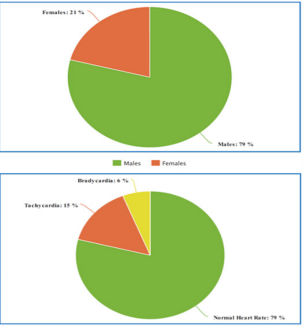
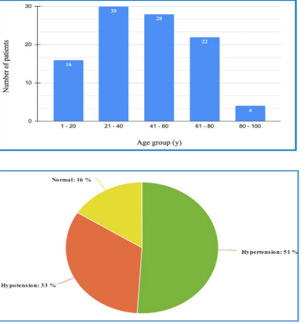
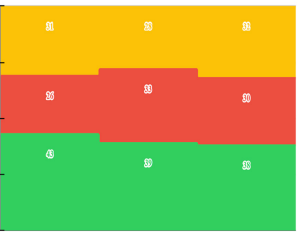
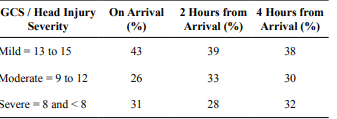
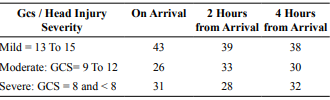
Background: Millions of people sustain head injuries by different MOIs due to various causes most of them being preventable. Head injuries mostly end up in either mortality or de-capacitating disabilities, often persisting lifelong. They cause the society to pay the heavy penalty of “the global loss of economy and human resources.” The study of the profiles of the head injury patients throws light on many important causes for concern to formulate strategies for patient management and injury prevention, as proved by studies. Early institution of appropriate management and care based on the head injury severity per GCS scores and timely transfers of patients to facilities that can cope with the patients’ needs play a pivotal role in preventing the worsening of primary and occurrence of secondary neuronal damages. Aim: To evaluate the clinical profile of Head Injury patients presenting to ED. Objectives: 1) To evaluate the correlation between GCS scores and the Head Injury severity 2) To evaluate the correlation between the time bound changes in the GCS scores and head injury severity Materials and Methods: The pre-approved prospective observational study was conducted on 100 head injury patients of both genders of all ages, presented to the ED of a quaternary care hospital in Kerala, India. Inclusion and exclusion criteria were strictly adhered to in the patient selection. MOIs in these patients were RTAs and nonaccidental (slip and fall) and accidental falls (fall from height). The clinical profile data collected, analyzed, and studied included gender, age, vital signs (heart rate and blood pressure on arrival), mechanism of injury, the need for cervical spine immobilization, the patient disposal, and GCS scores, and head injury severity based on GCS scores the last two assessed on patients' arrival, and subsequently at 2 and 4 hours after that. Results: The head injury prevalence was preponderant in the males and the age group between 20 and 50 years. Almost all the head injuries were due to high energy impacts, caused mainly through RTAs (> 2/3) and many (about 1/3) by non-accidental falls, and the last few (3%) because of accidental falls from heights. Except for a hand full of patients, all others needed cervical spine immobilization. However, all others were hospitalized in the ICU for the few duly discharged after observation in the ED, and the others were wheeled to or for emergent neurosurgical procedures after resuscitation. Based on GCS scores on arrival, the head injury severity was moderate and severe in one-fourth and one-third of the patients, respectively. There had been time bound de-escalation of the GCS scores with a proportional escalation of the severity in an appreciable number of patients. Conclusion: A part from the preponderance of head injury prevalence in the males and the second to fifth decade of life, most of the head injuries were due to high energy impacts, the majority of them being caused by RTAs and next by non-accidental falls, especially in the older adults and lastly in the least few due to accidental falls from height, often of occupational in nature. Except for very few, all others needed cervical spine immobilization and ICU care. In situations inaccessible for immediate access for Imaging, GCS scoring played a vital role in assessing and reassessing the head injury severity, which helped make patient management and transfer decisions early to prevent secondary neuronal injuries. “Most of the head injuries are often preventable.”A closer look globally at the prevailing traffic conditions, laxity in the traffic rules and regulations, including the lacuna in their implementation, would ensure safety on the road averting a high incidence of RTAs. Not only this, but also there needs to be a deep concern for the older adults succumbing to head injuries by ‘slip and fall’ and those sustaining head injuries by accidental falls from heights, mostly of occupational origin, are all of preventable nature by appropriate measures. Every health care personnel involved in the care of the head injury patients straight from the pre-hospital setup is being endorsed with the great responsibility of preventing the occurrence of secondary neuronal injuries in addition to averting further worsening of the already sustained neural damages.
References
- 1. GBD 2016 Traumatic Brain Injury and Spinal Cord Injury Collaborators. Global, regional, and national burden of traumatic brain injury and spinal cord injury, 1990-2016: a systematic analysis for the Global Burden of Disease Study 2016. Lancet Neurol. 2019;18(1):56-87. doi: 10.1016/S1474-4422(18)30415-0.
- 2. Menon DK, Schwab K, Wright DW, Maas AI; Demographics and Clinical Assessment Working Group of the International and Interagency Initiative toward Common Data Elements for Research on Traumatic Brain Injury and Psychological Health. Position statement: definition of traumatic brain injury. Arch Phys Med Rehabil. 2010;91(11):1637-40. doi: 10.1016/j.apmr.2010.05.017.
- 3. Ilie G, Boak A, Adlaf EM, Asbridge M, Cusimano MD. Prevalence and correlates of traumatic brain injuries among adolescents. JAMA. 2013;309(24):2550-2. doi: 10.1001/jama.2013.6750.
- 4. Daugherty J, Waltzman D, Sarmiento K, Xu L. Traumatic Brain Injury-Related Deaths by Race/Ethnicity, Sex, Intent, and Mechanism of Injury—the United States, 2000–2017. MMWR Morb Mortal Wkly Rep. 2019;68(46):1050-6. doi: 10.15585/mmwr.mm6846a2.
- 5. Abhilash KP, Chakraborthy N, Pandian GR, Dhanawade VS, Bhanu TK, Priya K. Profile of trauma patients in the emergency department of a tertiary care hospital in South India. J Family Med Prim Care. 2016;5(3):558-63. doi: 10.4103/2249-4863.197279.
- 6. Turgut K, Sarihan ME, Colak C, Güven T, Gür A, Gürbüz S. Falls from height: A retrospective analysis. World J Emerg Med. 2018;9(1):46-50. doi: 10.5847/wjem.j.1920-8642.2018.01.007.
- 7. Jain V, Jain S, Dhaon B. A Multi Factorial Analysis of the epidemiology of Injuries from fall from Heights. Int J Crit Illn Inj Sci. 2014;4(4):283-7. doi: 10.4103/2229-5151.147519.
- 8. Balestreri M, Czosnyka M, Chatfield DA, Perkes IE, Hutchinson PJ, Pickard JD. Predictive value of Glasgow Coma Scale after brain trauma: change in trend over the past ten years. J Neurol Neurosurg Psychiatry. 2004;75(1):161-2.
- 9. Saatman KE, Duhaime AC, Bullock R, deKosky ST, Meaney DF, McIntosh TK, et al. Classification of traumatic brain injury for targeted therapies. J Neurotrauma. 2008;25(7):719-38. doi: 10.1089/neu.2008.0586.
- 10. Rajajee V. Management of acute moderate and severe traumatic brain injury. In: UpToDate. Post TW, editor. Waltham (MA): UpToDate; (Accessed 2021 Jul 26).
- 11. Servadei F, Murray GD, Penny K, Teasdale G, De RM, for the European Brain Injury Consortium. The value of the
- 12. Chang EF, Meeker M, Holland MC. Acute traumatic intraparenchymal hemorrhage: risk factors for progression in the early post-injury period. Neurosurgery. 2006;58(4):647-56; discussion 647-56. doi: 10.1227/01.NEU.0000197101.68538.E6.
- 13. Oertel M, Kelly DF, McArthur D, Glenn DP, Gravina VR, Lee JH, et al. Progressive hemorrhage after head trauma: predictors and consequences of the evolving injury. J Neurosurg. 2002;96(1):109-16. doi: 10.3171/jns.2002.96.1.0109.
- 14. Narayan RK, Maas AI, Servadei F, Skolnick BE, Tillinger MN, Marshall SB, et al. Progression of traumatic intracerebral hemorrhage: a prospective observational study. J Neurotrauma. 2008;25(6):629-39. doi: 10.1089/neu.2007.0385.
- 15. Rajajee V, Aminoff MJ, Moreira ME, Rabinstein AA, Wilterdink JL. Management of acute moderate and severe traumatic brain injury. In: UpToDate. Post TW, editor. Waltham (MA): UpToDate; (Accessed 2021 Jul 26).
Data Sharing Statement
There are no additional data available. All raw data and code are available upon request.
Funding
This research received no funding.
Author Contributions
All authors contributed significantly to the work and approve its publication.
Ethics Declaration
This article does not involve any human or animal subjects, and therefore does not require ethics approval.
Acknowledgements
We would like to express our gratitude to the patients, their families, and all those who have contributed to this study.
Conflicts of Interest
The authors report no conflicts of interest in this work.
About this article

Cite this article
Saba Ali, Gireesh Kumar, Sreekrishnan T P/Evaluation of the Clinical Profile of Head Injury Patients Presenting to ED/ Indian J Emerg Med 2023;9(1):09–15.
Licence:
Attribution-Non-commercial 4.0 International (CC BY-NC 4.0)This license enables reusers to distribute, remix, adapt, and build upon the material in any medium or format for noncommercial purposes only, and only so long as attribution is given to the creator.
| Received | Accepted | Published |
|---|---|---|
| September 10, 2022 | October 19, 2022 | March 30, 2023 |
DOI: /10.21088/ijem.2395.311X.9123.1
Keywords
Head injuryRTAsPre-hospitalTraffic rules and regulationsSearch for Similar Articles
Similar Articles
- Covid 19 Vaccine: Associated Henoch Schonlein Purpura in Young Adult Female
- A Rare Case of Intolerance to Medically Approved Dose of Sildenafil Citrate in a...
- Acute Mesenteric Ischemia: An Unusual Cause of Hematemesis in a 48 Year Old Man
- Brachial Artery Pseudoaneurysm Related Causally to Iatrogenic Coagulopathy in a...
- Combination Therapy for Acute Management of Yellow Oleander Poisoning: A Case Re...
Article Level Metrics
Last UpdatedSaturday 05 September 2026, 23:02:15 (IST)
4074
Accesses
23
922
00
Citations
NA
NA
NA
Download citation
Article Keywords
Keyword Highlighting
Highlight selected keywords in the article text.
Timeline
| Received | September 10, 2022 |
| Accepted | October 19, 2022 |
| Published | March 30, 2023 |
licence
Attribution-Non-commercial 4.0 International (CC BY-NC 4.0)
This license enables reusers to distribute, remix, adapt, and build upon the material in any medium or format for noncommercial purposes only, and only so long as attribution is given to the creator.