Full Text (PDF)
International Journal of Neurology and Neurosurgery 17(2):p 176-182, May-August 2025. | DOI: 10.21088/ijnns.0975.0223.17225.13
Review Article
Epigenetic Modification and their Significance in Neurodevelopmental Disorder
Prachi Srivastava, Yuvraj Singh, Shrijal Singh
Author Information
Licence:
Attribution-Non-commercial 4.0 International (CC BY-NC 4.0)This license enables reusers to distribute, remix, adapt, and build upon the material in any medium or format for noncommercial purposes only, and only so long as attribution is given to the creator.
International Journal of Neurology and Neurosurgery 17(2):p 176-182, May-August 2025. | DOI: 10.21088/ijnns.0975.0223.17225.13
How Cite This Article:
Prachi Srivastava, et al. Epigenetic Modification and their Significance in Neurodevelopmental Disorder. International Journal of Neurology and Neurosurgery. 2025; 17(2): 176-182.Timeline
Received : March 12, 2025
Accepted : April 26, 2025
Published : July 30, 2025
Abstract
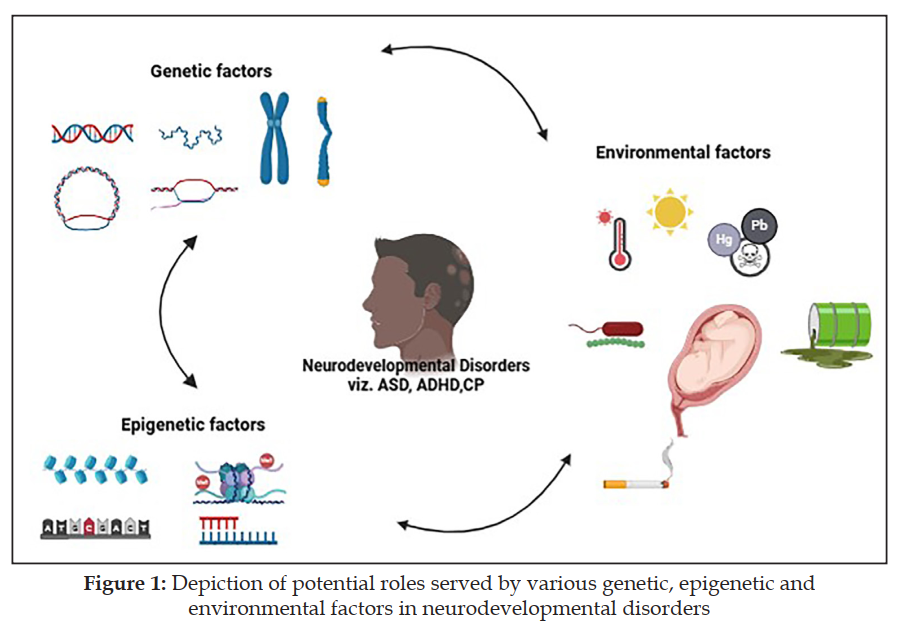
This study highlights the role of epigenetic processes as a key mechanism in the regulation and origin of neurodevelopmental disorders. Neurodevelopmental disorders encompass a different range of conditions that emerge while the developmental stage, marked by deficits in cognitive abilities or social interactions. Epigenetics plays a crucial role in gene regulation through chemical changes of DNA and histone proteins, which package the DNA. This regulation firstly involves DNA methylation and histone modifications, influencing chromatin structure and gene expression. The failure of this mechanism can cause various congenital disorders, some of which are discussed in this review like autism spectrum disorder (ASD), Attention/Deficit-Hyperactivity Disorder (ADHD), Genomic imprinting disorder, Cerebral Palsy (CP) and Intellectual disability disorders (IDDs). Thus, it summarizes the current association between epigenetics and the given disorders. Epigenetic modification in the genome are highly susceptible to environmental influences, including malnutrition, exposure to chemicals, and psychological stress, particularly during early development. Additionally, endocrine-disrupting chemicals can alter epigenetic patterns and gene expression, potentially contributing to conditions like autism spectrum disorder (ASD) and attention deficit hyperactivity disorder (ADHD). This highlights the role of epigenetic mechanisms in neurodevelopment throughout life and their impact on both neurodevelopmental and neurodegenerative disorders. By focussing on these aspects, this study aims to bring attention towards the environmental cues, their influence on epigenetics and the variance occurrence of congenital disorders.
References
- 1. Gapp K.;, Woldemichael B.T., Bohacek J., Mansuy I. Epigenetic regulation in neurodevelopment and neurodegenerative diseases Rights / license: Creative Commons Attribution-NonCommercial-NoDerivatives 4.0 International. doi:10.3929/ethz-b-000063022
- 2. Mohandas N., Bass-Stringer S., Maksimovic J., et al. Epigenome-wide analysis in newborn blood spots from monozygotic twins discordant for cerebral palsy reveals consistent regional differences in DNA methylation. Clin Epigenetics. 2018; 10(1). doi:10.1186/s13148-018- 0457-4.
- 3. Iwase S., Bérubé N.G., Zhou Z., et al. Epigenetic etiology of intellectual disability. Journal of Neuroscience. 2017; 37(45): 10773-10782. doi:10.1523/JNEUROSCI.1840-17.2017.
- 4. Loke Y.J., Hannan A.J., Craig J.M. The role of epigenetic change in autism spectrum disorders. Front Neurol. 2015;6(MAY).doi:10.3389/fneur.2015.00107
- 5. Kubota T., Takae H., Miyake K. Epigenetic mechanisms and therapeutic perspectives for neurodevelopmental disorders. Pharmaceuticals. 2012; 5(4): 369-383. doi:10.3390/ph5040369.
- 6. Kubota T., Mochizuki K. Epigenetic effect of environmental factors on autism spectrum disorders. Int J Environ Res Public Health. 2016;13(5). doi:10.3390/ijerph13050504
- 7. Kundakovic M., Jaric I. The epigenetic link between prenatal adverse environments and neurodevelopmental disorders. Genes (Basel). 2017; 8(3). doi:10.3390/genes8030104
- 8. Dall’Aglio L., Muka T., Cecil CAM, et al.The role of epigenetic modifications in neurodevelopmental disorders: A systematic review. Neurosci Biobehav Rev. 2018; 94: 17-30. doi:10.1016/j.neubiorev.2018.07.011
- 9. Kubota T. Epigenetic alterations induced by environmental stress associated with metabolic and neurodevelopmental disorders. Environ Epigenet. 2016; 2(3). doi:10.1093/eep/dvw017
- 10. Cristancho A.G., Marsh E.D. Epigenetics modifiers: potential hub for understanding and treating neurodevelopmental disorders from hypoxic injury. J Neurodev Disord. 2020; 12(1). doi:10.1186/s11689-020-09344-z
- 11. Monk D., Mackay DJG, Eggermann T., Maher E.R., Riccio A. Genomic Imprinting Disorders: Les.sons on How Genome, Epigenome and Environment Interact.
- 12. Kalish J.M., Jiang C., Bartolomei M.S. Epigenetics and imprinting in human disease. International Journal of Developmental Biology. 2014; 58(2-4): 291-298. doi:10.1387/ ijdb.140077mb
- 13. The Majority of Genes Are Inherited in 2 Copies.
- 14. Dall’Aglio L., Muka T., Cecil CAM, et al.The role of epigenetic modifications in neurodevelopmental disorders: A systematic review. Neurosci Biobehav Rev. 2018; 94: 17-30. doi:10.1016/j.neubiorev.2018.07.011
- 15. Cecil CAM, Nigg J.T. Epigenetics and ADHD: Reflections on Current Knowledge, Research Priorities and Translational Potential. Mol Diagn Ther. 2022; 26(6): 581-606. doi:10.1007/ s40291-022-00609-y
- 16. Tran NQV, Miyake K. Neurodevelopmental Disorders and Environmental Toxicants: Epigenetics as an Underlying Mechanism. Int J Genomics. 2017; 2017. doi:10.1155/2017/7526592
- 17. Ke T., Tinkov A.A., Skalny A.V., et al. Developmental exposure to methylmercury and ADHD, a literature review of epigenetic studies. Environ Epigenet. 2021;7(1). doi:10.1093/eep/dvab014
- 18. Romero B., Robinson K.G., Batish M., Akins R.E. An emerging role for epigenetics in cerebral palsy. J Pers Med. 2021;11(11). doi:10.3390/jpm11111187
- 19. Bahado-Singh R.O., Vishweswaraiah S., Aydas B., Mishra N.K., Guda C., Radhakrishna U. Deep learning/artificial intelligence and bloodbased DNA epigenomic prediction of cerebral palsy. Int J Mol Sci. 2019; 20(9). doi:10.3390/ijms20092075
- 20. Salomon I. Neurobiological Insights Into Cerebral Palsy: A Review of the Mechanisms and Therapeutic Strategies. Brain Behav. 2024; 14(10): e70065. doi:10.1002/brb3.70065
- 21. Van Bokhoven H. Genetic and epigenetic networks in intellectual disabilities. Annu Rev Genet. 2011; 45: 81-104. doi:10.1146/annurevgenet-110410-132512
- 22. Parkel S., Lopez-Atalaya J.P., Barco A. Histone H3 lysine methylation in cognition and intellectual disability disorders. Learning and Memory. 2013; 20(10): 570-579. doi:10.1101/ lm.029363.112
- 23. Toma I. De, Gil L.M., Ossowski S., Dierssen M. Where Environment Meets Cognition: A Focus on Two Developmental Intellectual Disability Disorders. Neural Plast. 2016; 2016. doi:10.1155/2016/4235898
Data Sharing Statement
There are no additional data available. All raw data and code are available upon request.
Funding
This research received no funding.
Author Contributions
All authors contributed significantly to the work and approve its publication.
Ethics Declaration
This article does not involve any human or animal subjects, and therefore does not require ethics approval.
Acknowledgements
This article does not involve any human or animal subjects, and therefore does not require ethics approval.
Conflicts of Interest
No conflicts of interest.
About this article

Cite this article
Prachi Srivastava, et al. Epigenetic Modification and their Significance in Neurodevelopmental Disorder. International Journal of Neurology and Neurosurgery. 2025; 17(2): 176-182.
Licence:
Attribution-Non-commercial 4.0 International (CC BY-NC 4.0)This license enables reusers to distribute, remix, adapt, and build upon the material in any medium or format for noncommercial purposes only, and only so long as attribution is given to the creator.
| Received | Accepted | Published |
|---|---|---|
| March 12, 2025 | April 26, 2025 | July 30, 2025 |
DOI: 10.21088/ijnns.0975.0223.17225.13
Keywords
EpigeneticsNeurodevelopmental disordersDNA methylationASDADHDGenomic imprintingEnvironmental factorsSearch for Similar Articles
Similar Articles
- Intramedullary Capillary Hemangioma of Conus Medullaris: Case Report and Review...
- Atypical Miller Fisher Syndrome
- Therapeutic Potential of Passiflora incarnata in the Management of Neurological...
- Central or Axial Atlantoaxial Dislocation: Redefining Instability at the Craniov...
- Assessment of Neurocognitive Functions in Post-Acute Stroke Patients Undergoing...
Article Level Metrics
Last UpdatedTuesday 29 September 2026, 10:10:52 (IST)
2211
Accesses
24
272
00
Citations
NA
NA
NA
Download citation
Article Keywords
Keyword Highlighting
Highlight selected keywords in the article text.
Timeline
| Received | March 12, 2025 |
| Accepted | April 26, 2025 |
| Published | July 30, 2025 |
licence
Attribution-Non-commercial 4.0 International (CC BY-NC 4.0)
This license enables reusers to distribute, remix, adapt, and build upon the material in any medium or format for noncommercial purposes only, and only so long as attribution is given to the creator.