Full Text (PDF)
Indian Journal of Communicable Diseases 10(1):p 7-11, January - June 2024. | DOI: https://doi.org/10.21088/ijcd.2395.6631.10124.1
Original Article
Environmental Risk Analysis for Unintentional Childhood Injuries in a Rural Area of Delhi, India
Author Information
Licence:
Attribution-Non-commercial 4.0 International (CC BY-NC 4.0)This license enables reusers to distribute, remix, adapt, and build upon the material in any medium or format for noncommercial purposes only, and only so long as attribution is given to the creator.
Indian Journal of Communicable Diseases 10(1):p 7-11, January - June 2024. | DOI: https://doi.org/10.21088/ijcd.2395.6631.10124.1
How Cite This Article:
Banerjee B. Environmental Risk Analysis for Unintentional Childhood Injuries in a Rural Area of Delhi, India. Indian J Community Dis. 2024;10(1):7-11.Timeline
Received : October 25, 2023
Accepted : November 30, 2023
Published : June 28, 2024
Abstract
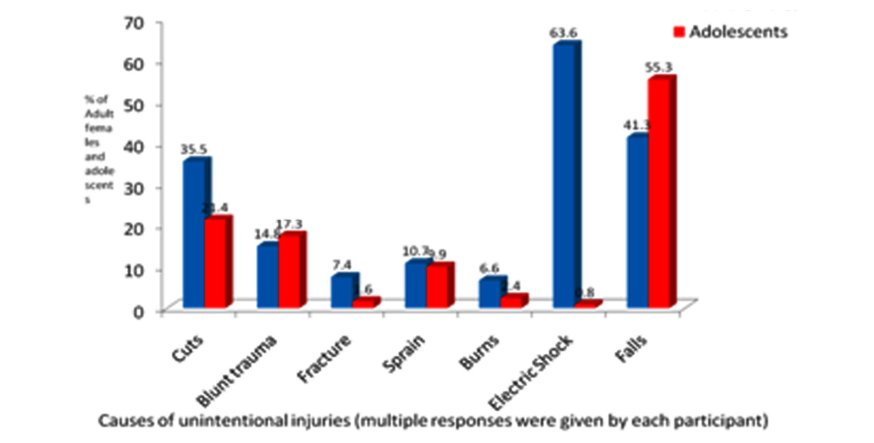
Unintentional childhood injuries cause high mortality and disability. Objective of this crosssectional study, conducted in two villages of Delhi, India, wasto assess risk of unintentional childhood injuries. Study population included adolescents and adult women of selected families. Data was collected by interview of the subjects and observation of domestic and peri-domestic environment, covering 121 houses, which included 299 adolescents and 164 women. Knowledge of the subjects regarding injuries and their prevention was assessed as Mean Subject Knowledge Score, which for the total population was 3.60 (15% of total score). Mean Family Practice Scoreas reported by subjects were 11.50 (38% of total score) and 10.60 (35% of total score) regarding injury prevention and injury treatment seeking behavior respectively. Mean environmental safety score was 19.95 (49.8% of total score). Mean knowledge score was 3.58 for adolescents and 5.00 for women. The difference was not statistically significant. Mean score regarding family practices for prevention of injuries was 13.45 for adolescents and 10.03 for women, with statistically significant difference. Mean score regarding injury treatment seeking behavior did not show any difference. Families under study are at high risk of unintentional childhood injuries, as knowledge of subjects and family practices regarding injury prevention and injury treatment seeking behaviorare poor, along with low environment safety score.
References
- 1. World Health Organisation, The global burden of disease 2004 update; WHO 2008, [Cited February 2018] Available from www.who.int/healthinfo/ global_burden_disease/GBD_report_2004update_ full.pdf?ua=1.
- 2. Jagnoor J, Suraweera W, Keay L, Ivers RQ, Thakur JS, Jha P and Million death study collaborators. Unintentional injury mortality in India, 2005: Nationally representative mortality survey of 1.1 million homes. BMC Public Health 2012 12:487.
- 3. Chandran A, Hyder AA, Peek-ASA C. The global burden of unintentional injuries and an agenda for progress. Epidemiol Rev. 2010 Apr;32(1):110-20.
- 4. Eldosoky RSH. Home related injuries among children - knowledge, attitude and practice about first aid among rural mothers. Eastern Mediterranean Health Journal 2012;18(10):1021-7.
- 5. Shriyan P, Prabhu V, Aithal KS, Yadav UN, Orgochukwu MJ. Profile of unintentional injury among under-five children in coastal Karnataka, India: A cross- sectional study. Int J Med Sci Public Health; 2014:3(11): 1317-9.
- 6. Inbaraj LR, Rose A, George K, Bose A. Perception on unintentional childhood injuries among mothers in rural south India. Indian J Public Health 2017;61:211-4.
- 7. Tiruneh BT, Bifftu BB, Anlay DZ, Yismaw YS, Tesfaye E, Dachew BA. Factors associated with unintentional injury among the paediatric age population in the hospitals of Amhara National Regional State, Ethiopia. African Journal of Emergency Medicine 2017; 7 (supplement):S55-S59.
- 8. Bhuvaneswari N, Prasuna JG, Goel MK, Rasania SK. An Epidemiological Study on Home Injuries among Children of 0–14 Years in South Delhi. Indian J Public Health. 2018;62(1):4-9.
Data Sharing Statement
There are no additional data available.
Funding
This research received no funding.
Author Contributions
All authors contributed significantly to the work and approve its publication.
Ethics Declaration
This article does not involve any human or animal subjects, and therefore does not require ethics approval.
Acknowledgements
Information not provide.
Conflicts of Interest
The authors report no conflicts of interest in this work.
About this article

Cite this article
Banerjee B. Environmental Risk Analysis for Unintentional Childhood Injuries in a Rural Area of Delhi, India. Indian J Community Dis. 2024;10(1):7-11.
Licence:
Attribution-Non-commercial 4.0 International (CC BY-NC 4.0)This license enables reusers to distribute, remix, adapt, and build upon the material in any medium or format for noncommercial purposes only, and only so long as attribution is given to the creator.
| Received | Accepted | Published |
|---|---|---|
| October 25, 2023 | November 30, 2023 | June 28, 2024 |
DOI: https://doi.org/10.21088/ijcd.2395.6631.10124.1
Keywords
Unintentional Childhood InjuriesInjury PreventionEnvironmental SafetySearch for Similar Articles
Similar Articles
- A Review on the Medicinal Properties, Phytoconstituents, and Biological Activiti...
- Rare Diseases in India: Burden, Health-System Response and Policy Implications f...
- Need Assessment for Planning HIV/AIDS Services in the Wake of World AIDS Day The...
- A Nation in the Grip of Dengue: How Climate, Pollution, and Urbanization are Fee...
- Emergence of Rabies Cases in Kerala: A Public Health Concern
Article Level Metrics
Last UpdatedMonday 07 September 2026, 03:47:40 (IST)
1118
Accesses
5
231
00
Citations
NA
NA
NA
Download citation
Article Keywords
Keyword Highlighting
Highlight selected keywords in the article text.
Timeline
| Received | October 25, 2023 |
| Accepted | November 30, 2023 |
| Published | June 28, 2024 |
licence
Attribution-Non-commercial 4.0 International (CC BY-NC 4.0)
This license enables reusers to distribute, remix, adapt, and build upon the material in any medium or format for noncommercial purposes only, and only so long as attribution is given to the creator.