Full Text (PDF)
Journal of Microbiology and Related Research 11(1):p 15-20, Jan-June 2025. | DOI: https://doi.org/10.21088/jmrr.2395.6623.11125.2
Original Article
Enhancement of Shelf-stable Brined Vegetables using Lactobacillus helveticus as a Food Additive
Ankita Suvagiya, Gira P. Mankad
Author Information
Licence:
Attribution-Non-commercial 4.0 International (CC BY-NC 4.0)This license enables reusers to distribute, remix, adapt, and build upon the material in any medium or format for noncommercial purposes only, and only so long as attribution is given to the creator.
Journal of Microbiology and Related Research 11(1):p 15-20, Jan-June 2025. | DOI: https://doi.org/10.21088/jmrr.2395.6623.11125.2
How Cite This Article:
Ankita Suvagiya, Gira P. Mankad. Enhancement of Shelf-stable Brined Vegetables using Lactobacillus helveticus as a Food Additive. J Microbiol Relat Res. 2025; 11(1): 15–20Timeline
Received : March 10, 2025
Accepted : May 12, 2025
Published : June 30, 2025
Abstract
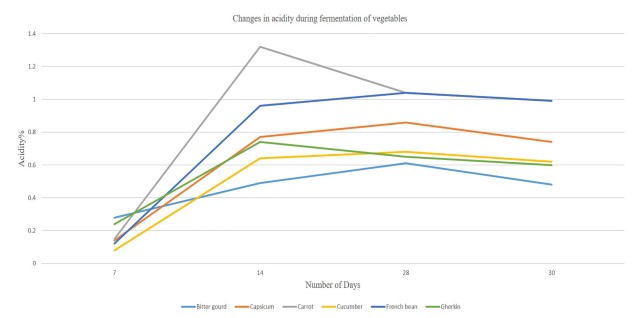
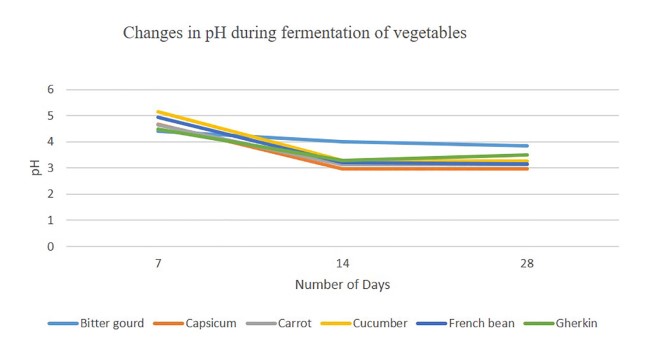
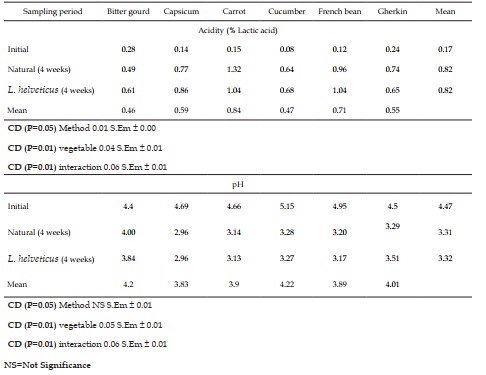
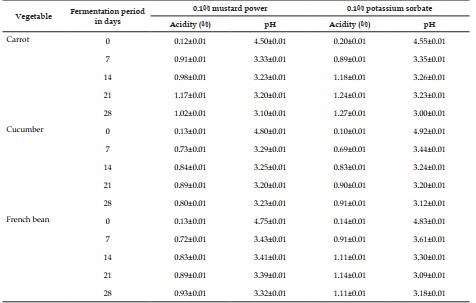
It was tried to preserve vegetables carrot, capsicum, cucumber, and cabbage by fermenting lactic acid. When vegetables were prepared correctly and put in a brine containing 2.5% equilibrated salt with additions, their natural flora fermented the vegetables. This fermentation process was compared to pure culture fermentation using Lactobacillus helveticus. After four weeks of fermentation at 20 ± 2o C, the pH of the fermented vegetables ranged from 2.97 to 4.02, with 0.5 to 1.31% lactic acid. When Lactobacillus helveticus fermented, acid production was often produced at a somewhat faster pace than when wild flora was used. In vegetable fermentation, mustard powder at 1% concentration was proven to be an effective substitute preservative. Fruits and vegetables’ shelf life is extended by lactic acid fermentation, which also improves their nutritional content, flavors, and toxicity levels. Fermented vegetables had acceptable quality in terms of color, texture, flavor, and taste and were microbiologically stable for six months of storage at room temperature (25 ± 8 o C).
References
- 1. Fleming, H.P., McFeeters, R.F., Daeschel, M. A., Humphries, E.G., & Thompson, R. (1988). Fermentation of cucumbers in anaerobic tanks. Journal of Food Science, 53(1), 127-133.
- 2. Demir, N., Bahçeci, K.S., & Acar, J. (2006). The effects of different initial Lactobacillus plantarum concentrations on some properties of fermented carrot juice. Journal of Food Processing and Preservation, 30(3), 352-363.
- 3. Pederson, C.S., & Albury, M.N. (1969). Bulletin: number 824: the sauerkraut fermentation.
- 4. Gordon, A.J., & Ford, R.A. (1973). The chemist’s companion: a handbook of practical data, techniques, and references.
- 5. John Wiley & Sons. Sistrunk, W.A., & Kozup, J. (1982). Influence of processing methodology on quality of cucumber pickles. Journal of Food Science, 47(3), 949-953.
- 6. Verma, L.R., & Joshi, V.K. (2000). Post-harvest technology of fruits and vegetables. Post harvest technology of fruits and vegetables, 1, 1-76.
- 7. Joshi, V.K., Sharma, S., & Rana, N.S. (2006). Production, purification, stability and efficacy of bacteriocin from isolates of natural lactic acid fermentation of vegetables. Food technology and Biotechnology, 44(3), 435-439.
- 8. Suresh, E.R. (2008). Development of shelfstable brined vegetables by lactic acid fermentation. Journal of Horticultural Sciences, 3(2), 150-155.
- 9. Kohli, P.N., & Kulkarni, P.R. (1973). Fermentation of cucumbers in brine. Ind. Fd. Packer, 27, 13-17.
- 10. Sethi, V., & Anand, J.C. (1984). Effect of mustard and its components on the fermentation of cauliflower. Indian Food Packer, 38(4), 41-46.
- 11. Ramdas, A.R., & Kulkarni, P.R. (1987). Fermentative preservation of carrots. Indian Food Packer, 41(5), 40-48.
- 12. Babu, A.J.G., & Suresh, N. (1996). Project management with time, cost, and quality considerations. European journal of operational research, 88(2), 320-327.
- 13. Castellano, P., Pérez Ibarreche, M., Blanco Massani, M., Fontana, C., & Vignolo, G.M. (2017). Strategies for pathogen biocontrol using lactic acid bacteria and their metabolites: A focus on meat ecosystems and industrial environments. Microorganisms, 5(3), 38.
- 14. Maki, M.A. A.R.I.T. (2004). Lactic acid bacteria in vegetable fermentations. Food Science and Technology-New York-Marcel Dekker, 139, 419-430.
- 15. Stamer, J.R., Stoyla, B.O., & Dunckel, B. A. (1971). Growth rates and fermentation patterns of lactic acid bacteria associated with the sauerkraut fermentation. Journal of Food Protection, 34(11), 521-525.
- 16. Ranganna, S. (1986). Handbook of analysis and quality control for fruit and vegetable products. Tata McGraw-Hill Education.
- 17. Daeschel, M.A., & Fleming, H.P. (1984). Selection of lactic acid bacteria for use in vegetable fermentations. Food microbiology, 1(4), 303-313.
- 18. Fleming, H. P., Thompson, R. L., Bell, T. A., & Hontz, L. H. (1978). Controlled fermentation of sliced cucumbers. Journal of Food Science, 43(3), 888-891.
- 19. Fleming, H.P., McFEETERS, R.F., & Thompson, R.L. (1987). Effects of sodium chloride concentration on firmness retention of cucumbers fermented and stored with calcium chloride. Journal of Food Science, 52(3), 653-657.
- 20. Buescher, R.W., Hudson, J.M., & Adams, J. R. (1979). Inhibition of polygalacturonase softening of cucumber pickles by calcium chloride. Journal of Food Science, 44(6), 1786-1787.
- 21. Buescher, R.W., & Burgin, C. (1988). Effect of calcium chloride and alum on fermentation, desalting, and firmness retention of cucumber pickles. Journal of Food Science, 53(1), 296-297.
- 22. Zaika, L.L., & Kissinger, J.C. (1979). Effects of some spices on acid production by starter cultures. Journal of Food Protection, 42(7), 572-576.
- 23. Sethi, V., & Anand, J.C. (1984). Effect of mustard and its components on the fermentation of cauliflower. Indian Food Packer, 38(4), 41-46.
Data Sharing Statement
There are no additional data available. All raw data and code are available upon request.
Funding
This research received no funding.
Author Contributions
All authors contributed significantly to the work and approve its publication.
Ethics Declaration
This article does not involve any human or animal subjects, and therefore does not require ethics approval.
Acknowledgements
We would like to express our gratitude to the patients, their families, and all those who have contributed to this study.
Conflicts of Interest
No conflicts of interest in this work.
About this article

Cite this article
Ankita Suvagiya, Gira P. Mankad. Enhancement of Shelf-stable Brined Vegetables using Lactobacillus helveticus as a Food Additive. J Microbiol Relat Res. 2025; 11(1): 15–20
Licence:
Attribution-Non-commercial 4.0 International (CC BY-NC 4.0)This license enables reusers to distribute, remix, adapt, and build upon the material in any medium or format for noncommercial purposes only, and only so long as attribution is given to the creator.
| Received | Accepted | Published |
|---|---|---|
| March 10, 2025 | May 12, 2025 | June 30, 2025 |
DOI: https://doi.org/10.21088/jmrr.2395.6623.11125.2
Keywords
VegetablesFood additiveNormal floraLactobacillus helveticusSearch for Similar Articles
Similar Articles
- Vitiligo: A Comprehensive Review
- Seaweed-Derived Bioplastics: A Sustainable Alternative to Petroleum Based Plasti...
- Antibiogram of Bacterial Isolates from Critical Care Patients in Sharda Hospital...
- Prevalence and Antimicrobial Resistance Patterns of Staphylococcus aureus Isolat...
- Bacteriology of Burn Wound Infections and their Antibiogram
Article Level Metrics
Last UpdatedSaturday 24 October 2026, 13:01:31 (IST)
1871
Accesses
8
223
00
Citations
NA
NA
NA
Download citation
Article Keywords
Keyword Highlighting
Highlight selected keywords in the article text.
Timeline
| Received | March 10, 2025 |
| Accepted | May 12, 2025 |
| Published | June 30, 2025 |
licence
Attribution-Non-commercial 4.0 International (CC BY-NC 4.0)
This license enables reusers to distribute, remix, adapt, and build upon the material in any medium or format for noncommercial purposes only, and only so long as attribution is given to the creator.