Full Text (PDF)
Indian Journal of Emergency Medicine 9(4):p 189-193, October-December 2023. | DOI: 10.21088/ijem.2395.311X.9423.4
Original Article
Emergency Department Re-attendances During the COVID-19 Pandemic: An Observational Cross-Sectional Analysis
Zeyar Win Naing, Zeyar Win Naing
Author Information
Licence:
Attribution-Non-commercial 4.0 International (CC BY-NC 4.0)This license enables reusers to distribute, remix, adapt, and build upon the material in any medium or format for noncommercial purposes only, and only so long as attribution is given to the creator.
Indian Journal of Emergency Medicine 9(4):p 189-193, October-December 2023. | DOI: 10.21088/ijem.2395.311X.9423.4
How Cite This Article:
Pillai KPG, Naing ZW. Emergency Department Re-attendances During the COVID-19 Pandemic: An Observational Cross-Sectional Analysis. Indian J Emerg Med. 2023;9(4):189-93.Timeline
Received : June 15, 2023
Accepted : August 05, 2023
Published : September 09, 2023
Abstract
Background: Emergency Department (ED) re-attendances are one of the clinical quality indicators to measure the quality of care delivered in the UK. There isn’t much information on ED re-attendance rates and reasons responsible for it during the COVID-19 pandemic. We aim to establish the ED re-attendance rate during the COVID-19 pandemic.
Methods: Data for this single centre study was compiled from Symphony, the department’s electronic patient records. We chose the month of April 2020 for this study and subsequently followed up to 28 days for re-attendances. Only patients aged 18 years and older, presenting with COVID-19 symptoms who were discharged from ED were included (n=310). We also studied the hospital admission and mortality rates among the patients who had re-attended.
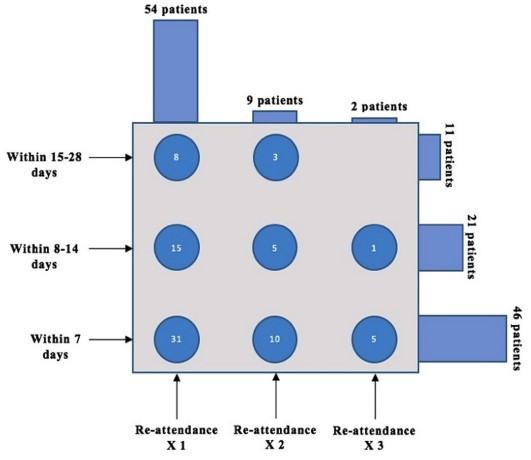
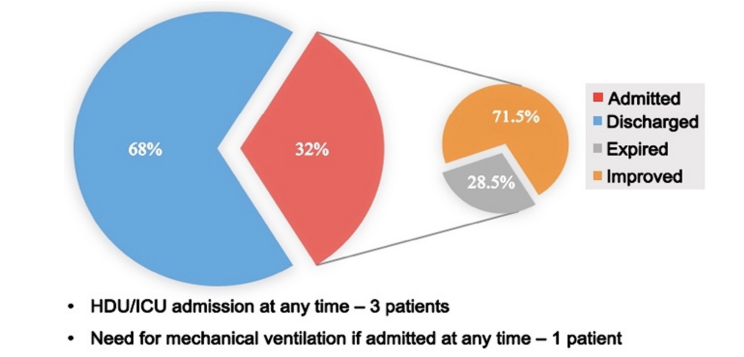
Results: Of the 310, 65 (21%) patients re-attended the ED more than once within 28 days and 27.6% of them belonged to the 41-50 age group. 30 (46.1%) patients were males and 35 (53.8%) were females. The majority (44.6%) of them were of white ethnicity. Among the re-attendees, most of them re-attended only once and within 7 days. Most of the re-attended patients were discharged and only 21 (32.3%) patients had a hospital admission. Of the admitted patients, 6 (28.5%) died in the hospital. Of the patients who died, 5 had tested positive for COVID-19.
Conclusions: ED re-attendances were significantly high during the COVID-19 pandemic compared to the national average from previous years.
References
- 1. NHS Digital. Provisional Accident and Emergency Quality Indicators - England. July 2020.
- 2. Emergency Department Clinical Quality Indicators: - ACEM guide to implementation.
- 3. What has been the impact of Covid-19 on urgent and emergency care across England? A Q & A. COVID-19 Dashboard by the Center for Systems Science and Engineering (CSSE) at Johns Hopkins University (JHU).
- 4. Coronavirus (COVID-19) in the UK. [Internet]. [cited 2020 Oct 5]. Hospital Accident & Emergency Activity 2018-19. Updated 31 July 2020..
- 5. Guidance COVID-19: investigation and initial clinical management of possible cases. Updated 31 July 2020.
- 6. The hidden impact of COVID-19 on patient care in the NHS in England. July 2020.
- 7. Thornton J. Covid-19: A & E visits in England fall by 25% in week after lockdown. BMJ. 2020;369:m1401.
- 8. Whiticar R, Webb H, Smith S. Re-attendance to the emergency department. Emerg Med J. 2008;25:360-1.
- 9. Petrilli CM, Jones SA, Yang J, Rajagopalan H, O’Donnell L, Chernyak Y, et al.
- 10. Factors associated with hospital admission and critical illness among 5279 people with coronavirus disease 2019 in
- 11. New York City: prospective cohort study. BMJ. 2020;369:m1966.
- 12. Liang W, Liang H, Ou L, et al. Development and validation of a clinical risk score to predict the occurrence of critical illness in hospitalized patients with COVID-19. JAMA Intern Med. 2020;180(8):1081-9.
- 13. Kilaru AS, Lee K, Snider CK, et al. Return hospital admissions among 1419 COVID-19 patients discharged from five U.S. emergency departments. Acad Emerg Med. 2020;00:1-4.
- 14. Coronavirus: How GPs have stopped seeing most patients in person.
- 15. Reschen ME, Bowen J, Novak A, et al. Impact of the COVID-19 pandemic on emergency department attendances and acute medical admissions. BMC Emerg Med. 2021 Nov;21(1):143.
- 16. Mulholland RH, Wood R, Stagg HR, et al. Impact of COVID-19 on accident and emergency attendances and emergency and planned hospital admissions in Scotland: an interrupted time-series analysis. J R Soc Med. 2020 Nov;113(11):444-53.
- 17. Daunt A, Perez-Guzman PN, Cafferkey J, et al. Factors associated with reattendance to emergency services following COVID-19 hospitalization. J Med Virol. 2021 Mar;93(3):1250-2.
Data Sharing Statement
There are no additional data available. All raw data and code are available upon request.
Funding
This research received no funding.
Author Contributions
All authors contributed significantly to the work and approve its publication.
Ethics Declaration
This article does not involve any human or animal subjects.
Acknowledgements
Information not provided.
Conflicts of Interest
The authors report no conflicts of interest in this work.
About this article

Cite this article
Pillai KPG, Naing ZW. Emergency Department Re-attendances During the COVID-19 Pandemic: An Observational Cross-Sectional Analysis. Indian J Emerg Med. 2023;9(4):189-93.
Licence:
Attribution-Non-commercial 4.0 International (CC BY-NC 4.0)This license enables reusers to distribute, remix, adapt, and build upon the material in any medium or format for noncommercial purposes only, and only so long as attribution is given to the creator.
| Received | Accepted | Published |
|---|---|---|
| June 15, 2023 | August 05, 2023 | September 09, 2023 |
DOI: 10.21088/ijem.2395.311X.9423.4
Keywords
Re-attendancesCOVID-19Emergency DepartmentSearch for Similar Articles
Similar Articles
- Covid 19 Vaccine: Associated Henoch Schonlein Purpura in Young Adult Female
- A Rare Case of Intolerance to Medically Approved Dose of Sildenafil Citrate in a...
- Acute Mesenteric Ischemia: An Unusual Cause of Hematemesis in a 48 Year Old Man
- Brachial Artery Pseudoaneurysm Related Causally to Iatrogenic Coagulopathy in a...
- Combination Therapy for Acute Management of Yellow Oleander Poisoning: A Case Re...
Article Level Metrics
Last UpdatedSunday 06 September 2026, 22:55:13 (IST)
4083
Accesses
10
922
00
Citations
NA
NA
NA
Download citation
Article Keywords
Keyword Highlighting
Highlight selected keywords in the article text.
Timeline
| Received | June 15, 2023 |
| Accepted | August 05, 2023 |
| Published | September 09, 2023 |
licence
Attribution-Non-commercial 4.0 International (CC BY-NC 4.0)
This license enables reusers to distribute, remix, adapt, and build upon the material in any medium or format for noncommercial purposes only, and only so long as attribution is given to the creator.