Full Text (PDF)
Indian Journal of Ancient Medicine and Yoga 19(1):p 7-12, Jan-March 2026. | DOI: https://doi.org/10.21088/ijamy.2455.8621.19126.1
Original Article
Elements of Yoga in the Skandha Mahapurana: A Comparative and Textual Study
Sasmita Nayak, Radha Madhab Dash
Author Information
Licence:
Attribution-Non-commercial 4.0 International (CC BY-NC 4.0)This license enables reusers to distribute, remix, adapt, and build upon the material in any medium or format for noncommercial purposes only, and only so long as attribution is given to the creator.
Indian Journal of Ancient Medicine and Yoga 19(1):p 7-12, Jan-March 2026. | DOI: https://doi.org/10.21088/ijamy.2455.8621.19126.1
How Cite This Article:
Nayak S, Dash RM. Elements of Yoga in the Skandha Mahapurana: A Comparative and Textual Study. Ind J Anct Med Yoga. 2026;19(1):07-12Timeline
Received : October 25, 2025
Accepted : December 13, 2025
Published : March 30, 2026
Abstract
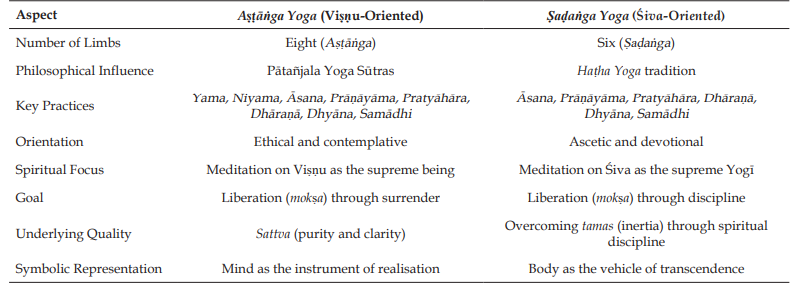
The Skanda Mahapurana (SMP) is one of the most comprehensive expositions of yogic philosophy in the Puranic literature. The purpose of this review is to detail the text’s philosophy of devotion and practical application, using its two presentations of Astanga and Sadanga Yoga, their philosophical, devotional and pragmatic dimensions within the text. The research presents an account to unpack the notion of Yoga under the SMP and compares it with Patanjala Yoga Sutras (PYS), listing all the similarities and differences in structural and spiritual orientation. The findings are that the SMP Astanga Yoga is deeply related to the classical system, focusing on moral control, concentration and meditation on Lord Visnu. At the same time, Sadanga Yoga is an ascetic, devotional path of life and is closer to Hatha Yoga and the ascetic path of Lord Siva; thus, it was also closely related to the Hatha teachings. The fusion of the two systems demonstrates the Puranic vision of the unification of philosophical meditation with ethical behaviour and devotional practice in an integrated path towards moksa (liberation).
References
- 1. Baba R, editor. The Skanda Mahapuraṇa (with Sanskrit text). Bombay: Venkateshwar Press; 1962.
- 2. Tagare GV. The Skanda Puraṇa (Ancient Indian Tradition and Mythology). Delhi: Motilal Banarsidass; 1982.
- 3. Feuerstein G. The Yoga Tradition: Its History, Literature, Philosophy and Practice. Chino Valley: Hohm Press; 1996.
- 4. Mallinson J. The Khecarividya of Adinatha: A Critical Edition and Annotated Translation. London: Routledge; 2011.
- 5. Rukmani TS. Yoga Philosophy of Patanjali: Containing His Yoga Aphorisms with Vyasa’s Commentary in Sanskrit and a Translation with Notes. New Delhi: Munshiram Manoharlal; 2008.
- 6. Sivaramamurti C. The Cosmic Dance of Siva. New Delhi: National Museum; 1976.
- 7. Kaple S. Puranic Yoga: Integration of Devotion and Discipline in Classical Texts. J Dharma. 2022;47(3):211-228.
- 8. Raghavan V. Studies in the Puraṇas with Special Reference to Yoga. Indian Counc Philos Res J. 2021;38(1):59-74.
- 9. Thakur P. Yogic Teachings in the Mahapuraṇas: A Textual Survey. J Indian Philos. 2015;43(2):199-214.
- 10. Dasgupta S. A History of Indian Philosophy, Vol. 1. Cambridge: Cambridge University Press; 1922.
Data Sharing Statement
There are no additional data available. All raw data and code are available upon request.
Funding
This research received no funding.
Author Contributions
Whether all authors contributed significantly to the work and approve its publication.
Ethics Declaration
This article does not involve any human or animal subjects, and therefore does not require ethics approval.
Acknowledgements
We would like to express our gratitude to the patients, their families, and all those who have contributed to this study.
Conflicts of Interest
The authors report no conflicts of interest in this work.
About this article

Cite this article
Nayak S, Dash RM. Elements of Yoga in the Skandha Mahapurana: A Comparative and Textual Study. Ind J Anct Med Yoga. 2026;19(1):07-12
Licence:
Attribution-Non-commercial 4.0 International (CC BY-NC 4.0)This license enables reusers to distribute, remix, adapt, and build upon the material in any medium or format for noncommercial purposes only, and only so long as attribution is given to the creator.
| Received | Accepted | Published |
|---|---|---|
| October 25, 2025 | December 13, 2025 | March 30, 2026 |
DOI: https://doi.org/10.21088/ijamy.2455.8621.19126.1
Keywords
Skanda MahapuranaAstanga YogaSadanga YogaBhaktiMoksaSearch for Similar Articles
Similar Articles
- Efficacy of Katupila Ghrita in the Management of Itartha dagdha Vrana (Burn Woun...
- Clinical Outcomes of Ayurvedic Management in Acute Influenza Like Illness: A Cas...
- Effect of Ayurvedic Drugs on Scalp Psoriasis (Kitibha Kustha)
- Yogic Elements in the Brahma Mahapurana: A Textual and Comparative Study
- Management of Adenoid Hypertrophy: An Ayurvedic Perspective
Article Level Metrics
Last UpdatedWednesday 16 September 2026, 14:39:06 (IST)
4112
Accesses
27
834
00
Citations
NA
NA
NA
Download citation
Article Keywords
Keyword Highlighting
Highlight selected keywords in the article text.
Timeline
| Received | October 25, 2025 |
| Accepted | December 13, 2025 |
| Published | March 30, 2026 |
licence
Attribution-Non-commercial 4.0 International (CC BY-NC 4.0)
This license enables reusers to distribute, remix, adapt, and build upon the material in any medium or format for noncommercial purposes only, and only so long as attribution is given to the creator.