Full Text (PDF)
Indian Journal of Trauma and Emergency Pediatrics 15(4):p 113-115, October – December 2023. | DOI: https://doi.org/10.21088/ijtep.2348.9987.15423.1
Original Article
Effectivness of Planned Teaching Programmed on Knowledge Regarding Vaginitis and its Prevention among Adolesecents Girl in Selected College of Rajkot
Author Information
Licence:
Attribution-Non-commercial 4.0 International (CC BY-NC 4.0)This license enables reusers to distribute, remix, adapt, and build upon the material in any medium or format for noncommercial purposes only, and only so long as attribution is given to the creator.
Indian Journal of Trauma and Emergency Pediatrics 15(4):p 113-115, October – December 2023. | DOI: https://doi.org/10.21088/ijtep.2348.9987.15423.1
How Cite This Article:
Usha Devi, Nagadkiya Sonal. Effectivness of Planned Teaching Programmed on Knowledge Regarding Vaginitis and Its Prevention Among Adolesecents Girl in Selected College of Rajkot. Indian J Trauma Emerg Pediatr. 2023;15(4):113–115.Timeline
Received : October 12, 2023
Accepted : November 21, 2023
Published : December 30, 2023
Abstract
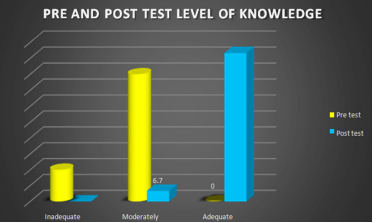
Vulvovaginitis is a common infection among adolescent and young adult women, characterized clinically by vulvar pruritus, irritation and burning, and vaginal discharge. Approximately three fourths of women experience vulvovaginitis during their lifetime and many of them have experienced their first infection during adolescence. There are different etiologic causes of vulvovaginitis but the most common causes in adolescents are yeast, bacterial vaginosis (BV), and trichomonas, especially in the presence of a higher rate of sexual activity in this population. The interplay of the vaginal pH, the thickness of the vaginal mucosal layer, and the constituency of the micro biomedical that inhabit the vaginal wall impact susceptibility of adolescents to vulvovaginitis. Adolescents with disabilities and pregnant adolescents are at a higher risk for vulvovaginal infection. The present Pre experimental one group pretest and posttest research design was conducted among adolescents’ girls to evaluate the effectiveness of vaginitis and its prevention. The researcher selected 60 samples based on non probity sampling technique. The results shown that the level of knowledge was improved after implementation of planned teaching, which indicates the planned teaching was effective. The researcher concluded that, the teaching aids will be helpful in improving knowledge among adolescents’ girls as well as public. The researcher recommended that, the community education programme and personal behavior change education is required to save the adolescents’ girls and reduce the morbidity and mortality in India.
References
- 1. Ram R, Bhattacharya SK, Bhattacharya K, Baur.B, Sarkar T, Bhattacharya A (2006) Reproductive tract infection among female adolescents, Indian Journal of community Medicine Jan-Mar;31.
- 2. Neeraja KP.(2006)Textbook of growth and development. New Delhi: Jaypee Publication;
- 3. Kotdwal P, Salvi V, Krishna R, (2004) Adolescent girl – an update. New Delhi: Jaypee Brothers Medical Publishers.
- 4. National Youth Policy as cited in adolescents in India – a profile UNFPA for UN system in India (2000).
- 5. Chaudhari L. (2007) Adolescent health and human rights concerns, Health action.
- 6. Uddin MJ, Chaudhari AM, (2008) Reproductive health awareness among adolescent girls in rural Bangladesh, Asia Pacific Journal of Public Health;20(2);117-28.
- 7. Rao PS, Devi S, Shriyan A, Rajaram M Jagadish Chandra K. (2004) Diagnosis of Bacterial Vaginitis in a rural set up. Indian Journal of Medical Microbiology;22.
- 8. Lavazzo C, Vogiatzi C, Falagas HE, A retrospective analysis of isolates from patients with vaginitis in a private Greek Obstetric/ Gynaecological hospital (2003- 2006), International Medical Journal of Experimental and Clinical Research 2008 Apr 1;14(4)
- 9. http://jgate-helinet.informindia.co.in
- 10. http://www.ncbi.nlm.nih.gov/pubmed/
- 11. www.incredibleindia.
Data Sharing Statement
There are no additional data available. All raw data and code are available upon request.
Funding
This research received no funding.
Author Contributions
All authors contributed significantly to the work and approve its publication.
Ethics Declaration
This article does not involve any human or animal subjects, and therefore does not require ethics approval.
Acknowledgements
We would like to express our gratitude to the patients, their families, and all those who have contributed to this study.
Conflicts of Interest
No conflicts of interest in this work.
About this article

Cite this article
Usha Devi, Nagadkiya Sonal. Effectivness of Planned Teaching Programmed on Knowledge Regarding Vaginitis and Its Prevention Among Adolesecents Girl in Selected College of Rajkot. Indian J Trauma Emerg Pediatr. 2023;15(4):113–115.
Licence:
Attribution-Non-commercial 4.0 International (CC BY-NC 4.0)This license enables reusers to distribute, remix, adapt, and build upon the material in any medium or format for noncommercial purposes only, and only so long as attribution is given to the creator.
| Received | Accepted | Published |
|---|---|---|
| October 12, 2023 | November 21, 2023 | December 30, 2023 |
DOI: https://doi.org/10.21088/ijtep.2348.9987.15423.1
Keywords
KnowledgeVaginitis and its preventionAdolescents’ girlsArticle Level Metrics
Last UpdatedSaturday 17 October 2026, 10:30:31 (IST)
1772
Accesses
24
245
00
Citations
NA
NA
NA
Download citation
Article Keywords
Keyword Highlighting
Highlight selected keywords in the article text.
Timeline
| Received | October 12, 2023 |
| Accepted | November 21, 2023 |
| Published | December 30, 2023 |
licence
Attribution-Non-commercial 4.0 International (CC BY-NC 4.0)
This license enables reusers to distribute, remix, adapt, and build upon the material in any medium or format for noncommercial purposes only, and only so long as attribution is given to the creator.