Full Text (PDF)
Indian Journal of Trauma and Emergency Pediatrics 15(4):p 117-120, October – December 2023. | DOI: https://doi.org/10.21088/ijtep.2348.9987.15423.2
Case Report
Apparent Haemolacria: A Case of Munchausen’s Syndrome
Utsav Anand Mani, Pranjal Tripathi, Haider Abbas, Mukesh Kumar, Devansh Goyal, Sharique Alam, Mohd Jahangir Alam, Mohd Saalim
Author Information
Licence:
Attribution-Non-commercial 4.0 International (CC BY-NC 4.0)This license enables reusers to distribute, remix, adapt, and build upon the material in any medium or format for noncommercial purposes only, and only so long as attribution is given to the creator.
Indian Journal of Trauma and Emergency Pediatrics 15(4):p 117-120, October – December 2023. | DOI: https://doi.org/10.21088/ijtep.2348.9987.15423.2
How Cite This Article:
Utsav Anand Mani, Pranjal Tripathi, Haider Abbas. Apparent Haemolacria: A Case of Munchausen’s Syndrome. Indian J Trauma Emerg Pediatr.2023;15(4):117–120.Timeline
Received : October 09, 2023
Accepted : November 21, 2023
Published : December 30, 2023
Abstract
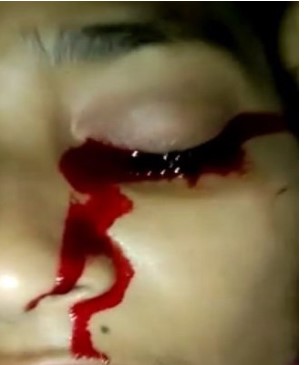
Haemolacria, also known as Bloody Tears due to its evident physical presentation, is a rare condition, which causes sudden panic and distress in both, the patient party and the health care providers. The patient, in her late teens, presented in the Department of Emergency Medicine of our tertiary care hospital, with a thin blood-stained streak from her left eye, without any active bleeding. Munchausen’s Syndrome is usually a diagnosis of exclusion due to its rarity. Haemolacria, an uncommon but worrying phenomenon, is one of the rare presentations of Munchausen syndrome.
References
- 1. Olry R, Haines DE. Historical and literary roots of Münchhausen syndromes: as intriguing as the syndromes themselves. Prog Brain Res. 2013;206:123–41.
- 2. Simpson SA, Pasic J. The peregrinating psychiatric patient in the emergency department. Western Journal of Emergency Medicine. 2016 Sep;17(5):600.
- 3. Naqvi S, Khan RA, Rupareliya C, Hanif R, Ali Z, Farooq F. Bleeding diathesis or fabrication: Munchausen syndrome. Cureus. 2017 Jun 12;9(6).
- 4. Ghosh S, Tale S, Handa N, Bhalla A. Rare case of red tears: ocular vicarious menstruation. BMJ Case Rep. 2021;14(3):e237294.
- 5. Rahman MS, Karim MR, Islam MM. Dissociative Disorders with Haemolacria: Series of Case Reports. Journal of Bangladesh College of Physicians & Surgeons. 2017 Jan 1;35(1).
- 6. Asher R. Münchhausen's syndrome. Lancet. 1951;1(6650):339–41.
- 7. Yates GP, Feldman MD. Factitious disorder: a systematic review of 455 cases in the professional literature. Gen Hosp Psychiatry. 2016;41:20–8.
- 8. Padhye KP, David KS, Dholakia SY, Mathew V, Murugan Y. ‘Munchausen syndrome’: a forgotten diagnosis in the spine. Eur Spine J. 2016;25 Suppl 1:152–6.
- 9. Jha A. Idiopathic hemolacria: a case report. J Psychiatrists Assoc Nepal. 2020;9(2):85–7.
- 10. Saha B. Intriguing haemorrhages: a review of last seven decades (1951-2021). Int J Res Med Sci. 2021;9(8):2520–34.
- 11. Pandey M, Sawhney A. Factitious bleeding disorder in a child: an unusual presentation of Munchausen syndrome. Indian Pediatr. 2014;51(12):1019–20.
- 12. Chaudhary A, Agasti M. Hemolacria: a rare presentation of Munchausen syndrome. Int J Ocul Oncol Oculoplasty. 2016;2(3):211–13.
- 13. Karadsheh MF. Bloody tears: a rare presentation of munchausen syndrome case report and review. Journal of Family Medicine and Primary Care. 2015 Jan;4(1):132.
- 14. Soumitra DA, Mohammed S, Doval N, Kartha A. Factitious disorder: a rare cause for unexplained epistaxis. Shanghai Arch Psychiatry. 2017;29(2):120
- 15. Bakkers JT, Crobach LF, Pauwels EK. Factitious gastrointestinal bleeding. J Nucl Med. 1985;26(6):666–7.
- 16. Ando T, Nomura T, Sugiyama S, Shin T, Mori K, Sumino Y, et al. Munchausen syndrome in the act of creating and enacting macroscopic hematuria. Urol Int. 2014;93(3):371–2.
- 17. Patenaude B, Zitsch R 3rd, Hirschi SD. Blood–but not bleeding–at a tracheotomy site: a case of Munchausen's syndrome. Ear Nose Throat J. 2006;85(10):677–9.
- 18. Hafiz AM, Mahboob H, Jan F. Factitious gastrointestinal bleeding: a case of Munchausen syndrome. Internet J Intern Med. 2009;8
Data Sharing Statement
There are no additional data available. All raw data and code are available upon request.
Funding
This research received no funding.
Author Contributions
All authors contributed significantly to the work and approve its publication.
Ethics Declaration
This article does not involve any human or animal subjects, and therefore does not require ethics approval.
Acknowledgements
We would like to express our gratitude to the patients, their families, and all those who have contributed to this study.
Conflicts of Interest
No conflicts of interest in this work.
About this article

Cite this article
Utsav Anand Mani, Pranjal Tripathi, Haider Abbas. Apparent Haemolacria: A Case of Munchausen’s Syndrome. Indian J Trauma Emerg Pediatr.2023;15(4):117–120.
Licence:
Attribution-Non-commercial 4.0 International (CC BY-NC 4.0)This license enables reusers to distribute, remix, adapt, and build upon the material in any medium or format for noncommercial purposes only, and only so long as attribution is given to the creator.
| Received | Accepted | Published |
|---|---|---|
| October 09, 2023 | November 21, 2023 | December 30, 2023 |
DOI: https://doi.org/10.21088/ijtep.2348.9987.15423.2
Keywords
Urological emergencyPsychiatric EmergencyPenile StrangulationCompulsivesexual behaviour disorder (CSBD)Compulsive sexual behaviour disorder (CSBD)Article Level Metrics
Last UpdatedSaturday 17 October 2026, 11:30:58 (IST)
1772
Accesses
17
245
00
Citations
NA
NA
NA
Download citation
Article Keywords
Keyword Highlighting
Highlight selected keywords in the article text.
Timeline
| Received | October 09, 2023 |
| Accepted | November 21, 2023 |
| Published | December 30, 2023 |
licence
Attribution-Non-commercial 4.0 International (CC BY-NC 4.0)
This license enables reusers to distribute, remix, adapt, and build upon the material in any medium or format for noncommercial purposes only, and only so long as attribution is given to the creator.