Full Text (PDF)
Community and Public Health Nursing 9(1):p 25-30, January-April 2024. | DOI: https://doi.org/10.21088/cphn.2455.8621.9124.4
Original Article
Effect of Teaching Program on Knowledge Regarding the Prevention and Management of Needle Stick Injury among Staff Nurses at Selected Hospital, Ajman, UAE
Saji Shibu, Geetha Chandran, Soney M. Varghese, Remya R. Pillai
Author Information
Licence:
Attribution-Non-commercial 4.0 International (CC BY-NC 4.0)This license enables reusers to distribute, remix, adapt, and build upon the material in any medium or format for noncommercial purposes only, and only so long as attribution is given to the creator.
Community and Public Health Nursing 9(1):p 25-30, January-April 2024. | DOI: https://doi.org/10.21088/cphn.2455.8621.9124.4
How Cite This Article:
Saji Shibu, Geetha Chandran, Soney M. Varghese et al. Effect of Teaching Program on Knowledge Regarding the Prevention and Management of Needle Stick Injury among Staff Nurses at Selected Hospital, Ajman, UAE. Community and Public Health Nursing. 2024;9(1):25–30.Timeline
Received : December 18, 2023
Accepted : December 17, 2024
Published : April 30, 2024
Abstract
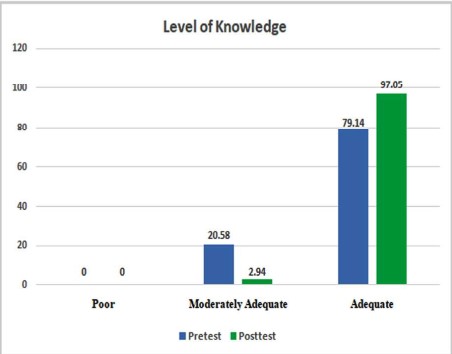
Introduction: World Health Organization estimates disclose that 1 in 10 health care workers (HCWs) worldwide sustain a needle stick injury each year. The risk of infection due to needle stick injuries (NSIs) varies from 0.5% to 40% for HIV and HBV infections, respectively. Globally, there is gross under-reporting of NSIs with the actual incidence of NSIs being much higher than those reported. Methodology: A quantitative research approach with one group pretest posttest design was used to assess the effectiveness of teaching program on knowledge regarding prevention and management of needle stick injury among staff nurse in a selected Hospital in Ajman, UAE. Data were obtained from 68 staff nurses by using a convenient sampling technique. Permission was sought from the hospital management and informed consent was taken from the participants. On 14th day after the teaching program, posttest was conducted for all the participants. The collected scores were tabulated and entered in the excel sheet and further analyzed by using SPSS statistical package. Results: The result shows that 79% of the staff nurses had adequate level of knowledge and only 21% had moderate level of knowledge. None of the staff nurses had poor knowledge regarding needle stick injury. After teaching program 97% of the staff nurses had adequate level of knowledge and only 3% had moderate level of knowledge. None of the staff nurses had poor knowledge regarding needle stick injury. Structured teaching program on needle stick injury was found to be effective at P (0.002). No association was found with any of the selected demographic variables. Conclusion: The findings of the study revealed that the structured teaching program could make a significant improvement in knowledge level of staff nurses. The study highlights the need for conducting similar awareness programs regarding prevention and management of needle stick injuries among healthcare professionals.
References
- 1. Norsayani MY, Noor HI. Study on incidence of needle stick injury and factors associated with this problem among medical students. J Occup Health. 2003;45(3):172–8.
- 2. Tan L, Hawk III JC, Sterling ML. Report of the Council on Scientific Affairs: Preventing need lestick injuries in health care settings. Archives of internal medicine. 2001 Apr 9;161(7):929-36.
- 3. Atenstaedt RL, Payne S, Roberts RJ, Russell IT, Russell D, Edwards RT. Needle-stick injuries in primary care in Wales. J Public Health (Oxf) 2007;29(4):434–40.
- 4. Lum D, Mason Z, Meyer-Rochow G, Neveldsen GB, Siriwardena M, Turner P, et al. Needle stick injuries in country general practice. N Z Med J. 1997;110 (1041):122–5.
- 5. Simonsen L, Kane A, Lloyd J, Zaffran M, Kane M. Unsafe injections in the developing world and transmission of blood borne pathogens: a review. Bull World Health Organ. 1999;77(10):789–800.
- 6. Hutin Y, Hauri A, Chiarello L, Catlin M, Stilwell B, Ghebrehiwet T, et al. Best infection control practices for intradermal, subcutaneous, and intra muscular needle injections. Bull World Health Organ. 2003;81(7):491–500.
- 7. CDC NIfOSaH. NIOSH Alert: preventing needle stick injuries in health care settings. 1999 NIOSH Publication No 2000-108.
- 8. Atenstaedt RL, Payne S, Roberts RJ, Russell IT, Russell D, Edwards RT. Needle-stick injuries in primary care in Wales. J Public Health (Oxf) 2007;29(4):434–40.
- 9. Askarian M, Malekmakan L. The prevalence of needle stick injuries in medical, dental, nursing and midwifery students at the university teaching hospitals of Shiraz, Iran. Indian J Med Sci. 2006;60(6):227–32.
- 10. Pruss-Ustun A, Rapiti E, Hutin Y. Estimation of the global burden of disease attributable to contaminated sharps injuries among health-care workers. Am J Ind Med. 2005; 48(6):482–90.
- 11. Dhandargi UN, Kamala KN. Effectiveness of Planned Teaching Programme on Knowledge Regarding Needle Stick Injury among the Staff Nurses. Volume 3, Issue 9, September– 2018. ISSN No:-2456-2165.
- 12. Sreelatha. M, Dr. P. Sudharani. To assess the effectiveness of structured teaching programme on knowledge regarding Needle Stick Injuries among 50 nurses. Indian Journal of Applied Research published on 2017. (26).
- 13. Elmiyeh B, Whitaker IS, James MJ, Chahal CA, Galea A, Alshafi K. Needle-stick injuries in the National Health Service: a culture of silence. J R Soc Med. 2004;97(7):326–7.
- 14. Jovic-Vranes A, Jankovic S, Vranes B. Safety practice and professional exposure to blood and bloodcontaining materials in serbian health care workers. J Occup Health. 2006;48(5):377–82.
- 15. Sriram S. Study of needle stick injuries among healthcare providers: Evidence from a teaching hospital in India. Journal of family medicine and primary care. 2019 Feb;8(2):599.
- 16. Jacob A, Newson-Smith M, Murphy E, Steiner M, Dick F. Sharps injuries among health care workers in the United Arab Emirates. Occupational medicine. 2010 Aug 1;60(5):395-7.
- 17. Amini M, Behzadnia MJ, Saboori F, Bahadori M, Ravangard R. Needle-stick injuries among healthcare workers in a teaching hospital. Trauma monthly. 2015 Nov;20(4).
- 18. Kifah Habib Alfulayw 1, Sultan T. Al-Otaibi and Hatem A. Alqahtani 1. Factors associated with need lestick injuries among healthcare workers. BMC Health Services Research (2021) 21:1074.
- 19. Wilburn SQ, Eijkemans G. Preventing need lestick injuries among healthcare workers: a WHO-ICN collaboration. International journal of occupational and environmental health. 2004 Oct 1;10(4):451-6.
- 20. Prüss-Üstün A, Rapiti E, Hutin Y. Estimation of the global burden of disease attributable to contaminated sharps injuries among health-care workers. American journal of industrial medicine. 2005 Dec; 48(6):482-90.
- 21. Tokars JI, Marcus R, Culver DH, Schable CA, McKibben PS, Bandea CI, et al. Surveillance of HIV infection and zidovudine use among health care workers after occupational exposure to HIVinfected blood. Ann Intern Med. 1993;118:913–9.
- 22. Elder A, Paterson C. Sharps injuries in UK health care: A review of injury rates, viral transmission and potential efficacy of safety devices. Occup Med (Lond) 2006;56:566–74.
- 23. Goel V, Kumar D, Lingaiah R, Singh S. Occurrence of needlestick and injuries among health-care workers of a tertiary care teaching hospital in North India. Journal of laboratory physicians. 2017 Jan;9(01):020-5.
- 24. Cheung K, Ho SC, Ching SS, Chang KK. Analysis of needlestick injuries among nursing students in Hong Kong. Accident Analysis & Prevention. 2010 Nov 1;42(6):1744-50.
- 25. Zhang X, Chen Y, Li Y, Hu J, Zhang C, Li Z, Stallones L, Xiang H. Needlestick and sharps injuries among nursing students in Nanjing, China. Workplace health & safety. 2018 Jun;66(6):276-84.
- 26. Prof Dr. Sindhu Devi M, Mrs. Reshmi R. S. A study to evaluate effectiveness of structured teaching programme regarding Needle Stick Injury among first year B.Sc Nursing students at Ernakulam. IJRCS. 2019 Sep:(3): 9.
- 27. Al Qadire M, Ballad CA, Al Omari O, Aldiabat KM, Shindi YA, Khalaf A. Prevalence, student nurses’ knowledge and practices of needle stick injuries during clinical training: a cross-sectional survey. BMC nursing. 2021 Dec;20(1):1-7.
- 28. Suliman M, Al Qadire M, Alazzam M, Aloush S, Alsaraireh A, Alsaraireh FA. Students nurses' knowledge and prevalence of Needle Stick Injury in Jordan. Nurse education today. 2018 Jan 1;60:23-7.
- 29. Nawafleh HA, El Abozead S, Al Momani MM, Aaraj H. Investigating needle stick injuries: Incidence, knowledge and perception among South Jordanian nursing students. J Nurs Educ Pract. 2017 Nov 29;8(4):59-69.
- 30. Lakbala P, Azar FE, Kamali H. Needlestick and sharps injuries among house keeping workers in hospitals of Shiraz, Iran. BMC research notes. 2012 Dec;5(1):1-5.
- 31. Galougahi MH. Evaluation of needle stick injuries among nurses of Khanevadeh Hospital in Tehran. Iranian journal of nursing and midwifery research. 2010;15(4):172.
- 32. Muralidhar S, Kumar Singh P, Jain RK, Malhotra M, Bala M. Needle stick injuries among health care workers in a tertiary care hospital of India. Indian Journal of Medical Research. 2010 Mar 1;131(3):405.
- 33. Siddique K, Mirza S, Tauqir SF, Anwar I, Malik AZ. Knowledge attitude and practices regarding needle stick injuries amongst healthcare providers. Pakistan J Surg. 2008;24(4):243-8.
- 34. George F. Effectiveness of structured teaching programme on knowledge regarding prevention and management of needle stick injury among selected student nurses. Religion. 2020 Jan 16;99(1):99.
- 35. Singh S. A pre-experimental study to assess the effectiveness of structured teaching programme regarding knowledge of needle stick injury and its prevention among nursing students in selected nursing institutes Faridabad, Haryana. Int J Sci Healthcare Res. 2020;5(2):407-12.
- 36. Bijani M, Rostami K, Momennasab M, Yektatalab S. Evaluating the effectiveness of a continuing education program for prevention of occupational exposure to needle stick injuries in nursing staff based on Kirkpatrick's Model. Journal of the National Medical Association. 2018 Oct 1;110(5):459- 63.
- 37. Prof. Ravi kumar B.R Phd, Mrs. EkataRavikumar to assess the effectiveness of structured teaching Programme on knowledge and practices to prevent needle stick injuries among the staff nurses working in VPIMS, Lucknow. International journal of scientific Volume-7 | Issue-9 | September-2018. International journal of scientific reserch.
- 38. Chopade UA, Kadam S, Hiremath P. A study to assess the effectiveness of planned teaching programme (ptp) on knowledge regarding needle stick, sharp injuries and their prevention among 1 st year b. sc. nursing students at kins, karad. International Journal of Health Sciences and Research. 2015;5(8):401-6.
- 39. Mir MA, Bashir M, Akhter K. Effectiveness of Teaching Programme on Knowledge of GNMII Year Students regarding Prevention of Needle Stick Injuries at Ancillary Medical Training School, ShireenBagh, Srinagar. Trends in Nursing Administration and Education (2348-2141). 2021 Nov 2;10(2):17-23.
Data Sharing Statement
There are no additional data available. All raw data and code are available upon request.
Funding
This research received no funding.
Author Contributions
All authors contributed significantly to the work and approve its publication.
Ethics Declaration
This article does not involve any human or animal subjects, and therefore does not require ethics approval.
Acknowledgements
We would like to express our gratitude to the patients, their families, and all those who have contributed to this study.
Conflicts of Interest
No conflicts of interest in this work.
About this article

Cite this article
Saji Shibu, Geetha Chandran, Soney M. Varghese et al. Effect of Teaching Program on Knowledge Regarding the Prevention and Management of Needle Stick Injury among Staff Nurses at Selected Hospital, Ajman, UAE. Community and Public Health Nursing. 2024;9(1):25–30.
Licence:
Attribution-Non-commercial 4.0 International (CC BY-NC 4.0)This license enables reusers to distribute, remix, adapt, and build upon the material in any medium or format for noncommercial purposes only, and only so long as attribution is given to the creator.
| Received | Accepted | Published |
|---|---|---|
| December 18, 2023 | December 17, 2024 | April 30, 2024 |
DOI: https://doi.org/10.21088/cphn.2455.8621.9124.4
Keywords
Needle Stick InjuryStaff NursesStructured Teaching ProgramSearch for Similar Articles
Similar Articles
- A Study to assess the Effectivness of Planned Teaching Progamme on Dengue Fever...
- Review on Breastfeeding Techniques
- Breastfeeding Friendly Working Environment
- Pattern of Sleep and Sleep-Disturbing Factors Among Adults in UAE
- Raising Women’s Knowledge and Awareness about Long-acting Reversible Contracepti...
Article Level Metrics
Last UpdatedThursday 15 October 2026, 04:22:31 (IST)
7828
Accesses
3
1627
00
Citations
NA
NA
NA
Download citation
Article Keywords
Keyword Highlighting
Highlight selected keywords in the article text.
Timeline
| Received | December 18, 2023 |
| Accepted | December 17, 2024 |
| Published | April 30, 2024 |
licence
Attribution-Non-commercial 4.0 International (CC BY-NC 4.0)
This license enables reusers to distribute, remix, adapt, and build upon the material in any medium or format for noncommercial purposes only, and only so long as attribution is given to the creator.