Full Text (PDF)
Community and Public Health Nursing 9(1):p 13-16, January-April 2024. | DOI: https://doi.org/10.21088/cphn.2455.8621.9124.2
Original Article
A Study to assess the Effectivness of Planned Teaching Progamme on Dengue Fever in Terms of Knowledge
Alka Tajne, Bhavana Patel, Sufi Pathan, Snehal Gamit, Neha Gamit, Sanjana Gamit, Suvarta Gamit, Minaxi Gamit
Author Information
Licence:
Attribution-Non-commercial 4.0 International (CC BY-NC 4.0)This license enables reusers to distribute, remix, adapt, and build upon the material in any medium or format for noncommercial purposes only, and only so long as attribution is given to the creator.
Community and Public Health Nursing 9(1):p 13-16, January-April 2024. | DOI: https://doi.org/10.21088/cphn.2455.8621.9124.2
How Cite This Article:
Alka Tajne, Bhavana Patel, Sufi Pathan et al. A Study to assess the Effectivness of Planned Teaching Progamme on Dengue Fever In terms of Knowledge/Community and Public Health Nursing. 2024;9(1):13–16.Timeline
Received : January 20, 2024
Accepted : February 19, 2024
Published : April 30, 2024
Abstract
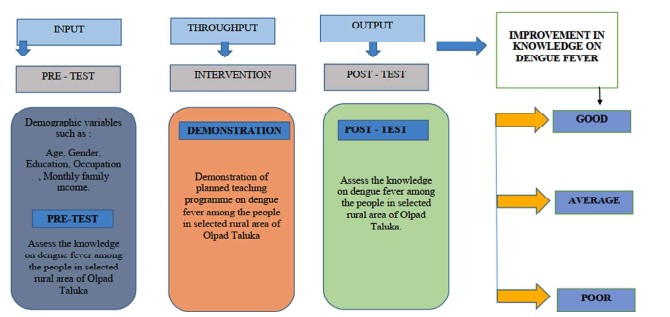
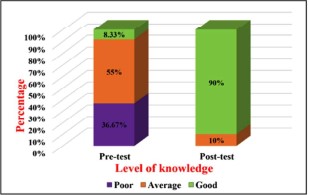
The study was experimental in nature with one group pre-test post-test design. The Planned teaching programme on dengue fever was developed by reviewing the extensive. Literature on dengue fever in terms of knowledge. The samples of 60 people were selected through probability simple random sampling technique. The instrument used for generating necessary data was a structured knowledge questionnaire. The obtained data was analysed by using both descriptive and inferential statistical in terms of Mean, Standard Deviation, ‘t’value. In the overall content area, mean gain scores were comparatively higher after exposure to planned teaching programme on dengue fever findings indicate that the planned teaching programme is a suitable and effective method of instruction. On the basis of findings, the following recommendation were made: The study can be replicated on a large sample, there by findings can be generalised for a large population.
References
- 1. Neelam Kumari,“A Textbook of Community Health Nursing – 1, 6th edition, published by Pee Vee, page no: 491 – 495.
- 2. BT Basvanthappa, “Essentials of Community Health Nursing, published by Jaypee, page no: 164 – 168.
- 3. Black’s Medical Surgical Nursing, volume - 1, First South Asia edition, published by Elsevier, page no: 343.
- 4. Black’s Medical Surgical Nursing, volume - 2, First South Asia edition, published by Elsevier, page no: 2053.
- 5. Brunner and Suddharth’s textbook of Medical Surgical Nursing, volume - 2, 13th edition, published by Wolters Kluwer, page no: 2112 – 2113.
- 6. Kochuthresiamma Thomas, “Medical Surgical Nursing, volume – 2, published by Jaypee, page no: 760 – 761.
- 7. Lewi’s “Medical Surgical Nursing”, volume – 1, Second South Asia edition, Elsevier Publications.
- 8. Polit and Hungler (1999), Nursing Research principles and methods, 6th edition, Philadelphia, Lippincott.
- 9. KP Neerja, Textbook of Nursing Education, 1st edition, Jaypee Brothers, Medical publishers, Nagpur, Mumbai 2003.
- 10. Denise F Polite, “Nursing Research” eleventh edition, Wolters Kluwer Health.
- 11. Javed Ansari, Davinder kaur,“Medical Surgical Nursing”, Part 2, 4th edition, S.Vikash and company.
- 12. Park K, “Text book of Preventive and Social Medicine” 18th edition Bhanot publication; 2005.
- 13. K.K. Gulani “Community Health Nursing”, 2nd edition, Kumar publishing house.
- 14. Nisha Clement, Dr. I. Clement “Nursing research and statistics”2nd edition, EMMESS publications.
- 15. Suresh K. Sharma, (2011), “Nursing Research & Statistics”, India Elsevier Publications. 16. S. Mani. (2012). Bionomics and control of aedes mosquito. Indian journal of medical research. 126.pg no:112- 115.
Data Sharing Statement
There are no additional data available. All raw data and code are available upon request.
Funding
This research received no funding.
Author Contributions
All authors contributed significantly to the work and approve its publication.
Ethics Declaration
This article does not involve any human or animal subjects, and therefore does not require ethics approval.
Acknowledgements
We would like to express our gratitude to the patients, their families, and all those who have contributed to this study.
Conflicts of Interest
No conflicts of interest in this work.
About this article

Cite this article
Alka Tajne, Bhavana Patel, Sufi Pathan et al. A Study to assess the Effectivness of Planned Teaching Progamme on Dengue Fever In terms of Knowledge/Community and Public Health Nursing. 2024;9(1):13–16.
Licence:
Attribution-Non-commercial 4.0 International (CC BY-NC 4.0)This license enables reusers to distribute, remix, adapt, and build upon the material in any medium or format for noncommercial purposes only, and only so long as attribution is given to the creator.
| Received | Accepted | Published |
|---|---|---|
| January 20, 2024 | February 19, 2024 | April 30, 2024 |
DOI: https://doi.org/10.21088/cphn.2455.8621.9124.2
Keywords
Effectiveness of Planned Teaching ProgrammePeopleDengue FeverSearch for Similar Articles
Similar Articles
- Effect of Teaching Program on Knowledge Regarding the Prevention and Management...
- Review on Breastfeeding Techniques
- Breastfeeding Friendly Working Environment
- Pattern of Sleep and Sleep-Disturbing Factors Among Adults in UAE
- Raising Women’s Knowledge and Awareness about Long-acting Reversible Contracepti...
Article Level Metrics
Last UpdatedThursday 15 October 2026, 04:19:18 (IST)
7828
Accesses
3
1627
00
Citations
NA
NA
NA
Download citation
Article Keywords
Keyword Highlighting
Highlight selected keywords in the article text.
Timeline
| Received | January 20, 2024 |
| Accepted | February 19, 2024 |
| Published | April 30, 2024 |
licence
Attribution-Non-commercial 4.0 International (CC BY-NC 4.0)
This license enables reusers to distribute, remix, adapt, and build upon the material in any medium or format for noncommercial purposes only, and only so long as attribution is given to the creator.