Full Text (PDF)
Journal of Social Welfare and Management 14(3(Part-II)):p 211-219, September-December 2022. | DOI: https://doi.org/10.21088/jswm.0975.0231.14322.8
Review Article
Does Dividend Policy Influence Financial Performance? Evidence from Selected IT Companies in India
Brajaballav Pal, Debasish Bera
Author Information
Licence:
Attribution-Non-commercial 4.0 International (CC BY-NC 4.0)This license enables reusers to distribute, remix, adapt, and build upon the material in any medium or format for noncommercial purposes only, and only so long as attribution is given to the creator.
Journal of Social Welfare and Management 14(3(Part-II)):p 211-219, September-December 2022. | DOI: https://doi.org/10.21088/jswm.0975.0231.14322.8
How Cite This Article:
Brajaballav Pal, Debasish Bera/Does Dividend Policy Influence Financial Performance? Evidence from Selected IT Companies in India/J Soc Welfare Manag. 2022;14,3(Part-II):211–219.Timeline
Received : August 20, 2022
Accepted : September 03, 2022
Published : December 30, 2022
Abstract
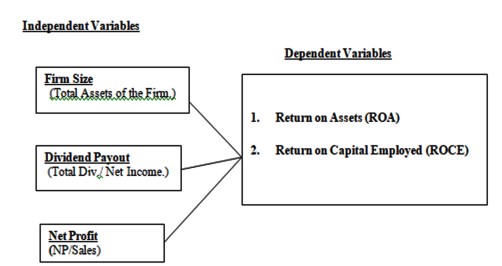
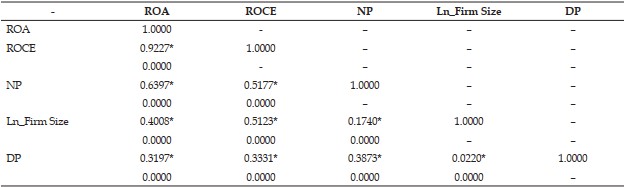
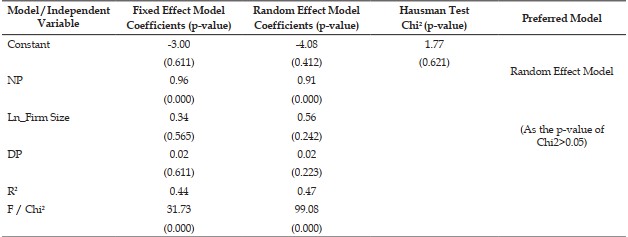
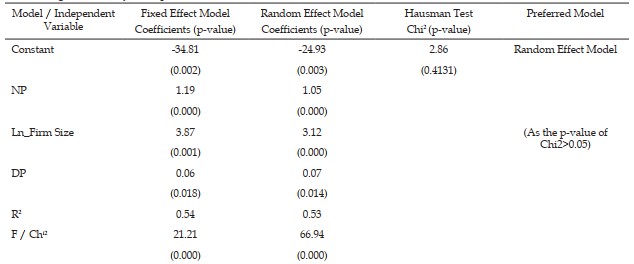
The purpose of the study is to examine the impact of Dividend Policy on firm’s financial performance; especially on selected Indian IT Companies. The data have been collected from the annual reports, journals and money control website. Panel data regression model has been applied to examine the impact of dividend policy on financial performance of Selected Indian IT Companiesfor the study period ranging from 2011 to 2020. For the purpose of the study, we have considered 10 Indian ITsector companies on the basis of their Revenue and Market Capitalisation. Findings of the study reveal that Net Profit, Firm size and Dividend pay out Ratio have statistically significant effects on financial performance.
References
- 1. Usha, S. (2008). “Financial Performance Analysis of Selected Software Company in India”, International Journal of Enterprise and Innovation Management Studies(IJEIMS), Vol. 1(3), pp. 96-108, 2008.
- 2. Sharma, N. (2011), “Financial Analysis of Indian Automobile Industry”, International Journal of Research in Computer Application and Management, Vol. 1, Issue: 9, pp. 01-116, 2011.
- 3. Daniel, A.M.J.,(2013), “A Study Of Financial Status Of Tata Motors Ltd”, Indian Journal of Applied Research, Vol. 3, Issue: 4, pp. 320-322, 2013.
- 4. Meften, H.S., Tirkey, M.R. (2014), “Analysis of Financial Statement of Hindustan Petroleum Corporation Ltd”, European Academy Research, Vol. II, Issue: 8, pp. 10885-10897, 2014.
- 5. Ganga, M., Kalaiselvan, P., Surya, R. (2015). “Evaluation of Financial Performance”, International Journal Scientific and Research Publication,Vol. 5, Issue: 4, 2018.
- 6. Ravichandran, M., Subramaniam, V. (2016). “A Study of Financial Performance Analysis of Force Motor Limited”, International Journal for Innovative Research in Science & Technology (IJIRST).Vol. 2, Issue: 11, pp. 662-666, 2016.
- 7. Kumar, A. (2018). “Financial Performance Analysis of Selected Indian IT Companies: A Comparative Study”, International Journal of Innovative Research & Studies, Vol. 8, Issue: IV, pp. 250-359, 2018.
- 8. Kanagavalli, G., Devi, R.S. (2018). “Financial Performance of Selected Automobile Companies”, International Journal of Management (IJM), Vol. 9, Issue: 4, pp. 14-23, 2018.
- 9. Narayanan, R., Sharma, S. (2019)., “Financial Performance in Maruti Suzuki”, Int. J. Manag. Bus. Res., 9(3), pp. 01-07, 2019.
- 10. Husain, T., S., Sunardi, N. & L. (2020), “Firm’s Value Prediction Based on Profitability Ratios and Dividend Policy”, Research & Innovation Initiative, 3112 Jarvis Ave, Warren, MI 48091, USA, 2(2), pp. 13-26, 2020.
- 11. Murekefu, T.M., Ouma, O.P. (2010), “The Relationship between Dividend Pay-out and Firm Performance: A Study of Listed Company in Kenya”, European Scientific Journal, Vol. 8, Issue: 9, pp. 199-215, 2010.
- 12. Chashmi, N., Fadaee, M. (2016), “Impact of Financial Performance and Growth Opportunities on Success or Failure of Companies: Evidence from Tehran Stock Exchange”, Journal of Accounting & Marketing, Vol. 5, Issue: 2, pp. 01-04, 2016.
- 13. Farrukh, K., Irshad, S., Khakwani, M.S., Ishaque, S., Ansari, N.Y. (2017), “Impact of Dividend Policy on Shareholders Wealth and Firm Performance in Pakistan”, Cogent Business & Management, pp. 01-11, 2017.
- 14. Kimunduu, G.M., Mwangi, M., Kaijage, E., Ochieng, D.E., (2017), “Financial Performance and Dividend Policy”, Retrieved from URL:http://dx.doi.org/10.19044/esj.2017. v13n28p138.
- 15. Kolawole, E., Sadiq, M.S., Lucky, O.,(2018), “Effect of Dividend Policy on the Performance of listed Oil and Gas Firms in Nigeria”, International Journal of Scientific and Research Publication,Vol. 8, Issue: 6, pp. 289-302, 2018.
- 16. Sondakh, R.(2019), “The Effect of Dividend Policy, Liquidity, Profitability and Firm Size on Firm Value in Financial Service Sector Industries listed in Indonesia Stock Exchange 2015-2018 Period”, Vol. 8, Issue: 2, pp. 91- 101, 2019, Retrieved from https://www. researchgate.net/publication/334810501.
- 17. Kanakriyah, R.(2020), “Dividend Policy and Companies’ Financial Performance” Journal of Asian Finance, Economics and Business, Vol. 7, Issue: 10, pp. 531-541, 2020.
- 18. https://www.moneycontrol.com
- 19. https://www.nseindia.com/
- 20. https://www.bseindia.com
Data Sharing Statement
There are no additional data available. All raw data and code are available upon request.
Funding
This research received no funding.
Author Contributions
All authors contributed significantly to the work and approve its publication.
Ethics Declaration
This article does not involve any human or animal subjects, and therefore does not require ethics approval.
Acknowledgements
We would like to express our gratitude to the patients, their families, and all those who have contributed to this study.
Conflicts of Interest
No conflicts of interest in this work.
About this article

Cite this article
Brajaballav Pal, Debasish Bera/Does Dividend Policy Influence Financial Performance? Evidence from Selected IT Companies in India/J Soc Welfare Manag. 2022;14,3(Part-II):211–219.
Licence:
Attribution-Non-commercial 4.0 International (CC BY-NC 4.0)This license enables reusers to distribute, remix, adapt, and build upon the material in any medium or format for noncommercial purposes only, and only so long as attribution is given to the creator.
| Received | Accepted | Published |
|---|---|---|
| August 20, 2022 | September 03, 2022 | December 30, 2022 |
DOI: https://doi.org/10.21088/jswm.0975.0231.14322.8
Keywords
Financial performanceROAROCEDividend PayoutFirm SizeNet ProfitSearch for Similar Articles
Similar Articles
- Electronic Publishing: A Powerful Tool in Academic Environment
- Natural Farming & the Concept of Recycle, Reuse through Case Studies
- From Home to the Gig: Empowering Women in Thoothukudi District of Tamil Nadu sta...
- Determinants of FinTech Adoption: An Analysis of Perceptual and Behavioural Infl...
- The Illusion of Prestige: Pay-and-Take Awards and the Glorified Profile Culture...
Article Level Metrics
Last UpdatedTuesday 22 September 2026, 03:33:50 (IST)
2753
Accesses
6
293
00
Citations
NA
NA
NA
Download citation
Article Keywords
Keyword Highlighting
Highlight selected keywords in the article text.
Timeline
| Received | August 20, 2022 |
| Accepted | September 03, 2022 |
| Published | December 30, 2022 |
licence
Attribution-Non-commercial 4.0 International (CC BY-NC 4.0)
This license enables reusers to distribute, remix, adapt, and build upon the material in any medium or format for noncommercial purposes only, and only so long as attribution is given to the creator.