Full Text (PDF)
Physiotherapy and Occupational Therapy Journal 17(4):p 223-231, October-December 2024. | DOI: https://doi.org/10.21088/potj.0974.5777.17424.5
Original Article
Correlation of Physical and Motor Skills with Smashing Accuracy in Badminton Players
Dibyendunarayan D. Bid, M. H. Gayatheri Iyer, Roshani Kishorbhai Navadiya, Bharvi Rasikbhai Diyora
Author Information
Licence:
Attribution-Non-commercial 4.0 International (CC BY-NC 4.0)This license enables reusers to distribute, remix, adapt, and build upon the material in any medium or format for noncommercial purposes only, and only so long as attribution is given to the creator.
Physiotherapy and Occupational Therapy Journal 17(4):p 223-231, October-December 2024. | DOI: https://doi.org/10.21088/potj.0974.5777.17424.5
How Cite This Article:
Dibyendunarayan D. Bid, M. H. Gayatheri Iyer et al., Correlation of Physical and Motor Skills with Smashing Accuracy in Badminton Players. Physio. and Occ. Therapy Jr. 2024;17(4):223-231.Timeline
Received : October 27, 2024
Accepted : December 08, 2024
Published : December 25, 2024
Abstract
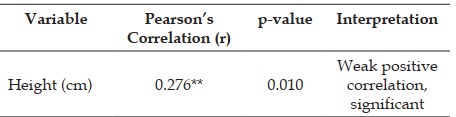
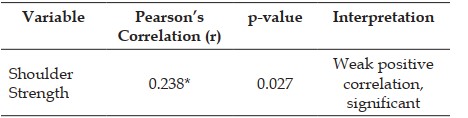
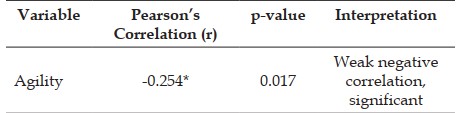
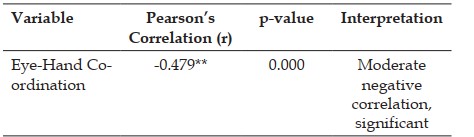
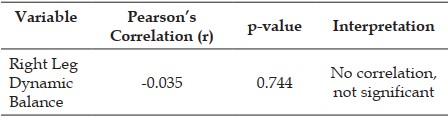
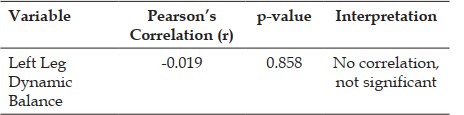
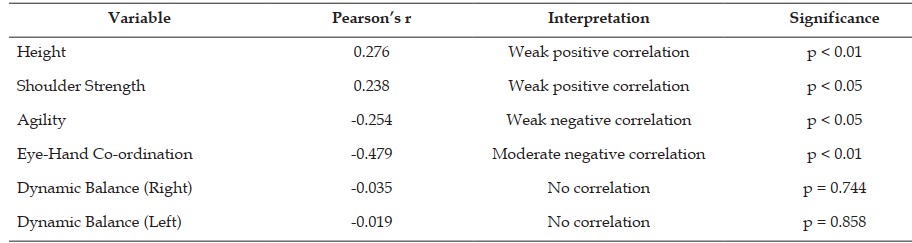
Introduction: A badminton smash is a critical offensive shot that requires exceptional speed, power, and precision to outperform opponents. Successful execution depends on a variety of physical and motor skills, but the specific contributions of agility, eye-hand coordination, dynamic balance, height, and shoulder strength to smashing accuracy have not been thoroughly examined. This study aimed to determine how these physical attributes impact the accuracy of smashes in skilled badminton players, offering insights into improving training regimens. Methods and Materials: A cross-sectional study was conducted with 87 skilled badminton players aged 16–25 years. Physical attributes were evaluated using standardized tests: agility was measured using the Illinois Agility Test, eye-hand coordination through the Plate Tapping Test, and shoulder strength with a dynamometer. Smash accuracy was assessed through specific skill-based tests designed to gauge shot placement precision. Correlation analysis was employed to examine the relationships between each physical attribute and smash accuracy. Results: The analysis demonstrated moderate positive correlations between smash accuracy and agility (r = 0.45), shoulder strength (r = 0.42), and eye-hand coordination (r = 0.58), suggesting that players who are faster, stronger, and have better coordination tend to perform more accurately. Eye-hand coordination emerged as the most influential factor, exhibiting the strongest correlation with the smash accuracy. A minimal correlation was observed with height (r = 0.12), while dynamic balance showed no significant association with smash precision. Discussion: The findings underscore the critical role of agility, shoulder strength, and eye-hand coordination in enhancing smash accuracy in badminton. In particular, eye-hand coordination is vital for precise execution. These results suggest that training programs should prioritize agility and coordination exercises to enhance player smash performance. The lack of significant impact from height and dynamic balance indicates that for badminton smashes, coordination and strength-based attributes are more predictive of success than purely physical characteristics such as height. Conclusion: This study highlights the importance of specific motor skills, especially agility and eye-hand coordination, in refining smash accuracy in badminton.For coaches and players, these insights provide a basis for targeted training strategies focusing on coordination and strength to enhance game performance. Further research could investigate these relationships in different playing styles or experience levels to broaden the understanding of the physical attributes of badminton success.
References
- 1. https://twitter.com/SW_Londoner?ref_ src=twsrc%5Etfw. 11 best sports participation in the world 2021. Available from: https:// www.swlondoner.co.uk/sport/21122021-theworlds-11-best-sports-participation.
- 2. Pardiwala DN, Subbiah K, Rao N, Modi R. Badminton Injuries in Elite Athletes: A Review of Epidemiology and Biomechanics. Indian journal of orthopaedics. 2020; 54(3):237-45.
- 3. Abián-Vicén J, Del Coso J, González-Millán C, Salinero JJ, Abián P. Analysis of dehydration and strength in elite badminton players. PLoS One. 2012; 7(5):e37821.
- 4. Phomsoupha M, Laffaye G. The science of badminton: game characteristics, anthropometry, physiology, visual fitness and biomechanics. Sports Med. 2015; 45(4):473-95.
- 5. records gw. Fastest badminton hit in competition (male) 2017. Available from: https://www. guinnessworldrecords.com/world-records/fastest-badminton-hit-in-competition-(male).
- 6. Hughes M, Cosgrove M. Sport and Exercise Physiology Testing Guidelines: The British Association of Sport and Exercise Science Guide. 2006.
- 7. Sturgess S, Newton RU. Design and implementation of a specific strength program for badminton. Strength & Conditioning Journal. 2008; 30(3):33-41.
- 8. Tiwari L, Rai V, Srinet S. Relationship of selected motor fitness components with the performance of badminton player. Asian J Phys Educ Comput Sci Sports. 2011; 5(1):88-91.
- 9. Li F, Li S, Zhang X, Shan G. Biomechanical Insights for Developing Evidence-Based Training Programs: Unveiling the Kinematic Secrets of the Overhead Forehand Smash in Badminton through Novice-Skilled Player Comparison. Applied Sciences. 2023; 13(22):12488.
- 10. Ibrahim Hamed Ibrahim H. The Effect of Core Stability Training on Dynamic Balance and Smash Stroke Performance in Badminton Players. International Journal of Sports Science and Physical Education. 2017; 2(3):44-52.
- 11. Ozmen T, Aydogmus M. Effect of core strength training on dynamic balance and agility in adolescent badminton players. Journal of bodywork and movement therapies. 2016; 20(3):565-70.
- 12. Hachana Y, Chaabène H, Nabli MA, Attia A, Moualhi J, Farhat N, et al. Test-retest reliability, criterion-related validity, and minimal detectable change of the Illinois agility test in male team sport athletes. J Strength Cond Res. 2013; 27(10):2752-9.
- 13. Raya MA, Gailey RS, Gaunaurd IA, Jayne DM, Campbell SM, Gagne E, et al. Comparison of three agility tests with male servicemembers: Edgren Side Step Test, T-Test, and Illinois Agility Test. J Rehabil Res Dev. 2013; 50(7):951- 60.
- 14. Oja P, Tuxworth B. Eurofit for adults: Assessment of health-related fitness: Council of Europe; 1995.
- 15. Reiman MP, Manske RC. Functional Testing in Human Performance: Human Kinetics; 2009.
- 16. Asif M, Zutshi K, Munjal J, Dhingra M. Relationship Among Height, Explosive Power and Shoulder Strength on Smashing Accuracy in Male Badminton Players. 2018. 2018.
- 17. Akoglu H. User’s guide to correlation coefficients. Turk J Emerg Med. 2018;18(3):91-3.
- 18. Burhan Z, Hidayat T, Herlina H. Hubungan Hasil Akurasi Smash Forehand Pada Bulu Tangkis PB Darek. Nusra: Jurnal Penelitian dan Ilmu Pendidikan. 2023; 4(4):1112-22.
- 19. Poliszczuk T, Mosakowska M. Anthropometric Profile of Polish Elite Badminton Players. Polish Journal of Sports Medicine. 2010;26:45-55.
- 20. Sakurai S, Ohtsuki T. Muscle activity and accuracy of performance of the smash stroke in badminton with reference to skill and practice. Journal of sports sciences. 2000; 18(11):901-14.
- 21. Ellenbecker TS, Aoki R. Step by Step Guide to Understanding the Kinetic Chain Concept in the Overhead Athlete. Current Reviews in Musculoskeletal Medicine. 2020; 13(2):155-63.
- 22. Seroyer ST, Nho SJ, Bach BR, Bush-Joseph CA, Nicholson GP, Romeo AA. The Kinetic Chain in Overhand Pitching: Its Potential Role for Performance Enhancement and Injury Prevention. Sports Health. 2010; 2(2):135-46.
- 23. Rusdiana A, Subarjah H, B B, Budiman D, Wibowo R, Nurjaya DR, et al. Kinetics Analysis of Overhead Standing Smash in Badminton. 2021. 2021; 6(1):8.
- 24. Phomsoupha M, Laffaye G. The Science of Badminton: Game Characteristics, Anthropometry, Physiology, Visual Fitness and Biomechanics. Sports Medicine. 2015; 45(4):473-95.
- 25. Li S, Zhang Z, Wan B, Wilde B, Shan G. The relevance of body positioning and its training effect on badminton smash. Journal of sports sciences. 2017; 35(4):310-6.
- 26. Ishibe K, Aihara S, Hayashi Y, Iwata H, editors. The development of an immersive three-dimensional virtual reality system for identifying hand–eye coordination in badminton. 2020 IEEE International Conference on Systems, Man, and Cybernetics (SMC); 2020 11-14 Oct. 2020.
- 27. Rajaeian B, Yaali R, oftadeh s, Shah hoseini A, Rezvan Nobahar S. The Effect of Visual Training on the Visual Skills of Skilled Badminton Athletes. Research in Sport Management and Motor Behavior. 2021; 11(22):40-54.
- 28. Chen Y, Zulnaidi H, Syed Ali SKB. Study on the eye movement characteristics of the badminton practitioners of different levels regarding visual attention. Frontiers in Psychology. 2023; 13.
- 29. Dube SP, Mungal SU, Kulkarni MB. Simple visual reaction time in badminton players: A comparative study. National Journal of Physiology, Pharmacy and Pharmacology. 2015; 5:18-20.
- 30. Vincze A, Jurchis R, Iliescu D. The dynamics of Quiet Eye under stress in elite table tennis performance. International Journal of Sport and Exercise Psychology. 2023; 21(4):689-705.
- 31. Wong TKK, Ma AWW, Liu KPY, Chung LMY, Bae Y-H, Fong SSM, et al. Balance control, agility, eye–hand coordination, and sport performance of amateur badminton players: A cross-sectional study. Medicine. 2019; 98(2):e14134.
Data Sharing Statement
There are no additional data available. All raw data and code are available upon request.
Author Contributions
All authors contributed significantly to the work and approve its publication.
Ethics Declaration
This article does not involve any human or animal subjects, and therefore does not require ethics approval.
Acknowledgements
We would like to express our gratitude to the patients, their families, and all those who have contributed to this study.
Conflicts of Interest
No conflicts of interest in this work.
About this article

Cite this article
Dibyendunarayan D. Bid, M. H. Gayatheri Iyer et al., Correlation of Physical and Motor Skills with Smashing Accuracy in Badminton Players. Physio. and Occ. Therapy Jr. 2024;17(4):223-231.
Licence:
Attribution-Non-commercial 4.0 International (CC BY-NC 4.0)This license enables reusers to distribute, remix, adapt, and build upon the material in any medium or format for noncommercial purposes only, and only so long as attribution is given to the creator.
| Received | Accepted | Published |
|---|---|---|
| October 27, 2024 | December 08, 2024 | December 25, 2024 |
DOI: https://doi.org/10.21088/potj.0974.5777.17424.5
Keywords
BadmintonSmash AccuracyAgilityEye-Hand CoordinationShoulder StrengthMotor SkillsPhysical AttributesPerformance TrainingSearch for Similar Articles
Similar Articles
- Leadership in Physiotherapy: A Narrative Review
- Effectiveness of Low Level Laser Theapy in the Management of Temporomandibular J...
- The Impact of Air Pollution on Cardiopulmonary Health: Molecular Mechanisms, Pre...
- Efectiveness of Physiotherapy in Postpartum Women with Diastasis Recti: A Review
- Pain Neuroscience Education: Transforming Physiotherapy Practice
Article Level Metrics
Last UpdatedSunday 25 October 2026, 17:55:27 (IST)
4407
Accesses
24
739
00
Citations
NA
NA
NA
Download citation
Article Keywords
Keyword Highlighting
Highlight selected keywords in the article text.
Timeline
| Received | October 27, 2024 |
| Accepted | December 08, 2024 |
| Published | December 25, 2024 |
licence
Attribution-Non-commercial 4.0 International (CC BY-NC 4.0)
This license enables reusers to distribute, remix, adapt, and build upon the material in any medium or format for noncommercial purposes only, and only so long as attribution is given to the creator.