Full Text (PDF)
Physiotherapy and Occupational Therapy Journal 18(3):p 205-210, July-Sep 2025. | DOI: https://doi.org/10.21088/potj.0974.5777.18325.3
Original Article
Correlation of Forward Head Posture with Temporomandibular Joint Dysfunction among
Siddiqui M. Aejaz, Shaikh Fatima, Pal Arpita, Shaikh Anam, Trivedi Aditi, Bhatiya Krupa
Author Information
Licence:
Attribution-Non-commercial 4.0 International (CC BY-NC 4.0)This license enables reusers to distribute, remix, adapt, and build upon the material in any medium or format for noncommercial purposes only, and only so long as attribution is given to the creator.
Physiotherapy and Occupational Therapy Journal 18(3):p 205-210, July-Sep 2025. | DOI: https://doi.org/10.21088/potj.0974.5777.18325.3
How Cite This Article:
Siddiqui M. Aejaz, Shaikh Fatima, Pal Arpita et. al, Correlation of Forward Head Posture with Temporomandibular Joint Dysfunction among Adults across Ahmedabad. Physio. and Occ. Therapy Jr. 2025; 18(3): 205-210.Timeline
Received : March 11, 2025
Accepted : June 18, 2025
Published : September 30, 2025
Abstract
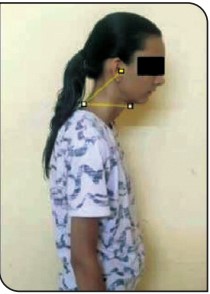
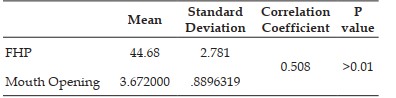
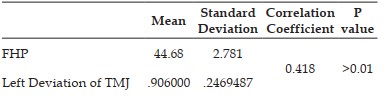
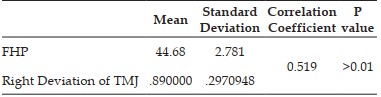
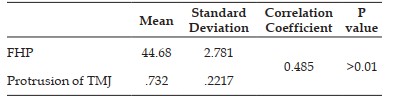
Aims: Evaluation of correlation between forward head posture and Temporomandibular joint dysfunction. Settings and Design: It is an observational study. Methods and Material: Image J Software, Plastic Scale (Ruler), Measure tape, Data collection form, Consent form Statistical analysis used: Spearman’s correlation coefficient was used to find the correlations of: a.FHP with Mouth Opening, b.FHP with Left deviation of TMJ, c.FHP with Right deviation of TMJ, c.FHP with Protrusion of TMJ. Results: This study shows that there is moderate correlation between forward head posture and mouth deviation in all side. Conclusions: The finding suggests that, there is significant correlation of FHP and TMD. Further, the outcome revealed that TMD was seen in young adults aged between 20 years to 30 years, compared to older age groups. Moreover, among total of 50 individuals, 60% were Females. Our study supports the all previous article stating the moderate to modest correlation. Limitation of the study: The individuals were not divided in different groups according to their complaint of TMD. So, the conclusion can be generalized to large group of patients. Key Messages: The present study was conducted to assess correlation of FHP with TMD. The findings suggests that, there is significant correlation of FHP and TMD. Further, the outcome revealed that TMD was seen in young adults aged between 20 years to 30 years, compared to older age groups. Moreover, among total of 50 individuals, 60% were females. Hence, in this study we found that younger individuals are more affected with TMD compared to older individuals, especially Females.
References
- 1. Monalisa P, Dr. Patitapaban M, Meeta Agarwal. Relationship between Temporomandibular Joint Dysfunction, Forward Head Posture and Severity of Neck Pain in Subjects with Neck Pain and Temporomandibular Joint Dysfunction .IOSR Journal of Dental and Medical Sciences (IOSR-JDMS). December, 2020; Volume 19:01-10.
- 2. Ramalingam V, Subramaniam A. Prevalence and associated risk factors of forward head posture among university students. Scopus IJPHRD Citation Score. 2019 Jul;10(7):775.
- 3. Elena Nicoleta Bordea, Angelo Pellegrini, Arsenie Dan Spînu, Roxana Victoria Ivaşcu, Victor Nimigean, Vanda Roxana Nimigean. Factors influencing the articular eminence of the temporomandibular joint (review). Experimental and therapeutic medicine. May 2021; 22(1084).
- 4. Stocum DL, Roberts WE. Part I: development and physiology of the temporomandibular joint. Current osteoporosis reports. 2018 Aug; 16:360-8.
- 5. Scolaro A, Khijmatgar S, Rai PM, Falsarone F, Alicchio F, Mosca A, Greco C, Del Fabbro M, Tartaglia GM. Efficacy of Kinematic Parameters for Assessment of Temporomandibular Joint Function and Dysfunction: A Systematic Review and Meta - Analysis. Bioengineering. 2022; 9 (7): 269.
- 6. Cullen, KE. (Mar 2012). “The vestibular system: multimodal integration and encoding of selfmotion for motor control”. Trends Neurosci 35 (3): 185–96.
- 7. Bueno, C. H., Pereira, D. D., Pattussi, M. P., Grossi, P. K., & Grossi, M. L. (2018). Gender differences in temporomandibular disorders in adult populational studies: A systematic review and meta-analysis. Journal of Oral Rehabilitation, 45(9), 720–729.
- 8. Nawaz MK, Sivaraman GS, Krishnamoorthy S, Balaji S. Temporomandibular joint dysfunction syndrome associated with betel nut chewing: A clinical study. Journal of Orofacial Research. 2015:142-5.
- 9. Saddu SC, Dyasanoor S, Valappila NJ, Ravi BV. The evaluation of head and craniocervical posture among patients with and without temporomandibular joint disorders-A comparative study. Journal of Clinical and Diagnostic Research: JCDR. 2015 Aug;9(8):ZC55.
- 10. Mamania JA, Anap DB. Prevalence of forward head posture amongst physiotherapy students: A cross-sectional study. International Journal of Education and Research in Health Sciences. 2019;1(4):125-7.
- 11. Naz A, Bashir MS, Noor R. Prevalance of forward head posture among university students. Rawal Med J. 2018 Apr 1;43(2):260.
- 12. Schneider CA, Rasband WS, Eliceiri KW (2012). “NIH Image to ImageJ: 25 years of image analysis”. Nat Methods. 9 (7): 671–675. doi:10.1038/nmeth.2089. PMC 5554542. PMID 22930834.
- 13. Omran NG, Yousef AM, Hamada HA, Matar AG, Osman DA. Effect of forward head posture on temporomandibular joint proprioception in postpubertal females: An observational study. Fizjoterapia Polska. 2019;19(2):142-6.
- 14. Lee WY, Okeson JP, Lindroth J. The relationship between forward head posture and temporomandibular disorders. Journal of orofacial pain. 1995 Apr 1;9(2).
- 15. Thirunavukarasu AJ, Ferro A, Sardesai A, Biyani G, Dubb SS, Brassett C, Hamilton DL. Temporomandibular joint anatomy: Ultrasonographic appearances and sexual dimorphism. Clinical Anatomy. 2021 Oct;34(7):1043-9.
Funding
This research received no funding.
Author Contributions
All authors contributed significantly to the work and approve its publication.
Ethics Declaration
This article does not involve any human or animal subjects, and therefore does not require ethics approval.
Acknowledgements
We would like to express our gratitude to the patients, their families, and all those who have contributed to this study.
Conflicts of Interest
No conflicts of interest in this work.
About this article

Cite this article
Siddiqui M. Aejaz, Shaikh Fatima, Pal Arpita et. al, Correlation of Forward Head Posture with Temporomandibular Joint Dysfunction among Adults across Ahmedabad. Physio. and Occ. Therapy Jr. 2025; 18(3): 205-210.
Licence:
Attribution-Non-commercial 4.0 International (CC BY-NC 4.0)This license enables reusers to distribute, remix, adapt, and build upon the material in any medium or format for noncommercial purposes only, and only so long as attribution is given to the creator.
| Received | Accepted | Published |
|---|---|---|
| March 11, 2025 | June 18, 2025 | September 30, 2025 |
DOI: https://doi.org/10.21088/potj.0974.5777.18325.3
Keywords
Forward head postureTemporomandibular joint dysfunctionTobacco chewersSearch for Similar Articles
Similar Articles
- Leadership in Physiotherapy: A Narrative Review
- Effectiveness of Low Level Laser Theapy in the Management of Temporomandibular J...
- The Impact of Air Pollution on Cardiopulmonary Health: Molecular Mechanisms, Pre...
- Efectiveness of Physiotherapy in Postpartum Women with Diastasis Recti: A Review
- Pain Neuroscience Education: Transforming Physiotherapy Practice
Article Level Metrics
Last UpdatedFriday 23 October 2026, 15:18:49 (IST)
4358
Accesses
12
739
00
Citations
NA
NA
NA
Download citation
Article Keywords
Keyword Highlighting
Highlight selected keywords in the article text.
Timeline
| Received | March 11, 2025 |
| Accepted | June 18, 2025 |
| Published | September 30, 2025 |
licence
Attribution-Non-commercial 4.0 International (CC BY-NC 4.0)
This license enables reusers to distribute, remix, adapt, and build upon the material in any medium or format for noncommercial purposes only, and only so long as attribution is given to the creator.