Full Text (PDF)
Indian Journal of Maternal-Fetal & Neonatal Medicine 9(1):p 9-15, january-June 2022. | DOI: https://doi.org/10.21088/ijmfnm.2347.999X.9122.1
Original Article
Comparison of Surfactant Administration Methods-Insure (Intubate Surfactant Administration Extubate) and Lisa (Least Invasive Surfactant Administration): A Randomized Controlled Study in Preterm Infants with Respiratory Distress Syndrome
Akshitkumar Svarup Singh Ganasva, Omprakash Shital Shukla
Author Information
Licence:
Attribution-Non-commercial 4.0 International (CC BY-NC 4.0)This license enables reusers to distribute, remix, adapt, and build upon the material in any medium or format for noncommercial purposes only, and only so long as attribution is given to the creator.
Indian Journal of Maternal-Fetal & Neonatal Medicine 9(1):p 9-15, january-June 2022. | DOI: https://doi.org/10.21088/ijmfnm.2347.999X.9122.1
How Cite This Article:
Omprakash Shital Shukla, Akshitkumar Svarup Singh Ganasva/Comparison of Surfactant Administration MethodsInsure (Intubate Surfactant Administration Extubate) and Lisa (Least Invasive Surfactant Administration): A Randomized Controlled Study in Preterm Infants with Respiratory Distress Syndrome/ Indian Journal of Maternal-Fetal & Neonatal Medicine 2022;9(1):9–15.Timeline
Received : January 06, 2022
Accepted : February 12, 2022
Published : June 30, 2022
Abstract
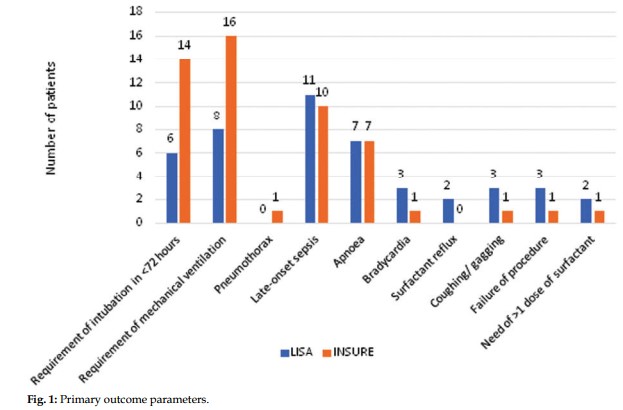
Objective: To compare the efficacy, need for mechanical ventilation within 72 hours of surfactant administration, and primary and secondary outcomes after LISA and INSURE methods. Methodology: A randomized control study was conducted at NICUs at Medical college, Vadodara, and GMERS, Gotri for a period of 8 months. A total of 40 preterm infants between 28 to 34 weeks of gestation with RDS who required surfactant administration were enrolled and randomized into two groups of 20 patients each. Surfactant was administered by LISA and INSURE method according to randomization. Results: There were 70% male infants in the LISA group, and 55% in INSURE group. Mean GA in the LISA group was 30.3±2.2 weeks, and 30.95±1.88 weeks in INSURE group, and mean birth weight was 1.24±0.3 kg in the LISA group and 1.25±0.3 kg in INSURE group. 40% of patients in LISA and 55% in INSURE group had not received antenatal steroids. Basic characteristics and maternal risk factors were comparable in both groups. Mechanical ventilation was required within 72 hours of surfactant administration in 6 patients (30%) in the LISA group and 14 patients (70%) in INSURE group (p-value = 0.0238). 8 patients (40%) from the LISA group and 16 patients (80%) from INSURE group required mechanical ventilation during their entire NICU stay (p=0.0268). Conclusion: The requirement of mechanical ventilation within 72 hours of surfactant administration as well as during the entire NICU stay was more in INSURE group than the LISA group with a statistically significant difference.
References
- 1. Seger N, Soll R. Animal derived surfactant extract for treatment of respiratory distress syndrome. Cochrane Database of Systematic Reviews. 2009. p. 1465–858.
- 2. Soll R. Synthetic surfactant for respiratory distress syndrome in preterm infants. Cochrane Database Syst Rev. 1998;1469-493XI(2):CD001149.
- 3. Herting E, Härtel C, Göpel W. Less invasive surfactant administration (LISA): Chances and limitations. Archives of Disease in Childhood: Fetal and Neonatal Edition. 2019.
- 4. Verder H, Robertson B, Greisen G, Ebbesen F, Albertsen P, Lundstrom K, et al. Surfactant Therapy and Nasal Continuous Positive Airway Pressure for Newborns with Respiratory Distress Syndrome. N Engl J Med. 1994;331(16):1051–5.
- 5. Dunn MS, Kaempf J, De Klerk A, De Klerk R, Reilly M, Howard D, et al. Randomized trial comparing 3 approaches to the initial respiratory management of preterm neonates. Pediatrics. 2011;128(5).
- 6. Pillow JJ, Minocchieri S. Innovation in surfactant therapy II: Surfactant administration by aerosolization. Neonatology. 2012. p. 337–44.
- 7. More K, Sakhuja P, Shah PS. Minimally invasive surfactant administration in preterm infants: A meta-narrative review. JAMA Pediatr. 2014;168(10):901–8.
- 8. Klebermass-Schrehof K, Wald M, Schwindt J, Grill A, Prusa AR, Haiden N, et al. Less invasive surfactant administration in extremely preterm infants: Impact on mortality and morbidity. Neonatology. 2013;103(4):252–8.
- 9. Kanmaz HG, Erdeve O, Canpolat FE, Mutlu B, Dilmen U. Surfactant administration via thin catheter during spontaneous breathing: Randomized controlled trial. Pediatrics.
- 10. Aldana-Aguirre JC, Pinto M, Featherstone RM, Kumar M. Less invasive surfactant administration versus intubation for surfactant delivery in preterm infants with respiratory distress syndrome: A systematic review and meta-analysis. Arch Dis Child Fetal Neonatal Ed. 2017;102(1):F17–23.
- 11. Halim A, Shirazi H, Riaz S, Gul SS, Ali W. Less invasive surfactant administration in preterm infants with respiratory distress syndrome. J Coll Physicians Surg Pakistan. 2019;29(3):226–30.
- 12. Aguar M, Cernada M, Brugada M, Gimeno A, Gutierrez A, Vento M. Minimally invasive surfactant therapy with a gastric tube is as effective as the intubation, surfactant, and extubation technique in preterm babies. Acta Paediatr Int J Paediatr. 2014.
Data Sharing Statement
There are no additional data available. All raw data and code are available upon request.
Funding
This research received no funding.
Author Contributions
All authors contributed significantly to the work and approve its publication.
Ethics Declaration
This article does not involve any human or animal subjects, and therefore does not require ethics approval.
Acknowledgements
We would like to express our gratitude to the patients, their families, and all those who have contributed to this study.
Conflicts of Interest
No conflicts of interest in this work.
About this article

Cite this article
Omprakash Shital Shukla, Akshitkumar Svarup Singh Ganasva/Comparison of Surfactant Administration MethodsInsure (Intubate Surfactant Administration Extubate) and Lisa (Least Invasive Surfactant Administration): A Randomized Controlled Study in Preterm Infants with Respiratory Distress Syndrome/ Indian Journal of Maternal-Fetal & Neonatal Medicine 2022;9(1):9–15.
Licence:
Attribution-Non-commercial 4.0 International (CC BY-NC 4.0)This license enables reusers to distribute, remix, adapt, and build upon the material in any medium or format for noncommercial purposes only, and only so long as attribution is given to the creator.
| Received | Accepted | Published |
|---|---|---|
| January 06, 2022 | February 12, 2022 | June 30, 2022 |
DOI: https://doi.org/10.21088/ijmfnm.2347.999X.9122.1
Keywords
PretermRDSSurfactantMechanical ventilation;LISAINSURESearch for Similar Articles
Similar Articles
- Maternal Mental-Health During Pregnancy and Postpartum Period: A Review of Recen...
- Prenatal Diagnosis of Costello Syndrome: A Case Report
- Innovations in Obstetric Hemorrhage Management: The Evolution of Transvaginal Ba...
- Maternal Plasma Cytokines and the Subsequent Risk of Uterine Atony and Postpartu...
- Amniotic Band Syndrome
Article Level Metrics
Last UpdatedSunday 18 October 2026, 15:49:44 (IST)
1732
Accesses
33
189
00
Citations
NA
NA
NA
Download citation
Article Keywords
Keyword Highlighting
Highlight selected keywords in the article text.
Timeline
| Received | January 06, 2022 |
| Accepted | February 12, 2022 |
| Published | June 30, 2022 |
licence
Attribution-Non-commercial 4.0 International (CC BY-NC 4.0)
This license enables reusers to distribute, remix, adapt, and build upon the material in any medium or format for noncommercial purposes only, and only so long as attribution is given to the creator.