Full Text (PDF)
Indian Journal of Ancient Medicine and Yoga 15(1):p 9-14, January – March 2022. | DOI: https://doi.org/10.21088/ijamy.0974.6986.15122.1
Original Article
Comparative Study of Different Market Sample with Genuine Sample of Kesar (Crocus Sativa) W R T Phytochemical Analysis
Ravi Dhaliya null, Ranjana Kaushal1 null, Ghanshyam Bahatara2 null, Ravi Dhaliya3 null
Author Information
Licence:
Attribution-Non-commercial 4.0 International (CC BY-NC 4.0)This license
enables reusers to distribute, remix, adapt, and build upon the material in any
medium or format for noncommercial purposes only, and only so long as
attribution is given to the creator.
Indian Journal of Ancient Medicine and Yoga 15(1):p 9-14, January – March 2022. | DOI: https://doi.org/10.21088/ijamy.0974.6986.15122.1
How Cite This Article:
Ranjana Kaushal, Ghanshyam Bahatara, Ravi Dhaliya/Comparative Study of Different Market Sample with Genuine Sample of Kesar (Crocus Sativa) W R T Phytochemical Analysis/Indian J Ancien Med Yog. 2022;15(1): 9–14.Timeline
Received : November 12, 2021
Accepted : November 30, 2021
Published : March 01, 2022
Abstract
Background: Kesar or saffron (Crocus sativus ), is known as the most expensive spice in the world and as beneficial for human health due to three main bioactive compounds: crocetin, picrocrocin and safranal. The demand for saffron is increasing worldwide for its interesting role in cuisine, medicine and cosmetics. The therapeutic efficacy of medicines depends on the quality and purity of ingredients used in formulations.
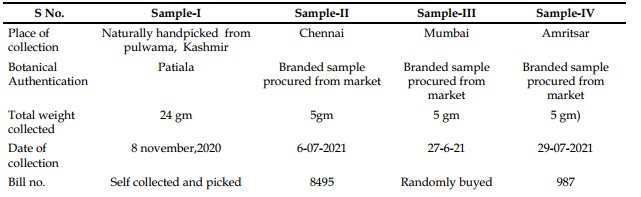
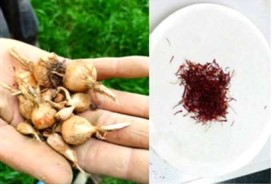
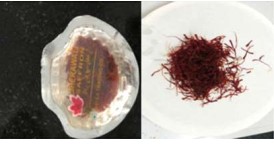
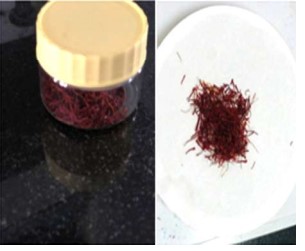
Material and Method: The study samples is been collected and handpicked from Kashmir and other 3 samples were collected from three major markets i.e. Amritsar, Chennai and Mumbai to see the difference on preliminary test like Pharmacognostic screening, physio chemical, Phytochemical and TLC, which are important tools in detecting of adulteration and substitution.
Results and Discussion: The results showed slight difference in microscopic and macroscopic characters in which sample I and sample II (Chennai) showed better quality. In this study total ash value is considerably low in sample I i.e. 0.06gm and sample III i.e. 0.06gm, which may be due to low content of carbonates, phosphates, silicates and silica. Study reveals that alkaloids were not much appreciated in sample II and sample IV. Saponins were not present in sample II. Flavonoids, Tannins, resins and glycosides were absent in sample IV. High amount of flavonoids, tannins, steroids and resins were present in sample I and sample II. High amount of Glycosides were present in sample III. Samples III and IV were not showed good amount of phytochemical which indicates the poor quality of the sample. It might be because of old samples collected or over drying of the samples which loses down many constituents. It could be either collected not from good source. The number of TLC bands found in sample I
were 10 and other sample II, III and IV showed 9, 8 and 18 respectively. Results showed sample II procured from Chennai market found to be equivalent with original and better than other two market samples.
Conclusion: Pharmacognostic, physicochemical and phytochemical methods are established techniques for the quality evaluation of highly valued medicinal plants. Present analytical study done to compare the original sample and market samples helpful in detecting the adulteration and authentication of drug. The preliminary data suggested sample collected from original source was superior in quality and possesses much phytochemicals with this sample II collected from Chennai market showed better quality as compared among other market sample.
Keywords: Kesar; Pharmacognosy; Physio chemical; Phytochemical; TLC.
References
- 1. Maria G.C., Antonella C. Looking for saffron (Crocus sativus L.) parents. Functional Plant Science and Biotechnology, 2010; 4(2):1-14.
- 2. Abdullaev, F I, Biomedical properties of saffron and its potential use in cancer therapy and chemoprevention trials, Cancer Det. Preven, 2004; 28(6):426-432.
- 3. LorianaCardone,; et al, Saffron (Crocus sativus L.), the king of spices: An overview. ScientiaHorticulturaeVolume 272, 15 October 2020, 109560
- 4. Anonymous (2001), The Ayurvedic Pharma -copoeia of India, 1st edi., Govt. of India, Ministry of Healtlh and Family Welfare, Dept. of Indian Systems of Medicine & Homeopathy, New Delhi. Part – I, Appendix – 3.
- 5. Khandelwal KR, Practical Pharmacognosy Techniques and Experiments, (t edition. Nirali Prakashan India (2003)
- 6. Shahabadkar G. Shamsundar and Swamy Paramjyothi. Preliminary pharmacognostical and phytochemical investigation on Sterculiafoetida Linn. Seeds African Journal of Biotechnology. 2010; 9(13) 1987-1989.
- 7. Ahmad Reza Gohari, Soodabeh Saeidnia, and Mahdie Kourepaz Mahmoodabadi. An overview on saffron, phytochemicals, and medicinal properties. Pharmacogn Rev. 2013 Jan-Jun; 7(13): 61–66.doi: 10.4103/0973- 7847.112850.
- 8. Kokate C, Purohit A and Gokale S: Practical Pharmacognosy. (Vallabh Prakashan, New Delhi), 1994, 10th edn: 112-120.
Data Sharing Statement
There are no additional data available. All raw data and code are available upon request.
Funding
This research received no funding.
Author Contributions
All authors contributed significantly to the work and approve its publication.
Ethics Declaration
Provide information related to the Ethics Committee approval with approval number OR write This article does not involve any human or animal subjects, and therefore does not require ethics approval.
Acknowledgements
We would like to express our gratitude to the patients, their families, and all those who have contributed to this study.
Conflicts of Interest
The authors report no conflicts of interest in this work.
About this article

Cite this article
Ranjana Kaushal, Ghanshyam Bahatara, Ravi Dhaliya/Comparative Study of Different Market Sample with Genuine Sample of Kesar (Crocus Sativa) W R T Phytochemical Analysis/Indian J Ancien Med Yog. 2022;15(1): 9–14.
Licence:
Attribution-Non-commercial 4.0 International (CC BY-NC 4.0)This license
enables reusers to distribute, remix, adapt, and build upon the material in any
medium or format for noncommercial purposes only, and only so long as
attribution is given to the creator.
| Received | Accepted | Published |
|---|---|---|
| November 12, 2021 | November 30, 2021 | March 01, 2022 |
DOI: https://doi.org/10.21088/ijamy.0974.6986.15122.1
Keywords
KesarPharmacognosyPhysio chemical;Phytochemical;TLCSearch for Similar Articles
Similar Articles
- Efficacy of Katupila Ghrita in the Management of Itartha dagdha Vrana (Burn Woun...
- Clinical Outcomes of Ayurvedic Management in Acute Influenza Like Illness: A Cas...
- Effect of Ayurvedic Drugs on Scalp Psoriasis (Kitibha Kustha)
- Yogic Elements in the Brahma Mahapurana: A Textual and Comparative Study
- Management of Adenoid Hypertrophy: An Ayurvedic Perspective
Article Level Metrics
Last UpdatedWednesday 16 September 2026, 14:39:24 (IST)
4112
Accesses
23
834
00
Citations
NA
NA
NA
Download citation
Article Keywords
Keyword Highlighting
Highlight selected keywords in the article text.
Timeline
| Received | November 12, 2021 |
| Accepted | November 30, 2021 |
| Published | March 01, 2022 |
licence
Attribution-Non-commercial 4.0 International (CC BY-NC 4.0)
This license
enables reusers to distribute, remix, adapt, and build upon the material in any
medium or format for noncommercial purposes only, and only so long as
attribution is given to the creator.