Full Text (PDF)
Indian Journal of Dental Education 17(2):p 79-88, April - June 2024. | DOI: https://doi.org/10.21088/ijde.0974.6099.17224.2
Original Article
Comparative Evaluation of Mechanical Properties of Room Temparature Vulcanized Maxillofacial Silicone Material with and without incorporation of 1% Clotrimazole as an Antifungal Agent: An inVitro Study
Shwetali Dattatray Powar, Abhijit Deshpande, Sampath Kumar N, Virsen Patil, Snehal Shende, Shweta Patil
Author Information
Licence:
Attribution-Non-commercial 4.0 International (CC BY-NC 4.0)This license enables reusers to distribute, remix, adapt, and build upon the material in any medium or format for noncommercial purposes only, and only so long as attribution is given to the creator.
Indian Journal of Dental Education 17(2):p 79-88, April - June 2024. | DOI: https://doi.org/10.21088/ijde.0974.6099.17224.2
How Cite This Article:
Shwetali Dattatray Powar, Abhijit Deshpande, Sampath Kumar N. et al. Comparative Evaluation of Mechanical Properties of Room Temparature Vulcanized Maxillofacial Silicone Material with and without incorporation of 1% Clotrimazole as an Antifungal Agent: An inVitro Study. Ind J Dent Educ 2024;17(2):79-88.Timeline
Received : April 30, 2024
Accepted : May 10, 2024
Published : June 11, 2024
Abstract
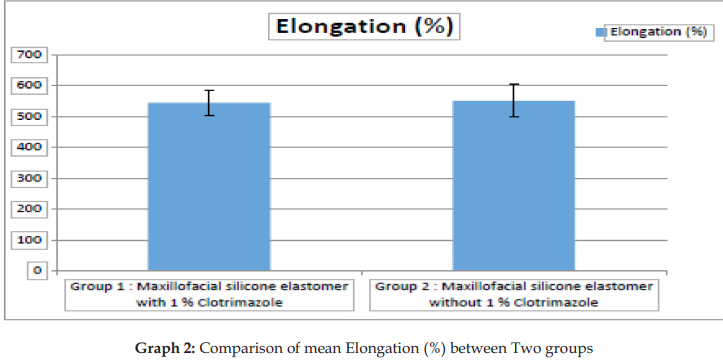
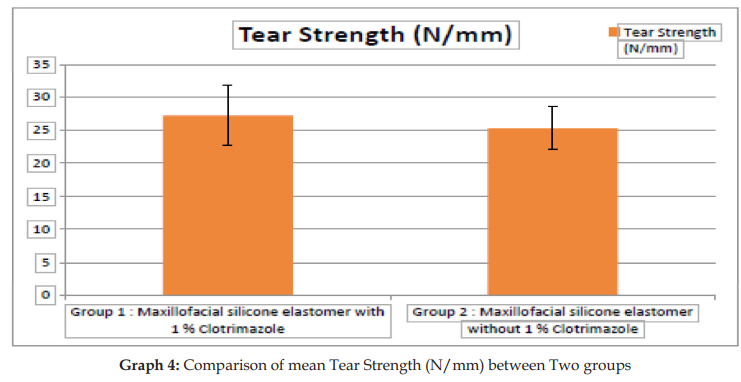
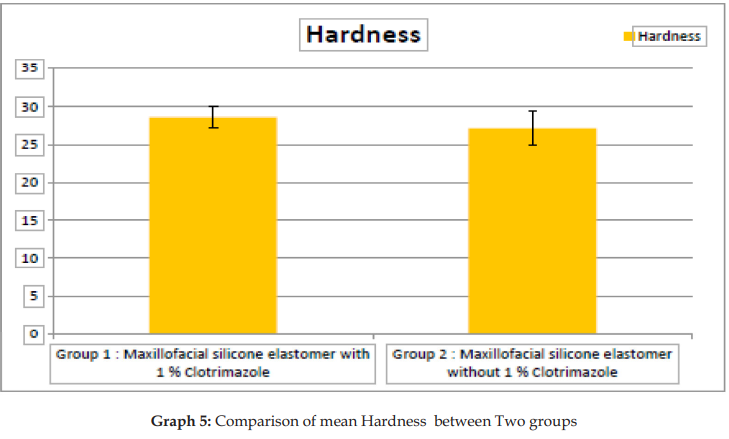
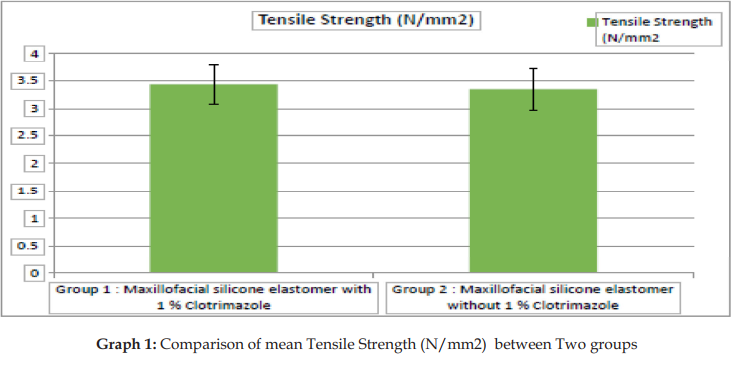
Introduction: Antifungal agents such as 1% Clotrimazole can be included in maxillofacial prostheses for their antifungal properties. Despite a lack of literature evidence supporting this connection, we conducted this study to assess and compare the physical properties of vulcanized maxillofacial silicone material with and without the inclusion of 1% Clotrimazole as an antifungal agent. Material and Method: Custom stainless steel molds were produced to assess mechanical properties (Tensile Strength, Elongation Percentage, Tear Strength, and Hardness). Three dies, compliant with ISO and ASTM standards, were crafted for silicone test specimens. To ensure even dispersion, 1% Clotrimazole, an antifungal agent, was added to part B of room temperature vulcanized maxillofacial silicone material (VST-30, Versiltal silicone). Results: Regardless of whether room temperature vulcanized maxillofacial silicone material included 1% Clotrimazole as an antifungal agent, all specimens displayed statistically insignificant changes in mechanical properties, including Tensile Strength, Elongation Percentage at break, and Tear Strength. However, a notable difference in Hardness was observed in the maxillofacial silicone material when comparing samples with and without 1% Clotrimazole. Samples with the antifungal agent exhibited improved mechanical properties (Tensile Strength, Elongation Percentage at break, Tear Strength, and Hardness) compared to those without the antifungal agent. Conclusion: Adding an antifungal agent to maxillofacial silicone elastomer is a viable option to enhance prostheses by reducing fungal activity. Additionally, it improves the mechanical properties (Tensile Strength, Elongation Percentage at break, Tear Strength, and Hardness) of medical-grade maxillofacial silicone material, extending the longevity of the prosthesis.
References
- 1. Haider YM, Abdullah ZS, Fatalla AA, Jani GH, Mokhtar N. Corrigendum to “evaluation of some mechanical properties of a maxillofacial silicon elastomer reinforced with polyester powder”. International Journal of Dentistry. 2020 Sep 23;2020:1.
- 2. Aziz T, Waters M, Jagger R. Development of a new poly (dimethylsiloxane) maxillofacial prosthetic material. Journal of Biomedical Materials Research Part B: Applied Biomaterials: An Official Journal of the Society for Biomaterials, the Japanese Society for Biomaterials, and the Australian Society for Biomaterials and the Korean Society for Biomaterials. 2003 May 15;65(2):252-61.
- 3. Bulbulian AH. Prosthetic reconstruction of nose and ear with a latex compound. Journal of the American Medical Association. 1941 Apr 5;116(14):1504-6.
- 4. Atta Allah J, Muddhaffer M. Influence of artificial weathering on some properties of nano silicon dioxide incorporated into maxillofacial silicone. Indian Journal of Scientific Research. 2017;6:423-8.
- 5. Al-Obaidi KA, Ali MM. The Influence of Halloysite Nanotube Addition on Some Properties of Room Temperature Vulcanized Maxillofacial Silicone before and after Simulated Aging. Indian Journal of Public Health Research & Development. 2019 Oct 1;10(10).
- 6. Kinkela Devcic M, Simonic-Kocijan S, Prpic J, Paskovic I, Cabov T, Kovac Z, Glazar I. Oral canddal colonization in patients with different prosthetic appliances. Journal of Fungi. 2021 Aug 16;7(8):662.
- 7. Atay A, Piskin B, Akin H, Sipahi C, Karakas A, Saracli MA. Evaluation of Candida albicans adherence on the surface of various maxillofacial silicone materials. J Mycol Med. 2013 Mar;23(1):27- 32. doi: 10.1016/j.mycmed.2012.12.005. Epub 2013 Jan 29. PMID: 23375858.
- 8. Tooyama H, Matsumoto T, Hayashi K, Kurashina K, Kurita H, Uchida M, Kasuga E, Honda T. Candida concentrations determined following concentrated oral rinse culture reflect clinical oral signs. BMC Oral Health. 2015 Dec;15:1-8.
- 9. Andreopoulos AG, Evangelatou M: Evaluation of various reinforcements for maxillofacial silicone elastomers. J Biomater Appl 1994; 8(4):344-60.
- 10. Leow ME, Kour AK, Inglis TJ, Kumarasinghe G, Pho RW: Fungal colonization in digital silicone rubber prostheses. Prosthet Orthot Int. 1997 Dec; 21(3):195-8.
- 11. Schmidt, A.E. & Lesche, D. & Reitemeier, B.K. Properties of materials for maxillofacial prostheses treated with a liner. Journal of Facial and Somato Prosthetics. 2002; 8: 101- 110.
- 12. Azeez, Zainab & Tukmachi, Mustafa & Hussein Mohammed, Dhuha. (2018). Effect of Silver-Zinc Zeolite Addition on Mechanical Properties of Maxillofacial Silicone. 7. 19- 29.
- 13. Al-Hakam J Ibrahim, Hikmat Jameel Al-Judy. Mechanical properties of chitosan incorporated in maxillofacial silicone and its anti canddal activity in vitro. J Res Med Dent Sci, 2018, 6 (6): 101-107.
- 14. Tetteh S, Bibb RJ, Martin SJ. Mechanical and Morphological Effect of Plant Based Antimicrobial Solutions on Maxillofacial Silicone Elastomer. Materials. 2018; 11(6):925.
- 15. Pigno MA, Goldschmidt MC, Lemon JC: The efficacy of antifungal agents Incorporated into a facial prosthetic silicone elastomer. J Prosthet Dent. 1994 Mar;71(3):295-300.
- 16. Bell WT, Chalian VA, Moore BK: Polydimethyl siloxane materials in maxillofacial prosthetics: Evaluation and comparison of physical properties. J Prosthet Dent 1985; 54(3):405-10.
- 17. Andreopoulos AG, Evangelatou M, Tarantili PA: Properties of maxillofacial silicone elastomers reinforced with silica powder. J Biomater Appl 1998; 13(1):66-73.
- 18. Mitra A, Choudhary S, Garg H, H G J. Maxillofacial prosthetic materials- an inclination towards silicones. J Clin Diagn Res. 2014 Dec;8(12):ZE08-13. doi: 10.7860/JCDR/2014/9229.5244. Epub 2014 Dec 5. PMID: 25654054; PMCID: PMC4316360.
- 19. Xiao-na, Yi-min, Shi-bao. Comparison of Mechanical Properties of Cosmesil M511 and A-2186 Maxillofacial Silicone Elastomers. Journal of US -China Medical Scien 2007;4:34- 37.
- 20. Begum Z, Kola Z, Joshi P. Analysis of properties of commercially available silicone elastomers for maxillofacial prostheses. Int. Journal of Contemporary Dentistry. 2011;2(4):1-5.
- 21. Gunay Y, Kurtoglu C, Atay A, Karayazgan B, Gurbuz CC. Effect of tulle on the mechanical properties of a maxillofacial silicone elastomer. Dent Mater J. 2008;27(6):775-79.
- 22. B Karayazgan,Y gunay, G Evlioglu. Improved edge strength in a facial prosthesis by incorporation of tulle: a clinical report. The Journal of Prosthetic Dentistry. 2003;90(6):526-29.
- 23. Aziz T, Waters M, Jagger R: Analysis of the properties of silicone rubber maxillofacial prosthetic materials. J Dent 2003; 31(1):67-74.
- 24. Sharif A. Mohammad, Alvin G. wee, Deborah J. Rumsey and Scott R. Schricker. Maxillofacial materials reinforced with various concentrations of Polyhedral Silsesquioxanes. J Dent Biomech. 2010;1-9.
- 25. Cevik P. Evaluation of Shore A hardness of maxillofacial silicones: the effect of dark storage and nanoparticles. Eur Oral Res. 2018 May;52(2):99- 104. doi: 10.26650/eor.2018.469. Epub 2018 May 1. PMID: 30775710; PMCID: PMC6365122.
- 26. Lee HL, Wang RS, Hsu YC, Chuang CC, Chan HR, Chiu HC, Wang YB, Chen KY, Fu E. Antifungal effect of tissue conditioners containing poly (acryloyloxyethyltrimethyl ammonium chloride)- grafted chitosan on Candida albicans growth in vitro. Journal of dental sciences. 2018 Jun 1;13(2):160-6.
Data Sharing Statement
There are no additional data available.
Funding
This research received no funding.
Author Contributions
All authors contributed significantly to the work and approve its publication.
Ethics Declaration
This article does not involve any human or animal subjects, and therefore does not require ethics approval.
Acknowledgements
Information not provide.
Conflicts of Interest
The authors report no conflicts of interest in this work.
About this article

Cite this article
Shwetali Dattatray Powar, Abhijit Deshpande, Sampath Kumar N. et al. Comparative Evaluation of Mechanical Properties of Room Temparature Vulcanized Maxillofacial Silicone Material with and without incorporation of 1% Clotrimazole as an Antifungal Agent: An inVitro Study. Ind J Dent Educ 2024;17(2):79-88.
Licence:
Attribution-Non-commercial 4.0 International (CC BY-NC 4.0)This license enables reusers to distribute, remix, adapt, and build upon the material in any medium or format for noncommercial purposes only, and only so long as attribution is given to the creator.
| Received | Accepted | Published |
|---|---|---|
| April 30, 2024 | May 10, 2024 | June 11, 2024 |
DOI: https://doi.org/10.21088/ijde.0974.6099.17224.2
Keywords
Maxillofacial SiliconeClotrimazoleAntifungalIn-VitroPhysical PropertiesSearch for Similar Articles
Similar Articles
- One Step Apexification using PRF as Matrix and MTA Apical Barrier
- Infective Ulcers in the Oral Cavity: A Review
- Effect of COVID-19 Lockdown on Patients Undergoing Orthodontic Therapy in Distri...
- Wire Splinting: An Effective Management Approach for Lateral Luxation: A Clinica...
- Prosthodontics in Healthy Ageing and Longevity Medicine: A Critical Narrative R...
Article Level Metrics
Last UpdatedMonday 19 October 2026, 21:04:08 (IST)
3456
Accesses
15
611
00
Citations
NA
NA
NA
Download citation
Article Keywords
Keyword Highlighting
Highlight selected keywords in the article text.
Timeline
| Received | April 30, 2024 |
| Accepted | May 10, 2024 |
| Published | June 11, 2024 |
licence
Attribution-Non-commercial 4.0 International (CC BY-NC 4.0)
This license enables reusers to distribute, remix, adapt, and build upon the material in any medium or format for noncommercial purposes only, and only so long as attribution is given to the creator.